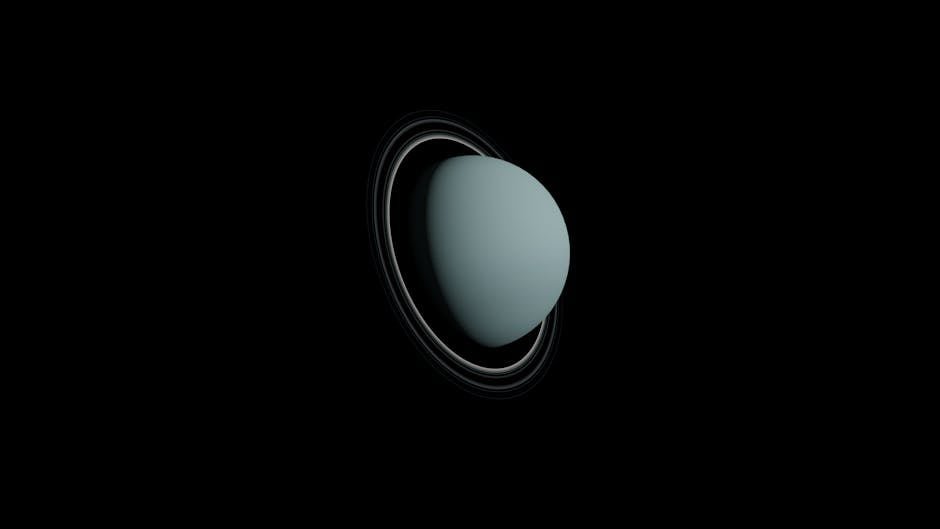
From Stellar Occultations to Infrared Visions (Image Credits: Pexels)
Astronomers recently decoded the faint glow of Uranus’ outermost rings, revealing compositions that trace back to distinct cosmic sources. These narrow bands, long shrouded in mystery, now suggest the ice giant harbors additional undiscovered moons or rocky bodies. The findings, drawn from decades of telescope data, highlight the intricate dance between the planet’s rings and its satellites, deepening our understanding of this tilted world’s formation.[1][2]
From Stellar Occultations to Infrared Visions
Stellar occultations in 1977 first revealed Uranus’ rings, marking the second ring system confirmed beyond Saturn. NASA’s Voyager 2 flyby in 1986 added details on inner structures and shepherd moons like Cordelia and Ophelia, which confine denser rings through gravitational tugs. The Hubble Space Telescope then spotted the outermost ν and μ rings between 2003 and 2005, extending the system’s reach far beyond expectations.[3]
Earth’s alignment with Uranus’ ring plane in 2007 offered a rare edge-on view from the W. M. Keck Observatory, capturing near-infrared images that hinted at color differences: the μ ring appeared blue from tiny particles, while the ν ring showed reddish tones suggestive of dust. These observations laid groundwork for a new analysis combining Keck archival data, Hubble spectra, and fresh James Webb Space Telescope images from February 2, 2025.[1]
Spectral Clues Unlock Ring Origins
Led by Imke de Pater of the University of California, Berkeley, researchers constructed the first full reflectance spectra for both rings across visible and infrared wavelengths. A shared absorption feature near 3 microns appeared in each, but their signatures diverged sharply. “By decoding the light from these rings, we can trace both their particle size distribution and composition, which sheds light on their origins,” de Pater explained.[2]
The μ ring’s spectrum matched pure water ice, confirming its blue hue stems from submicrometer grains. In contrast, the ν ring’s profile indicated rocky material laced with 10 to 15 percent carbon-rich organics, common in the outer solar system. Particle sizes varied too, with the μ ring favoring minuscule icy bits and the ν ring hosting dustier aggregates.[1]
Mab’s Icy Contribution Versus Nu’s Hidden Sources
The μ ring orbits near the small moon Mab, about 12 kilometers across. Micrometeorite impacts on this satellite eject tiny icy grains that form the ring, much like processes at Saturn’s Enceladus but without geysers – Mab lacks the size for such activity. This composition sets Mab apart, as most of Uranus’ 14 inner moons appear rocky.[3]
The ν ring tells a different story. Its reddish organics point to collisions and impacts among unseen rocky bodies rich in carbon compounds, likely orbiting between known moons like Portia and Rosalind. “The ν ring material is sourced from micrometeorite impacts on and collisions between unseen rocky bodies… which must orbit between some of the known moons,” de Pater noted. One puzzle persists: why these parent bodies differ so starkly in makeup.[2]
| Feature | μ Ring | ν Ring |
|---|---|---|
| Width | 17,000 km | 3,800 km |
| Color/Hue | Blue (tiny particles) | Reddish (dusty) |
| Composition | Water ice | Rocky + organics (10-15%) |
| Source | Mab moon impacts | Unseen rocky bodies |
Deepening the Uranian Enigma
These revelations imply a crowded inner system where hidden objects fuel ring maintenance. Earlier studies detected wave patterns in denser rings, hinting at shepherd moonlets as small as 4 to 14 kilometers across.[4] Brightness fluctuations in the μ ring add intrigue, as University of Idaho’s Matt Hedman observed: “We see hints that the μ ring’s brightness changes over time, and what could be causing those changes is still a mystery.”[1]
SETI Institute’s Mark Showalter suggested close-up views from a future mission would clarify Mab’s outlier status. NASA’s proposed Uranus Orbiter and Probe could provide them, building on James Webb’s recent detection of a 29th moon in 2025.[5]
- Uranus hosts 13 faint, narrow rings, mostly dark water ice mixed with organics.
- Shepherd moons like Cordelia confine inner rings via resonances.
- Outer rings extend the system to nearly 100,000 km from the planet’s center.
- Recent spectra span visible to mid-infrared for unprecedented detail.
- Unseen bodies challenge models of satellite formation post-collisions.
Key Takeaways
- μ ring particles hail from icy moon Mab, confirming its water-ice nature.
- ν ring organics signal hidden rocky collisions, pointing to more moons.
- Spectral analysis demands future missions to resolve compositional oddities.
Uranus’ rings continue to challenge assumptions about ice giant dynamics, blending known shepherds with potential hidden players. As telescopes like James Webb push boundaries, the hunt for these elusive moons promises revelations about planetary youth. What secrets might a Uranus flyby uncover next? Share your thoughts in the comments.