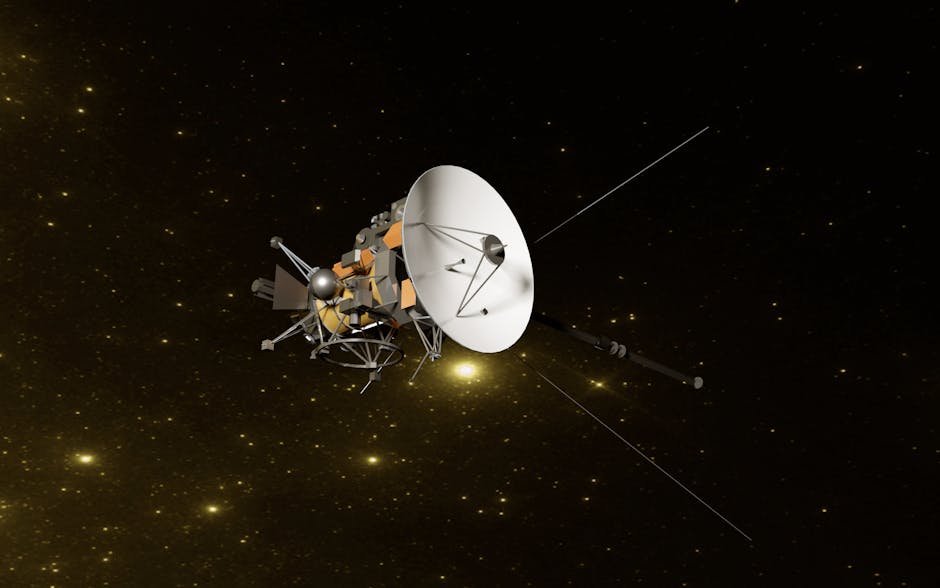
An Unexpected Power Drop Spurs Quick Action (Image Credits: Pexels)
Southern California – Mission engineers at NASA’s Jet Propulsion Laboratory took decisive action on April 17, 2026, by powering down a key instrument on Voyager 1, the farthest human-made object from Earth. The spacecraft, now more than 15 billion miles away, faces dwindling energy supplies from its aging nuclear power source. This move aims to extend operations in the uncharted interstellar medium, where the probe continues to deliver invaluable data.[1][2]
An Unexpected Power Drop Spurs Quick Action
A routine roll maneuver on February 27 revealed an unanticipated decline in Voyager 1’s power levels, prompting the team to accelerate their long-planned conservation strategy.[1] Engineers had anticipated gradual power loss, but this event narrowed the margins further. They selected the Low-energy Charged Particles (LECP) experiment as the next to deactivate, following a pre-established sequence developed years earlier by science and engineering specialists.
The commands traveled 23 hours to reach the spacecraft, with the shutdown process completing in just over three hours.[1] While most of the LECP went dark, a small 0.5-watt motor that spins its sensor remains active, preserving the option for reactivation if power allows. This careful approach underscores the precision required to manage a probe operating nearly 49 years beyond its design life.
The Vital Role of the LECP Instrument
Launched with Voyager 1 in 1977, the LECP diligently recorded low-energy charged particles, including ions, electrons, and cosmic rays from both the solar system and distant galaxy.[3] Its data illuminated the structure of the interstellar medium, revealing pressure fronts and zones of fluctuating particle density just beyond the heliosphere. No other spacecraft has matched this capability, making the Voyagers unique ambassadors to deep space.
Over decades, the instrument operated with minimal interruptions, contributing to our understanding of cosmic boundaries. Engineers viewed its deactivation reluctantly, as it marked the loss of one more window into the cosmos. Yet the decision aligned with the mission’s priority: sustaining core observations amid resource constraints.[2]
Navigating Voyager’s Declining Power Reserves
Voyager 1 and its twin, Voyager 2, draw electricity from radioisotope thermoelectric generators (RTGs) fueled by decaying plutonium, which produce about 4 watts less power annually.[1] After nearly five decades, these systems demand constant trade-offs, including heater shutdowns to prevent frozen fuel lines. Of the 10 identical instrument suites on each probe, seven now stand silent on Voyager 1.
The team followed a meticulous shutdown order to balance science return against survival needs. Voyager 2’s LECP met the same fate in March 2025, reflecting parallel challenges for both craft.[3] Current active instruments on Voyager 1 include a plasma wave detector and a magnetometer, both delivering robust data from interstellar realms.
| Spacecraft | LECP Status | Instruments Shut Off |
|---|---|---|
| Voyager 1 | Off (April 17, 2026) | 7 of 10 |
| Voyager 2 | Off (March 2025) | At least 7 |
Innovative Strategies for Extended Operations
Deactivating the LECP buys Voyager 1 approximately one year of additional runtime, allowing engineers to refine advanced power-saving techniques.[1] Dubbed “the Big Bang,” this fix involves replacing higher-power components with low-energy alternatives to maintain essential heating and data transmission. Testing begins on Voyager 2 in May and June 2026, with Voyager 1 potentially following in July or later.
“While shutting down a science instrument is not anybody’s preference, it is the best option available,” said Kareem Badaruddin, Voyager mission manager at JPL.[1] “Voyager 1 still has two remaining operating science instruments – one that listens to plasma waves and one that measures magnetic fields. They are still working great, sending back data from a region of space no other human-made craft has ever explored. The team remains focused on keeping both Voyagers going for as long as possible.”
- Plasma wave instrument: Detects waves in the interstellar plasma.
- Magnetometer: Maps magnetic fields in deep space.
- RTG management: Prioritizes engineering systems over non-essential science.
- Command delays: 23 hours one-way due to vast distance.
- Potential LECP revival: If Big Bang succeeds.
Key Takeaways
- LECP shutdown extends Voyager 1’s life by about a year amid RTG decay.
- Two instruments remain active, ensuring continued interstellar insights.
- “Big Bang” innovation could redefine power management for aging probes.
Voyager 1’s resilience exemplifies human ingenuity, pushing boundaries 15 billion miles from home. As power wanes, each decision weighs scientific legacy against operational reality, reminding us of the probes’ enduring quest. What do you think about these efforts to keep the Voyagers alive? Tell us in the comments.