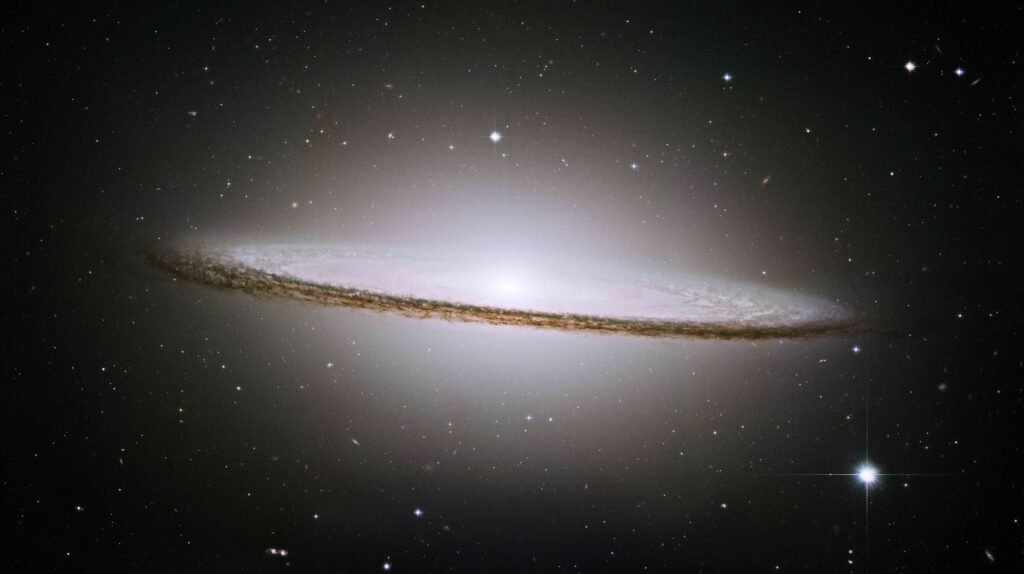
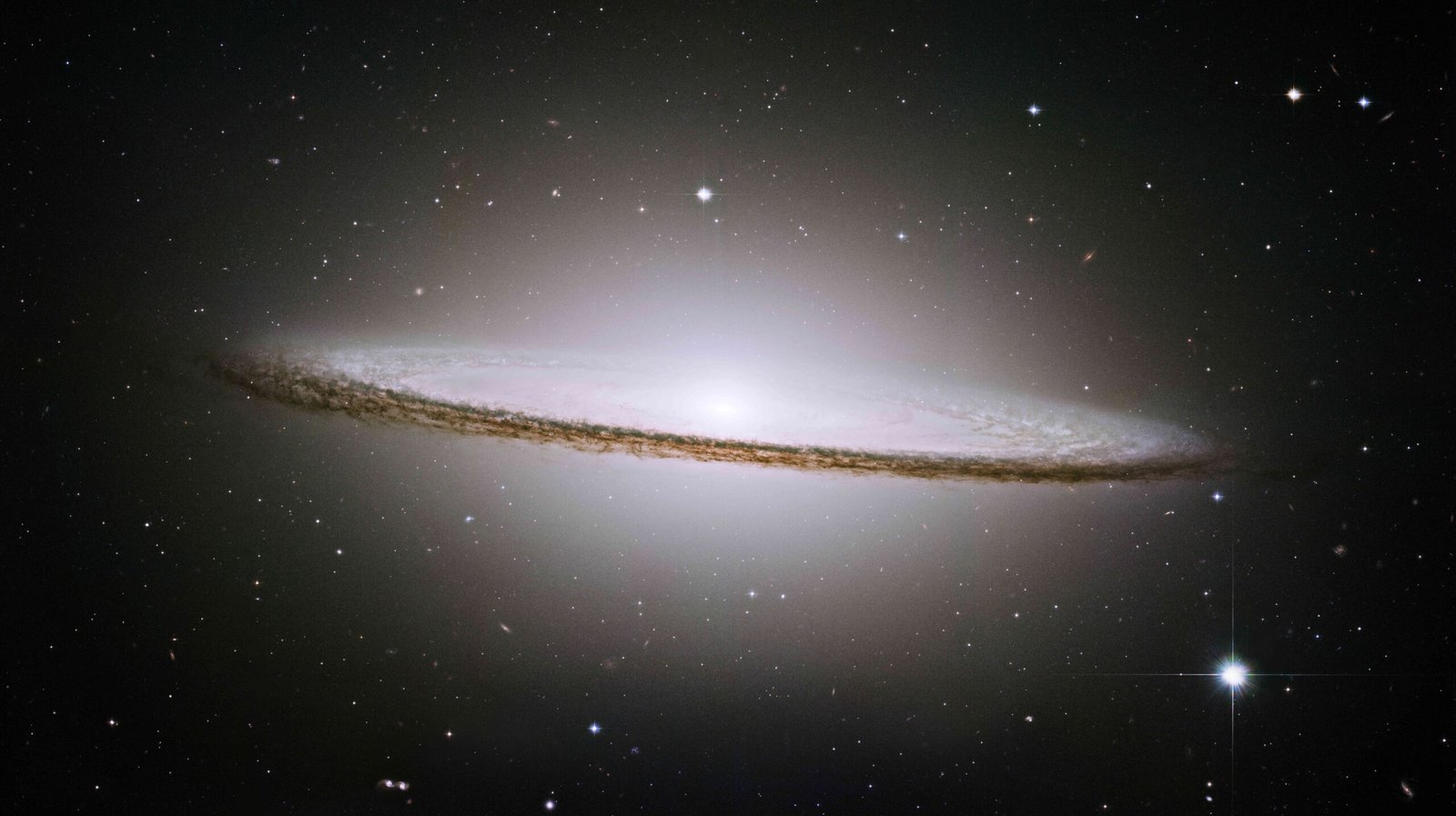
Clumps of Mystery in the Dark Halo (Image Credits: Upload.wikimedia.org)
Galaxies across the cosmos display striking patterns in their forms, from elegant spirals to rounded ellipticals. Researchers have long puzzled over why these structures appear so consistently, almost as if following a cosmic template. New findings suggest that tiny clumps of dark matter, known as dark subhaloes, play a crucial role in dictating these shapes.[1]
Clumps of Mystery in the Dark Halo
Every major galaxy resides within a vast halo of dark matter, an invisible scaffold far more massive than the stars and gas it contains. Within these halos lurk dark subhaloes – dense concentrations of dark matter that orbit like satellites around the central galaxy.[1] These subhaloes remain dark because they lack sufficient ordinary matter to ignite star formation, rendering them undetectable by light but potent through gravity.
Observations reveal these tiny structures swarming around galaxies such as the Milky Way. Their presence challenges astronomers to explain how such subtle influences could mold the grand architecture of galactic disks and bulges. Simulations indicate that dark subhaloes introduce perturbations that align with observed galaxy varieties.
Gravitational Whispers Guide Star Formation
Dark subhaloes exert subtle yet persistent gravitational tugs on the gas clouds destined to birth stars. These interactions prevent gas from settling into random configurations, instead channeling it toward stable patterns.[1] Over billions of years, repeated encounters amplify these effects, favoring the emergence of spiral arms or elliptical profiles.
In smooth dark matter halos without substructure, galaxies might evolve chaotically. However, the lumpiness introduced by subhaloes acts as a template, imprinting preferred orientations and elongations. This mechanism aligns theoretical predictions from cold dark matter models with real-sky surveys showing morphological biases.
From Simulations to Cosmic Reality
Astronomers rely on hydrodynamic simulations to test these ideas, modeling how baryonic matter responds to dark matter dynamics. Recent runs demonstrate that subhaloes scatter energy into stellar orbits, expanding disks and sharpening features.[1] Galaxies in these models consistently adopt shapes matching Hubble-type classifications.
- Spiral galaxies develop pronounced arms due to subhalo-induced density waves.
- Ellipticals form through mergers perturbed by nearby subhaloes.
- Dwarf companions exhibit irregular forms from intense subhalo interactions.
- Lenticular galaxies bridge the gap, with subhaloes quenching star formation selectively.
- Overall, subhalo abundance correlates with morphological diversity in clusters.
Challenges and Observational Clues
Detecting dark subhaloes directly proves elusive, as they emit no radiation. Indirect evidence emerges from stellar streams disrupted by their gravity or gravitational lensing distortions.[2] Telescopes like Gaia map these perturbations in the Milky Way’s halo, hinting at subhalo populations.
Tidal dwarf galaxies and ultrafaint satellites may trace subhalo locations, offering windows into their distribution. Future surveys with the James Webb Space Telescope could reveal gas signatures perturbed by these invisible masses. Meanwhile, tensions in small-scale structure tests refine cold dark matter predictions.
Key Takeaways
- Dark subhaloes embed within larger halos, influencing gas dynamics.
- They promote stable morphologies over chaotic evolution.
- Simulations link subhalo lumpiness to observed galaxy types.
This emerging picture positions dark subhaloes as cosmic sculptors, resolving why galaxies adhere to familiar blueprints amid the universe’s chaos. As observations sharpen, these findings could solidify dark matter’s role in structure formation. What implications do you see for future galaxy evolution studies? Share your thoughts in the comments.