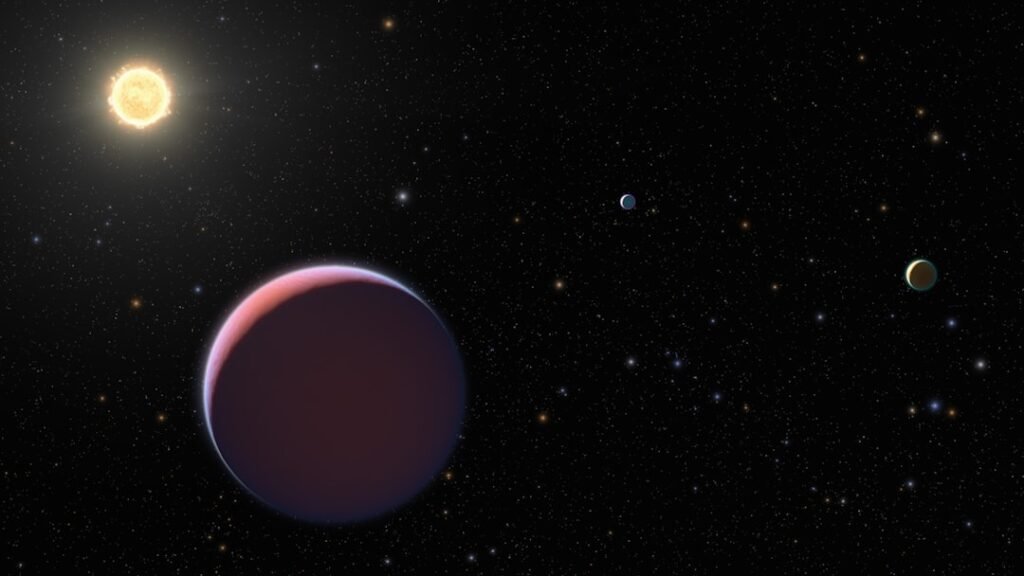
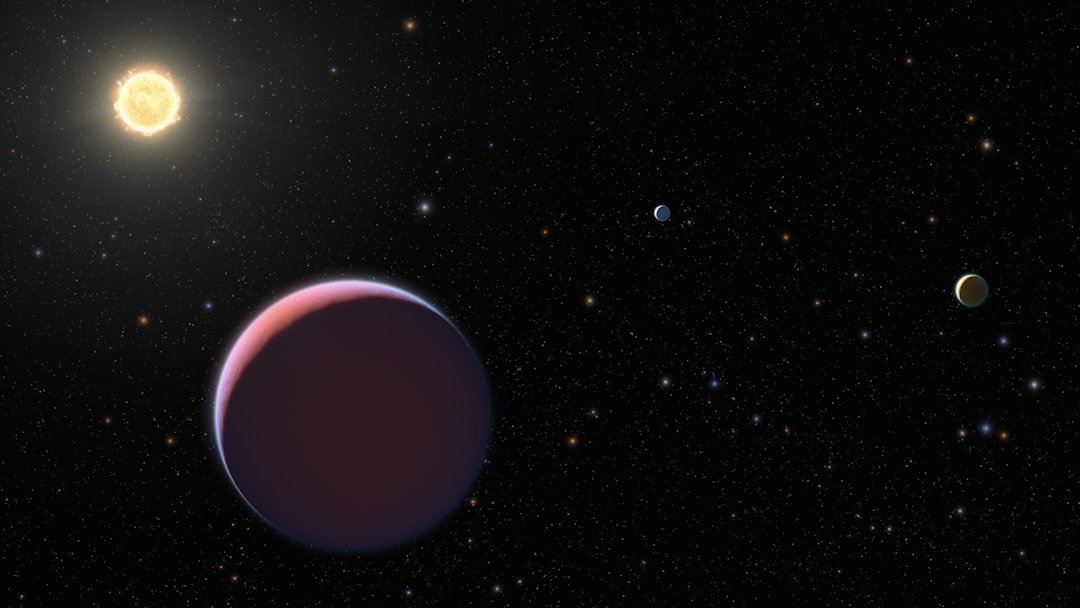
A System Captured in Flux (Image Credits: Unsplash)
Albuquerque, New Mexico – A team of astronomers from The University of New Mexico confirmed the presence of three distinct bodies in the TOI-201 exoplanet system, revealing a rare case where gravitational interactions visibly alter orbits over mere centuries.[1][2] Located 372 light-years away in the constellation Pictor, the host star – a young F-type star 32 percent larger and more massive than the Sun – anchors this dynamic setup.[2] The findings, detailed in a recent Science Advances paper, offer unprecedented insights into planetary evolution.[1]
A System Captured in Flux
Researchers observed orbital changes in TOI-201 unfolding on timescales humans can witness, a phenomenon seen in only a handful of systems.[1] The planets’ mutual inclinations – tilts relative to one another – drive these shifts through gravitational tugs, potentially via von-Zeipel-Kozai-Lidov oscillations.[3] In roughly 200 years, the current alignment allowing all three to transit will end, with the super-Earth ceasing first.[1]
Ismael Mireles, a Ph.D. candidate at UNM who led the study under Professor Diana Dragomir, highlighted the uniqueness. “This is one of only a handful of systems where planetary orbits can be watched actively changing on human timescales,” he stated. “It offers a rare real-time window into the dynamic lives of planetary systems.”[1]
The Eccentric Ensemble
TOI-201 hosts a super-Earth, a warm Jupiter, and a brown dwarf, each with starkly different traits. The inner super-Earth, TOI-201 d, hugs its star closely. The warm Jupiter, TOI-201 b, occupies a middle ground, while the outer brown dwarf, TOI-201 c, swings dramatically on its elongated path.[4]
| Body | Orbital Period | Mass | Eccentricity |
|---|---|---|---|
| TOI-201 d (super-Earth) | 5.85 days | ~6 Earth masses | 0.3 ± 0.1 |
| TOI-201 b (warm Jupiter) | 53 days | 0.52 Jupiter masses | ~0.28 |
| TOI-201 c (brown dwarf) | ~2,900 days (7.9 years) | 15.7 Jupiter masses | 0.651 ± 0.006 |
Both inner orbits fit within Mercury’s path around the Sun, whereas TOI-201 c stretches from inside Mars’ orbit to beyond Jupiter’s.[1] The brown dwarf, the longest-period transiting object detected by NASA’s TESS mission, exerts the dominant gravitational force.[4]
- TOI-201 d: Rocky world, 1.4 Earth radii, high density suggesting minimal atmosphere, too hot for liquid water.
- TOI-201 b: Gas giant bridging hot and cold Jupiters, key to migration puzzles.
- TOI-201 c: Teeters on planet-brown dwarf boundary, raising formation questions.
Multi-Tool Confirmation
The team combined data from NASA’s TESS for initial transits with ground-based follow-ups. Radial velocity measurements from spectrographs like CORALIE, HARPS, PFS, FEROS, and MINERVA-Australis quantified masses.[1] Transit timing variations (TTVs) revealed perturbations, while astrometry from Hipparcos and Gaia refined outer orbits.
Photometry from the Antarctic ASTEP telescope and LCOGT network proved crucial for long-period monitoring. “Our contribution was enabled by having a telescope in Antarctica,” noted University of Birmingham’s Professor Triaud.[1] Mireles described it as a “multi-year, large team effort.” The next TOI-201 c transit arrives March 26, 2031, inviting global observations.[1]
Probing Formation Mysteries
Tilted orbits challenge models where planets form coplanar in protoplanetary disks. “The planets’ orbits are tilted relative to each other, and because of that, they’re slowly pulling each other into new orientations,” Mireles explained.[1] Dragomir questioned TOI-201 c’s origins: “Since the mass of TOI-201 c is near the boundary separating massive planets from brown dwarfs, one mystery this system poses is whether this body formed like a planet or like a star.”[1]
“TOI-201 c is unique because of its extremely long orbital period (~7.9 years) and its location in a system with two interior planets,” Mireles added. “Most known transiting brown dwarfs orbit much closer to their stars.”[1] The system tests theories on giant planet migration and secular evolution.[3]
Key Takeaways
- TOI-201’s orbits evolve rapidly due to tilted planes, observable now but fleeting.
- Combines super-Earth, warm Jupiter, and brown dwarf – rare multi-body transit setup.
- Invites future scrutiny, especially TOI-201 c’s 2031 transit.
This discovery underscores how exoplanet systems can defy expectations, providing a live laboratory for cosmic dynamics. What surprises might the next transit reveal? Share your thoughts in the comments.