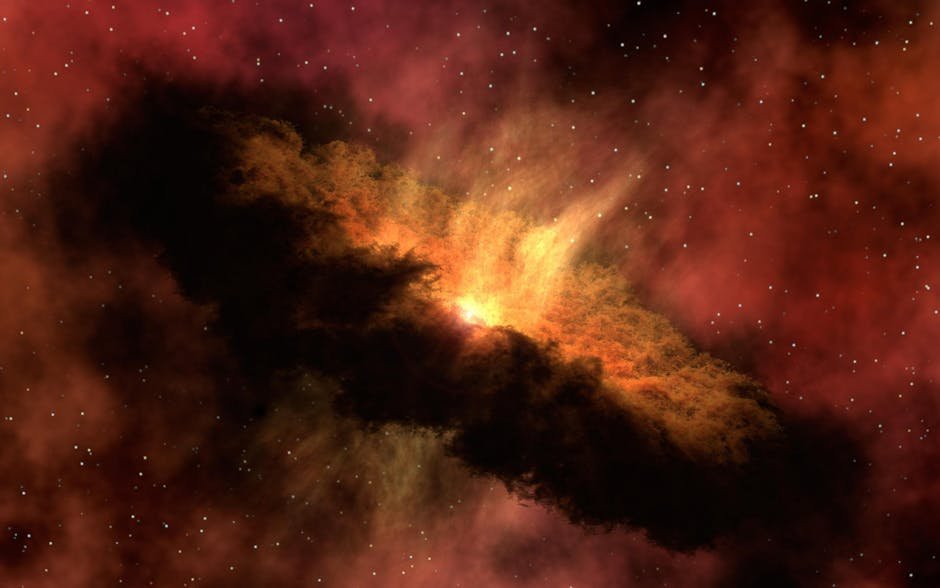
The Puzzle of the Universe’s Low-Entropy Dawn (Image Credits: Pexels)
The universe emerged from its earliest moments in a state of extraordinary order, a condition that has intrigued scientists for generations. This low-entropy beginning forms the core of the “past hypothesis” puzzle, questioning why the cosmos started so improbably smooth and structured. Cosmic inflation theory provides a elegant solution, revealing how our observable universe arose as one isolated pocket amid a vast, expanding backdrop.
The Puzzle of the Universe’s Low-Entropy Dawn
Physicists have grappled with the fact that the universe kicked off the hot Big Bang in a highly ordered configuration. Entropy, a measure of disorder or unavailable energy, should have dominated in such extreme conditions, yet the early cosmos displayed the opposite. This initial low entropy enabled the formation of stars, galaxies, and life itself, as systems locally decrease disorder by exporting it elsewhere.
The second law of thermodynamics dictates that entropy in isolated systems always rises, pointing toward an eventual heat death where equilibrium reigns. Our universe’s trajectory fits this pattern perfectly, with entropy levels climbing relentlessly since the Big Bang. Still, the starting point remains unexplained without additional physics.
Defining Entropy in a Cosmic Context
Entropy quantifies the number of ways a system can arrange itself microscopically while appearing uniform macroscopically. In the early universe, radiation and matter occupied a smooth, uniform state with minimal possible entropy for its volume. This setup allowed gravity to clump matter over time, fostering complexity amid rising overall disorder.
Consider everyday examples: a hot coffee cools by spreading heat, increasing entropy. Similarly, the universe transitions from ordered states to disordered ones, powering all change. The hot Big Bang inherited this low-entropy inheritance, setting the stage for 13.8 billion years of evolution.
Cosmic Inflation: The Engine of Exponential Growth
Cosmic inflation occurred in the universe’s first fleeting instants, a phase of ultra-rapid expansion driven by a hypothetical inflaton field. This process stretched quantum fluctuations to cosmic scales, smoothing the universe and seeding its large-scale structure. Inflation ended abruptly in our region, reheating the plasma that launched the hot Big Bang.
Unlike steady Big Bang expansion, inflation multiplied the universe’s scale by enormous factors in a fraction of a second. This mechanism ensured uniformity across vast distances, matching observations of the cosmic microwave background. Critically, it addressed uniformity without fine-tuning initial conditions.
Bubble Universes and the Entropy Solution
Inflation operates eternally in a larger multiverse framework, spawning disconnected bubble universes wherever the expansion halts locally. Each bubble emerges with intrinsically low entropy density, as the transition from inflating space to hot plasma resets the entropy clock. Our universe represents one such bubble, born 13.8 billion years ago in this manner.
This process upholds the second law, as entropy rises within each bubble while the surrounding inflating space maintains separation. No global entropy decrease occurs; instead, the multiverse compartmentalizes regions of low entropy. Inflation thus resolves the past hypothesis by providing a natural origin for our ordered start.
- Inflation creates isolated bubbles from a pre-existing inflating state.
- Each bubble begins with low entropy upon reheating.
- Bubbles remain disconnected, preserving local thermodynamics.
- This explains the smooth, uniform early universe without violations.
- Observations like cosmic microwave background flatness support inflation.
Broader Implications for Cosmology
The inflation model extends beyond entropy to predict a multiverse of diverse bubbles, each potentially with varying physical laws. This framework aligns with quantum field theory and general relativity, bridging micro and macro scales. It transforms the past hypothesis from a flaw into a feature of eternal inflation.
Challenges persist, such as directly detecting the inflaton or verifying multiverse predictions. Yet, inflation’s success in matching data strengthens its case. Future telescopes may probe primordial signals, refining our grasp of these origins.
Key Takeaways
- The past hypothesis highlights the universe’s improbably low starting entropy.
- Cosmic inflation generates low-entropy bubble universes naturally.
- This upholds thermodynamics while enabling cosmic evolution.
Cosmic inflation not only smooths the universe’s birth but redefines our place in an expansive multiverse. It turns a longstanding riddle into a profound insight, underscoring the elegance of nature’s laws. What do you think about this resolution to the entropy puzzle? Share your thoughts in the comments.