You probably do not think much about the center of the Earth when you are stuck in traffic, making coffee, or scrolling your phone late at night. Yet, thousands of kilometers beneath your feet, an immense, restless engine is running nonstop, quietly making your everyday life possible. Without this hidden power source, you would not have a protective magnetic shield, shifting continents, or even the stable conditions that let complex life evolve and survive.
When you start to picture the Earth as a living machine instead of a static rock, everything about your planet feels different. The ground you stand on becomes the thin crust of a much deeper story, driven by a churning metallic heart. As you trace how that heart shapes your climate, your technology, and even your GPS signal, you begin to see that your existence is tightly linked to something you will never see, never touch, but always rely on.
The Core You Never See: Structure and Extreme Conditions
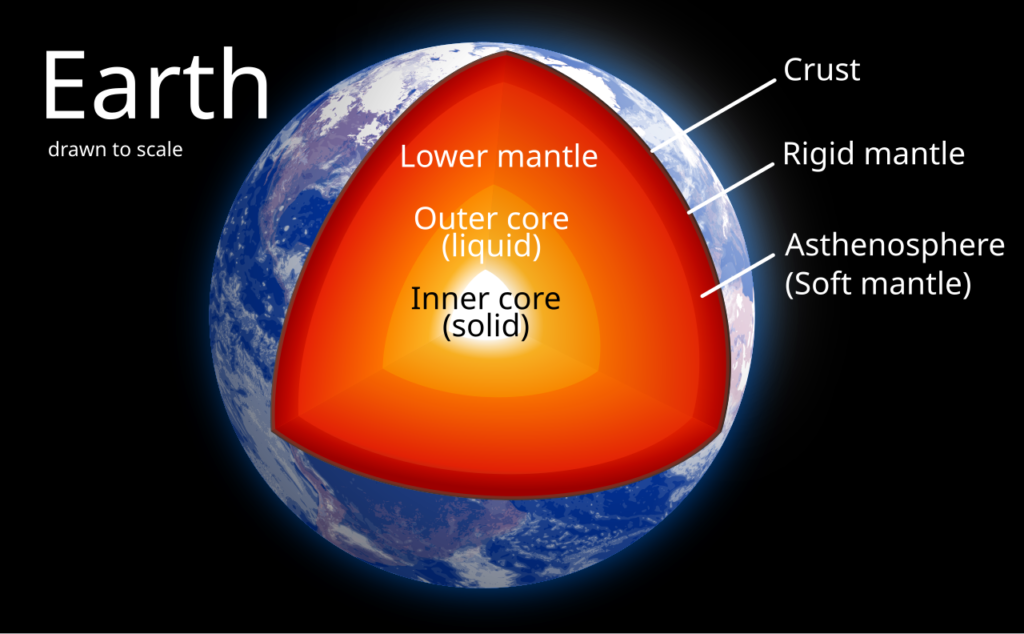
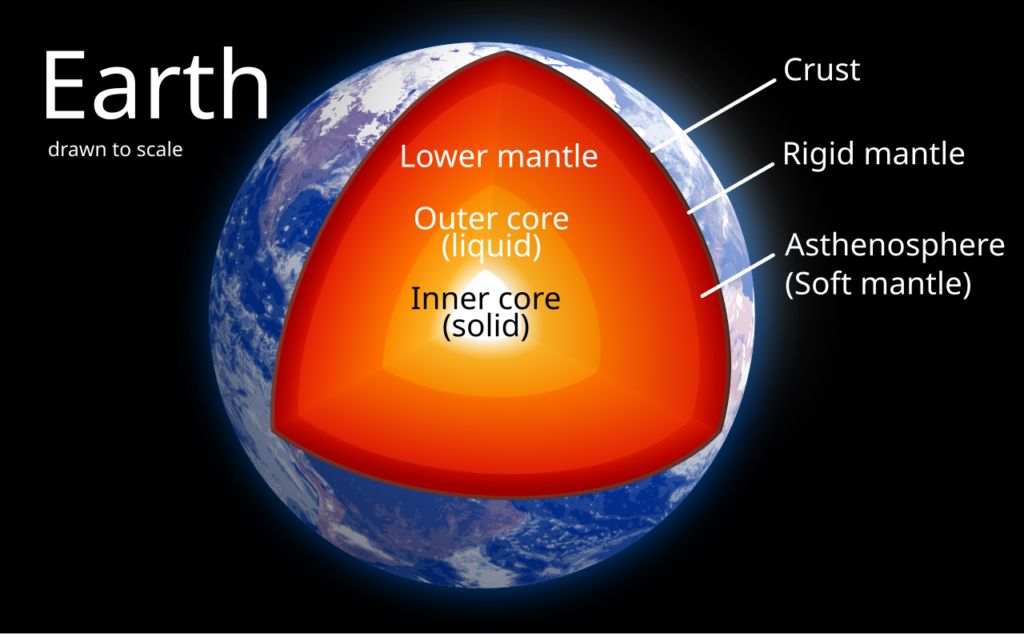
Deep under your feet, the Earth is layered like a gigantic onion, but the most dramatic part is the core. You can think of it as two nested spheres: a solid inner core made mostly of iron and some nickel, surrounded by a liquid outer core of molten metal. The inner core is roughly the size of the Moon, yet under such intense pressure that iron, which normally melts at much lower pressures, is squeezed into a solid state despite temperatures hotter than the surface of the Sun.
Above that sits the outer core, a roiling ocean of liquid iron and nickel thousands of kilometers deep. Here, temperatures are still blisteringly high, but the pressure is just low enough for the metal to flow like an incredibly thick, electrically conductive syrup. You never feel this directly, of course, but you can detect it indirectly through seismic waves from earthquakes that bend, slow, or speed up as they travel through different layers of the planet, revealing the contrast between solid inner core and liquid outer core.
How a Molten Metal Ocean Builds Your Magnetic Shield

If you could somehow float inside the outer core, you would be surrounded by a superheated, swirling sea of liquid metal moving in complex patterns. Because that metal conducts electricity, its motion generates powerful electrical currents. Those currents, in turn, create a magnetic field, in a process known as a geodynamo. You do not need to memorize the jargon, but you live with its consequences every day: this is the source of the Earth’s global magnetic field.
That magnetic field is much more than a neat compass trick for hiking trips. It forms a vast, invisible bubble – often called the magnetosphere – that deflects most charged particles streaming from the Sun. Without it, those particles would slam directly into the atmosphere, stripping it away over time and bombarding the surface with intense radiation. You rely on the core’s constant motion to keep that shield alive, so you can breathe, keep liquid water stable, and safely use technology that would be far more vulnerable in a harsher radiation environment.
Protecting Your Atmosphere and Technology from Space Weather

Because of the core-driven magnetic field, the Earth can stand up to the Sun’s mood swings in a way that you may take for granted. When a solar storm erupts, it flings vast clouds of energetic particles toward the Earth. Instead of ripping directly into the atmosphere, many of those particles are diverted along magnetic field lines, guided toward the poles, and dissipated higher up. That is when you might see dazzling auroras, which are the visible fingerprints of your planet’s magnetic defenses at work.
If you depend on satellites, navigation systems, and power grids – and you do, even if you do not see them – this protection is not merely aesthetic. Strong solar storms can still disrupt communications, induce currents in power lines, and temporarily disturb GPS accuracy. But without a robust magnetosphere built by the outer core, the damage would be far more severe and frequent. In a very real sense, the hidden motion of molten iron beneath you keeps the modern, technology-heavy part of your life from being constantly fried by space weather.
Driving Plate Tectonics from Below the Mantle

At first glance, plate tectonics might seem like something the mantle alone controls, with its slow, convective flow moving continents around. But the heat that keeps the mantle churning comes significantly from the core. Some of that heat is leftover energy from the planet’s formation, some from the gradual crystallization of the inner core, and some from radioactive decay in deep layers. Together, they create a long-lasting heat engine that keeps the lower mantle from freezing into stillness.
When you see mountains rising, oceans opening, or volcanoes forming along plate boundaries, you are looking at surface expressions of deep energy that started near the core-mantle boundary. Without that sustained heat flow, plate tectonics would likely grind to a halt. That would mean no long-term recycling of carbon, no fresh crust being created, and a much more static, geologically dead world. You might think a calmer planet sounds safer, but a geologically dead planet tends to be far less welcoming to evolving and maintaining complex life over billions of years.
Fueling Volcanoes, Earthquakes, and the Planet’s Long-Term Climate
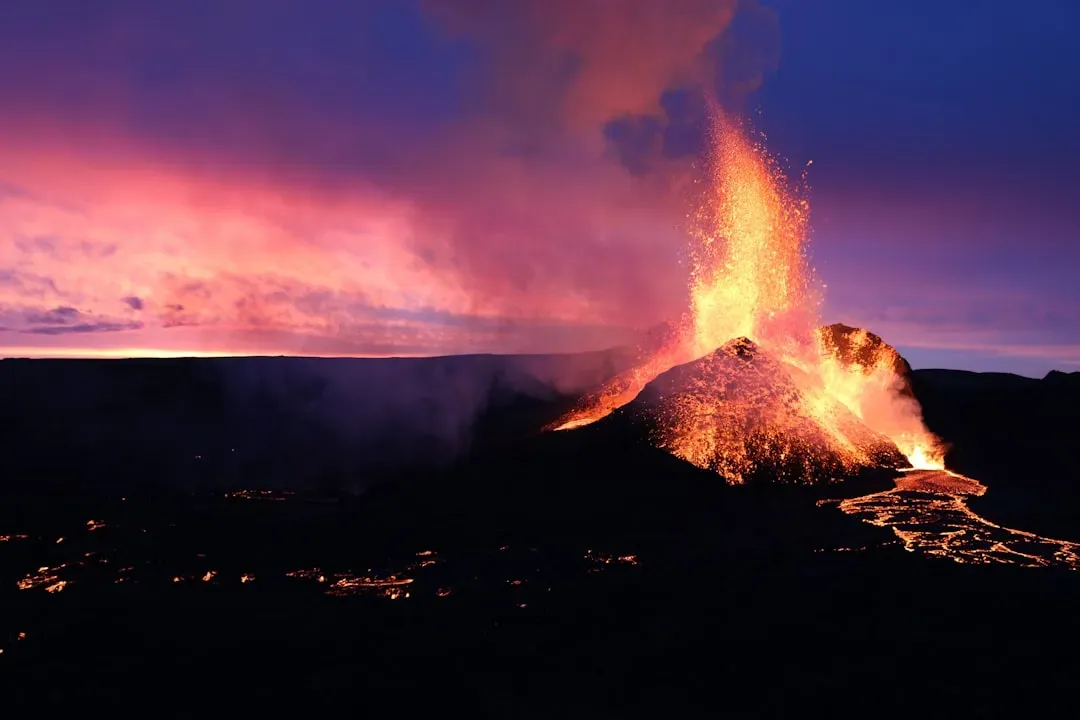
Every time you hear about a major volcanic eruption, you are seeing another way the core’s heat reaches the surface. Mantle plumes, hot upwellings rising from deep within the mantle, can be powered in part by heat leakage and dynamic interactions at the boundary between core and mantle. When these plumes punch through the crust, they create vast volcanic provinces or long chains of volcanoes over millions of years. As destructive as eruptions can be locally, they also release gases that play roles in long-term climate and atmospheric composition.
Earthquakes, too, are connected to the slow but relentless movement of plates that core heat sustains. When plates grind, collide, or slip past each other, they release energy suddenly, shaking the ground where you live. That can be terrifying, but if you zoom out in time, these movements help regulate surface conditions by cycling materials and reshaping landscapes. Over millions of years, the balance between volcanic outgassing and processes like weathering and subduction helps keep the climate within a range where liquid water and life can persist, even as the Sun itself slowly brightens over geological time.
Why the Core Matters for Life Compared to Other Worlds

When you compare Earth to other planets and moons, the importance of a live, churning core becomes clearer. Mars, for example, once had flowing water on its surface, but its global magnetic field faded long ago as its internal engine cooled and weakened. Without sustained magnetic shielding, the Martian atmosphere thinned, and conditions on the surface became far more hostile. When you look at that history, you can see what might have happened to Earth if its core had shut down early.
On the other hand, some icy moons in the outer solar system likely have internal oceans kept liquid by tidal heating rather than a metal core dynamo, showing you that there are different ways to power habitats. Still, for a rocky planet at Earth’s distance from its star, a vigorous metallic core seems to be a powerful ally for long-term habitability. When you ask whether life exists elsewhere, you are often indirectly asking about the hearts of those worlds: do they have enough internal energy to protect, stir, and sustain their surfaces the way yours does?
The Restless Inner Core and Its Subtle Changes

You might imagine the solid inner core as a perfectly stable metal ball, but evidence suggests it is more complicated and slowly evolving. Studies of seismic waves show that the inner core is not uniform; it appears to have regions with different crystal orientations and possibly even layers with slightly different properties. There are hints that the inner core might rotate at a slightly different rate than the rest of the planet over long timescales, though researchers are still debating the details.
These subtleties matter because they influence how heat is transferred to the outer core and how the geodynamo behaves. As iron gradually freezes onto the inner core, it releases heat and lighter elements into the outer core, feeding convection and helping sustain the magnetic field. In other words, the inner core is slowly growing and evolving, and you live during just one brief moment in that long process. Over geological ages, subtle shifts in this metallic heart can ripple outward, changing patterns in the magnetic field that you then detect at the surface.
How You Study a Place You Can Never Visit

You will never dig a tunnel to the core, but you can still learn a surprising amount about it using indirect tools. Seismology, which tracks how earthquake waves travel through the Earth, lets you map where materials are solid or liquid and how fast waves move in different directions. That is how you know there is a liquid outer core and a solid inner core in the first place. You can also use variations in gravity, measurements of the magnetic field, and high-pressure lab experiments on iron to refine your picture of what is happening far below.
Computer simulations pull these clues together into models that show how fluid metal might flow in the outer core and how that motion could produce the magnetic field you measure. These models are not perfect, and you are constantly updating them as new data arrives, but they give you a way to test ideas about why the field sometimes weakens, flips polarity, or changes shape. Studying the core this way is a bit like diagnosing a patient without ever seeing inside their body directly – you rely on scans, signals, and clever interpretation to piece the story together.
Conclusion: Living on a Planet with a Hot, Beating Heart

When you step back and connect all the pieces, you see that your world is not just a cold rock orbiting a distant star. You live on a planet with a hot, beating heart that powers your magnetic shield, stirs your mantle, drives your plates, fuels your volcanoes, and shapes the long-term conditions that let life endure. Every compass needle that swings north, every aurora that dances in the night sky, and every mountain chain that slowly rises is, in some way, a signature of the core’s restless energy.
The next time you look up at the stars or down at the ground beneath your shoes, you can remember that your existence depends on a place you will never visit but constantly feel the effects of. The Earth’s core is not just a distant curiosity for geophysicists; it is the engine room of your everyday reality, humming away in the dark, far below.