
Imagine measuring a tiny particle in your lab and, at that very instant, something about a partner particle on the other side of the galaxy is decided. No signal travels between them, no secret message passes through space, yet their properties line up in a way ordinary physics can’t easily explain. That unsettling idea is at the heart of quantum entanglement, one of the strangest and most powerful concepts in modern science.
For more than a century, entanglement has forced physicists to rethink what “separate” and “distant” really mean. It challenges common sense and even seems to poke at the idea of cause and effect. But this isn’t just philosophical weirdness. In the last two decades, entanglement has gone from an uncomfortable theoretical puzzle to a concrete tool for technologies like ultra-secure communication, quantum computers, and even future space-based networks. It might be the closest thing nature gives us to a real-life magic trick – except it’s all absolutely real.
The Weird Heart of Quantum Entanglement
At its core, entanglement means that two or more particles share a single quantum state, no matter how far apart they are. Instead of each particle having its own independent description, the system as a whole is described by one joint wavefunction. When you measure one particle, you instantly gain information about the other, as if they’re two sides of the same coin rather than two separate coins. This defies our usual picture of objects as self-contained things with their own individual properties.
What makes this so unsettling is that, before measurement, key properties like spin or polarization are not just “unknown” – they literally don’t have definite values. They exist in a superposition of possibilities, and the act of measurement forces a specific outcome. In an entangled pair, that “choice” is shared. Change the way you measure one particle, and the statistical pattern of results on the other side shifts in a way that classical physics can’t reproduce. It’s as if reality refuses to be neatly chopped into independent pieces.
Einstein’s “Spooky Action” and the Great Debate
When quantum theory emerged in the early twentieth century, not everyone was thrilled with its strange implications. One of the most famous critics was Albert Einstein, who couldn’t accept that nature would rely on randomness and nonlocal connections. He and his collaborators argued that quantum mechanics must be incomplete, and that there had to be some hidden variables – extra information tucked away in the particles – that restored a more familiar, local reality. They saw entanglement as a kind of mathematical illusion masking a deeper, classical process.
The key question became whether the weird correlations predicted by quantum theory could be mimicked by any theory that keeps signals limited to the speed of light and assigns pre-existing values to all observable properties. For decades, this was more of a philosophical argument than a practical one, because nobody knew how to test it directly. But in the 1960s, a new line of thought turned the debate from “What feels reasonable?” into “What can we experimentally prove?” That shift would eventually corner the classical worldview.
Bell’s Theorem: Proving Reality Is Nonlocal (In a Sense)
The turning point came when physicist John Bell showed how to turn the Einstein-style doubts into a concrete, testable prediction. Bell derived a set of inequalities that any local hidden-variable theory must obey. In simpler terms, he worked out mathematical limits on how strongly two distant systems could be correlated if nothing traveled faster than light and all properties were fixed in advance. If experiments violated those limits, then no such classical explanation could survive.
Quantum mechanics, on the other hand, confidently predicted that entangled particles would break those limits in a very specific way. Over the following decades, increasingly sophisticated experiments pushed harder and harder on the assumptions behind Bell’s inequalities. Measurements of entangled photons and other particles showed correlations that were stronger than any local hidden-variable model allows. The message was clear: the world doesn’t fit within the neat boundaries of classical locality. Something genuinely new is going on.
Experiments That Closed the Loopholes
Early tests of Bell’s ideas were suggestive but not airtight, because there were always possible loopholes. Maybe not all the entangled pairs were being detected, skewing the results. Maybe the choices of what to measure were somehow subtly connected to the particles’ properties. Skeptics could argue that the experiments hadn’t quite boxed in reality tightly enough. Over time, researchers designed clever setups to close these loopholes, using faster electronics, better detectors, and more random measurement choices.
By the mid-2010s, several so-called “loophole-free” Bell tests had been performed with entangled photons, atoms, and even electrons in solid-state systems. These experiments closed the main escape hatches at once: they ensured space-like separation between measurement events, used high-efficiency detectors, and relied on high-quality randomness. The results consistently matched quantum predictions and violated Bell’s inequalities. For this body of work, three researchers were awarded the Nobel Prize in Physics in 2022, marking mainstream recognition that entanglement is not just a quirky possibility – it’s a proven feature of our universe.
Entanglement Across Cities, Satellites, and Space
One of the most mind-bending aspects of entanglement is that distance doesn’t seem to matter. Experiments have demonstrated entanglement between laboratories separated by many kilometers, across lakes, through fiber-optic cables between cities, and even between ground stations and satellites in orbit. In 2017, a Chinese satellite successfully distributed entangled photons between distant locations on Earth, demonstrating space-based quantum communication over thousands of kilometers. The correlations held up despite the vast distances and the turbulent environment of the atmosphere.
More recently, teams around the world have been working on quantum repeaters and memory devices that can store and forward entanglement, a crucial step toward a global “quantum internet.” While you can’t use entanglement to send faster-than-light messages, you can use it to share secret encryption keys in a way that reveals any attempt at eavesdropping. It’s like sending two halves of an unbreakable lock that only fully forms when both sides perform matching operations. The idea that we might one day have an entanglement-enabled network linking ground stations, satellites, and even deep-space probes is no longer pure science fiction.
Why Entanglement Doesn’t Let You Break the Speed of Light
At first glance, entanglement sounds like a cheat code for the universe. Measure a particle here, and the other one “knows” instantly what result to line up with. That seems to scream faster-than-light communication. But the crucial catch is that while entanglement gives you strong correlations, it doesn’t let you control the individual outcomes. Each measurement result still looks random on its own. It’s only when you compare results later, using ordinary slower-than-light communication, that the spooky pattern emerges.
A helpful way to picture this is to imagine two sealed envelopes with matching, but randomly chosen, messages inside. When you open one, you immediately know the other, no matter how far away it is. Yet you can’t use that to send new information, because you didn’t get to pick the message in the first place. Entanglement works differently under the hood than envelopes and paper, but the limitation is similar. Nature lets you share deep, nonlocal correlations, but it keeps the speed-of-light limit for actual information transfer intact.
From Quantum Computers to Quantum Gravity: Why Entanglement Matters
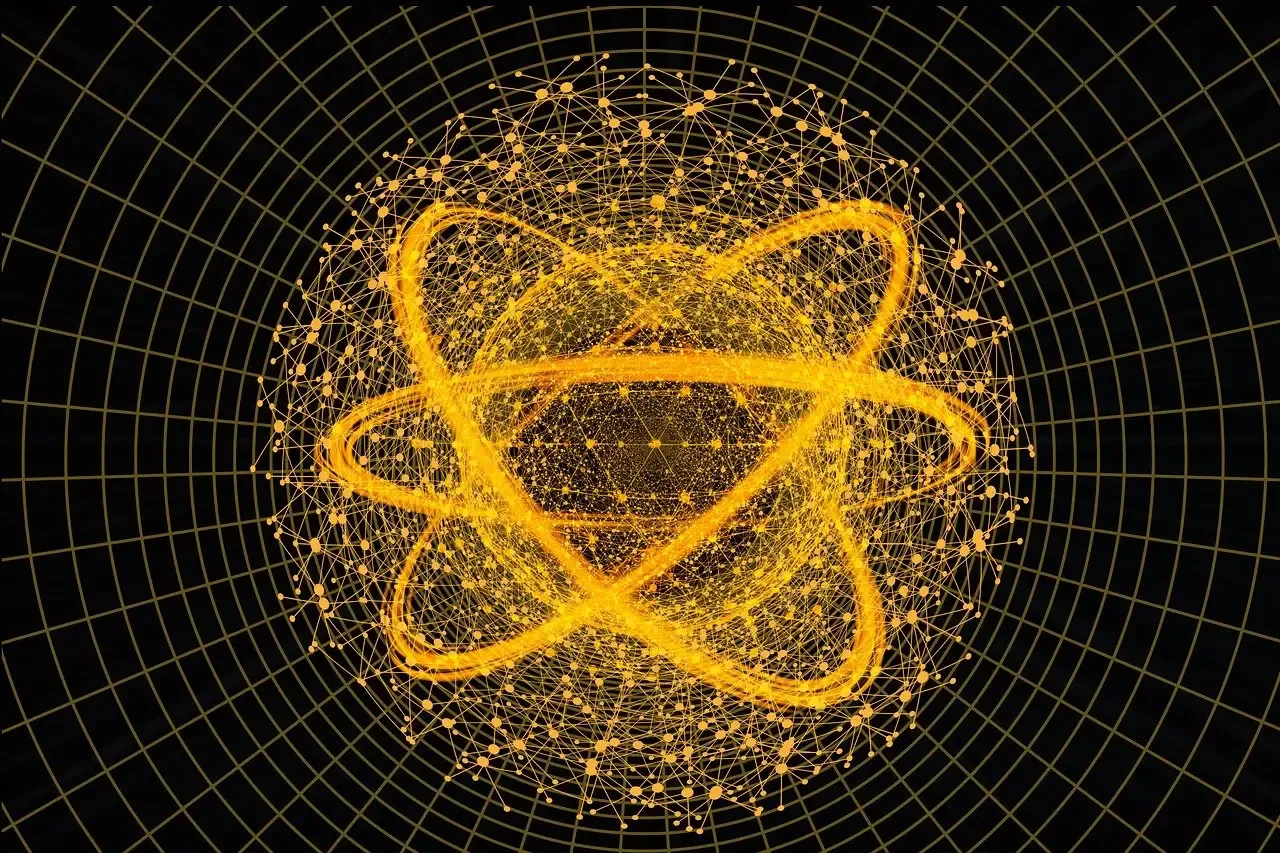
Far from being just a curiosity, entanglement sits at the center of several of the most exciting developments in physics and technology. Quantum computers rely on entangled qubits to process many possibilities at once, turning problems that would take a classical machine longer than the age of the universe into tasks that, in principle, might be solved in a practical time. Quantum error correction codes use carefully structured entanglement to protect fragile quantum information, the way a spiderweb uses many interconnected strands to stay intact even if a few break.
On a deeper level, entanglement has become a key tool for thinking about the fabric of space and time itself. Some researchers argue that the geometry of spacetime, and even the existence of smooth space as we know it, might emerge from patterns of entanglement in an underlying quantum system. Black hole physics, holographic principles, and attempts to merge quantum mechanics with gravity all make heavy use of entanglement as a guiding concept. What started as an odd side effect of quantum equations is now treated like a basic ingredient of reality.
Living with a Stranger Universe
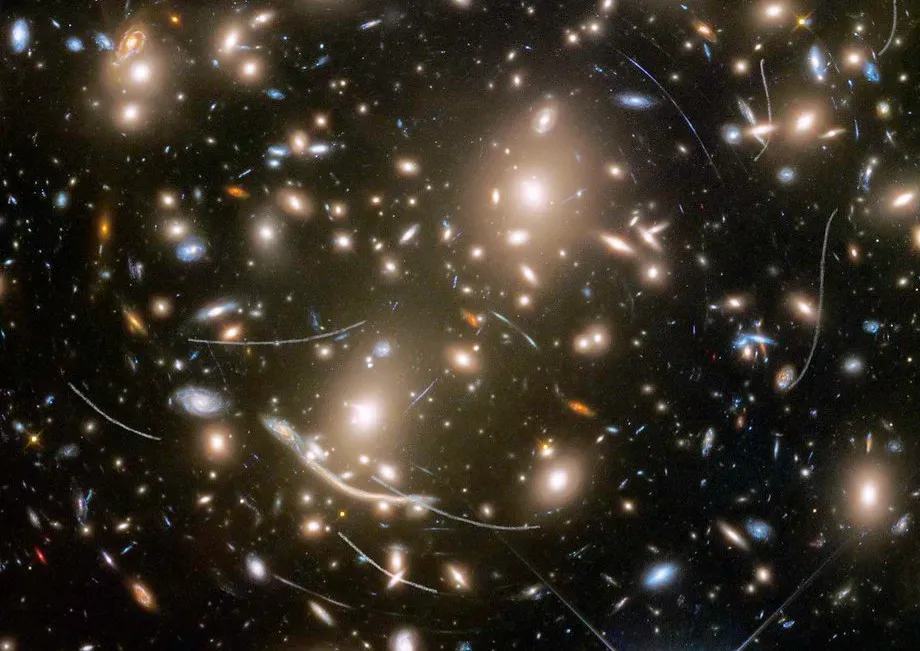
Quantum entanglement forces us to accept a world where separation is not as simple as distance and where parts of a system can remain deeply connected no matter how far they drift apart. The universe turns out to be less like a collection of isolated billiard balls and more like a vast, intricate tapestry, where pulling a thread in one corner can subtly reshape a pattern on the opposite side. That picture can feel disorienting at first, especially if you grew up with a very mechanical notion of cause and effect.
Yet there’s also something oddly comforting about it. Entanglement suggests that, at the most fundamental level, the universe is built on relationships rather than rigid boundaries. It hints that the deepest truths of nature might lie not in individual things, but in the links between them. As we push further with quantum technologies and cosmic-scale experiments, we’re likely to uncover even stranger consequences of this connectedness. If particles can stay bound across light-years, what else about reality might be more entangled than we ever imagined?