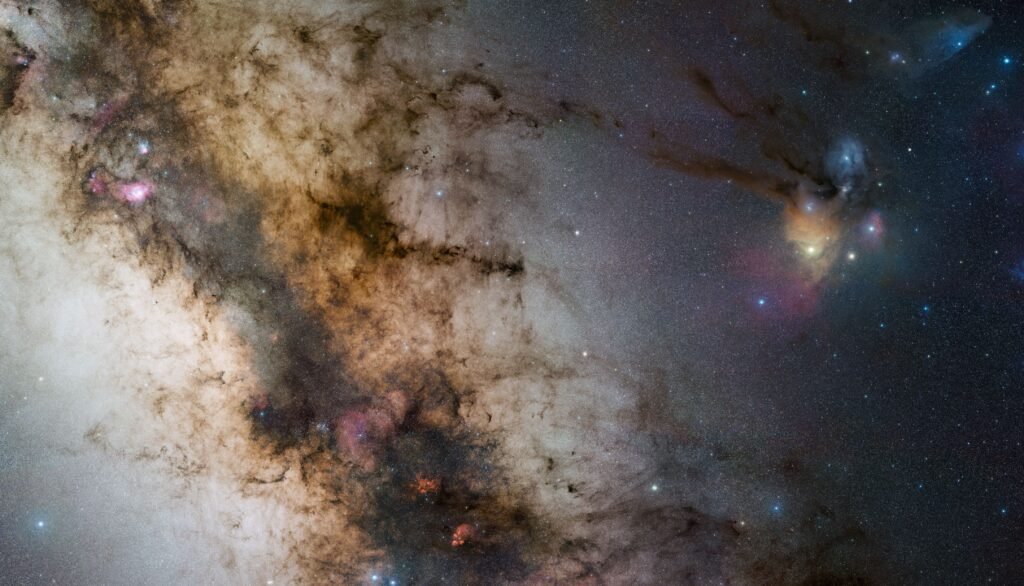
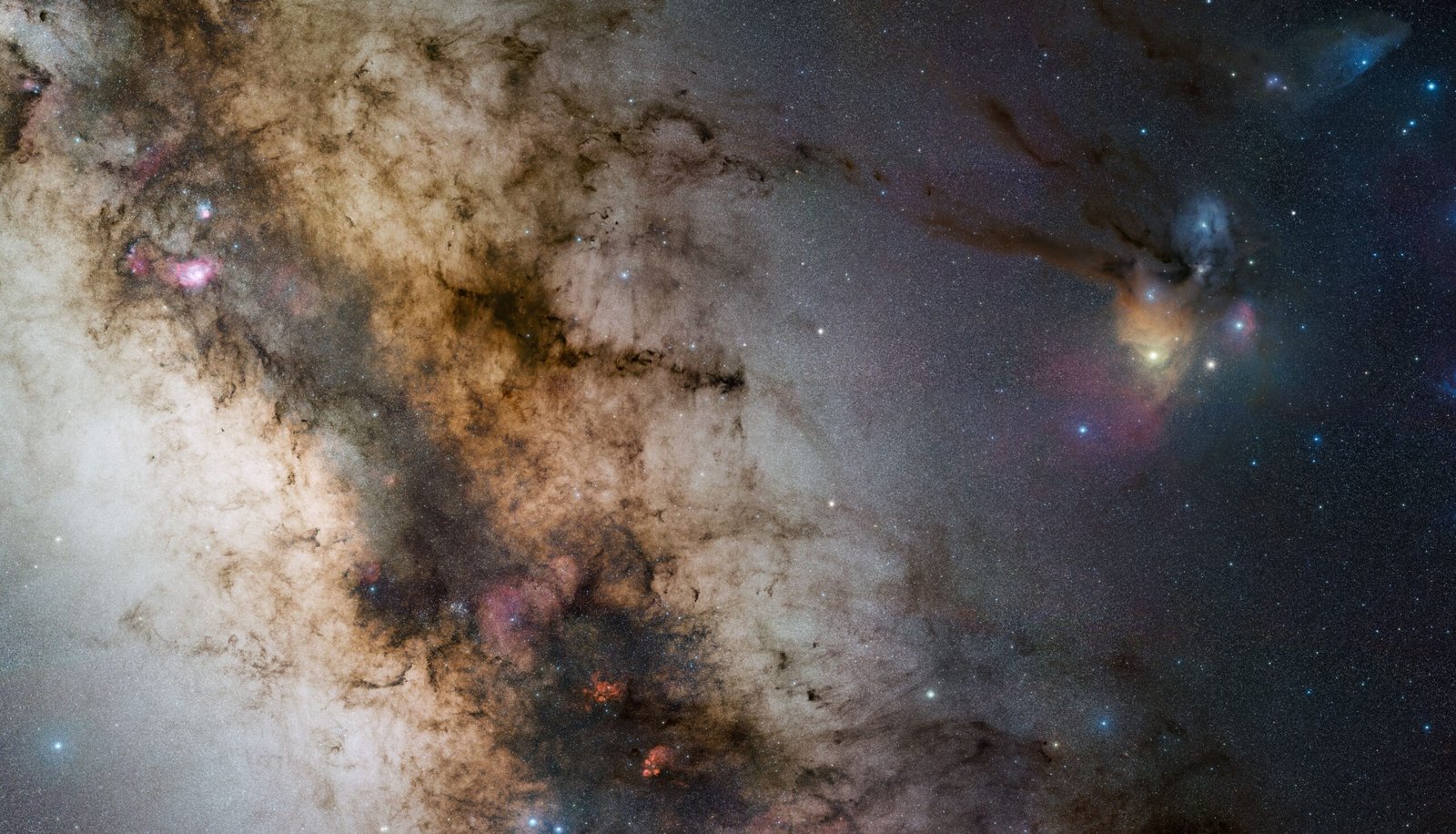
A Chaotic Nursery Orbiting a Supermassive Black Hole (Image Credits: Upload.wikimedia.org)
Astronomers captured the sharpest view yet of the dense, turbulent gases at the Milky Way’s center, offering fresh insights into the galaxy’s most extreme environment.
A Chaotic Nursery Orbiting a Supermassive Black Hole
The Central Molecular Zone, or CMZ, spans 650 light-years across and lies 28,000 light-years from Earth. This region orbits the galaxy’s central supermassive black hole amid a frenzy of massive star formation. Filaments twist through the area, some stretching dozens of light-years while others hug individual stars. Cold molecular clouds dominate, invisible to optical telescopes but glowing in radio waves. Researchers described the scene as far more complex than anticipated.
Steve Longmore, a project member from Liverpool John Moores University in the UK, highlighted the zone’s role in hosting some of the galaxy’s most massive stars. These stars burn brightly and briefly, often exploding as supernovas or even hypernovas. Such violence shapes the surrounding gas and offers a window into early universe conditions.
ALMA Delivers Its Largest Image Ever
The Atacama Large Millimeter/submillimeter Array, or ALMA, assembled the mosaic from multiple sub-images taken with its 66 radio telescopes in Chile’s Atacama Desert. This effort formed part of the ALMA CMZ Exploration Survey, or ACES, involving over 60 scientists worldwide. The array scanned millimeter radio wavelengths to map cold gases invisible at other frequencies. Katharina Immer from the European Southern Observatory noted the surprise at the data’s richness.
“We anticipated a high level of detail when designing the survey, but we were genuinely surprised by the complexity and richness revealed in the final mosaic,” Immer stated. The project leader, Longmore, emphasized how these observations trace molecular distributions through their unique radio emissions.
Chemical Riches in the Galactic Core
The mosaic exposed a diverse array of molecules within the CMZ, from simple compounds to intricate organics. Radio spectra revealed their presence by analyzing how they absorb or emit light at specific wavelengths.
- Silicon monoxide (SiO)
- Carbon monosulphide (CS)
- Sulphur monoxide (SO)
- Isocyanic acid (HNCO)
- Cyanoacetylene (HC3N)
- Complex organics like methanol, acetone, and ethanol
These clouds proved warmer and more turbulent than those in the Milky Way’s outskirts, influencing how stars and chemistry evolve there. The findings appeared in a series of papers published in Monthly Notices of the Royal Astronomical Society.
Future Probes into Extreme Environments
Ashley Barnes, also at the European Southern Observatory, pointed to upcoming enhancements. ALMA’s wideband sensitivity upgrade, combined with the Extremely Large Telescope, promises even sharper views. These tools will resolve finer structures and delve deeper into star-gas-black hole dynamics. For more details, see the ESO news release or the ACES project page.
The CMZ mirrors chaotic star-forming regions in the early universe, aiding models of galaxy growth. Longmore explained: “By studying how stars are born in the Central Molecular Zone, we can also gain a clearer picture of how galaxies grew and evolved.”
Key Takeaways
- The CMZ mosaic spans 650 light-years and maps over a dozen molecules.
- ALMA’s ACES survey involved 60+ scientists for unprecedented radio detail.
- Findings link local extremes to early universe galaxy formation.
This landmark image not only redefines our view of the Milky Way’s core but also sets the stage for decoding the universe’s starbirth history – what discoveries await next? Share your thoughts in the comments.