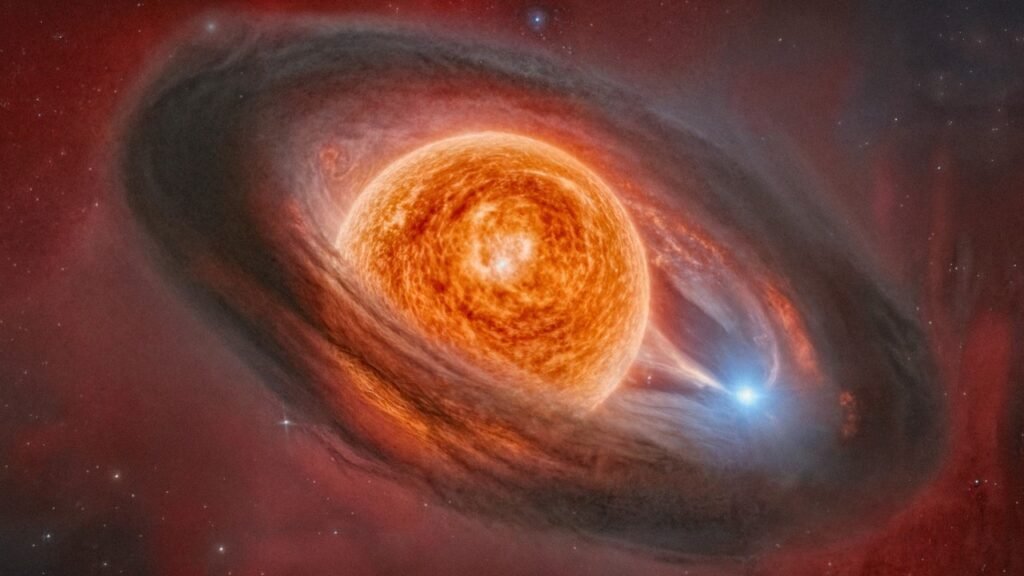
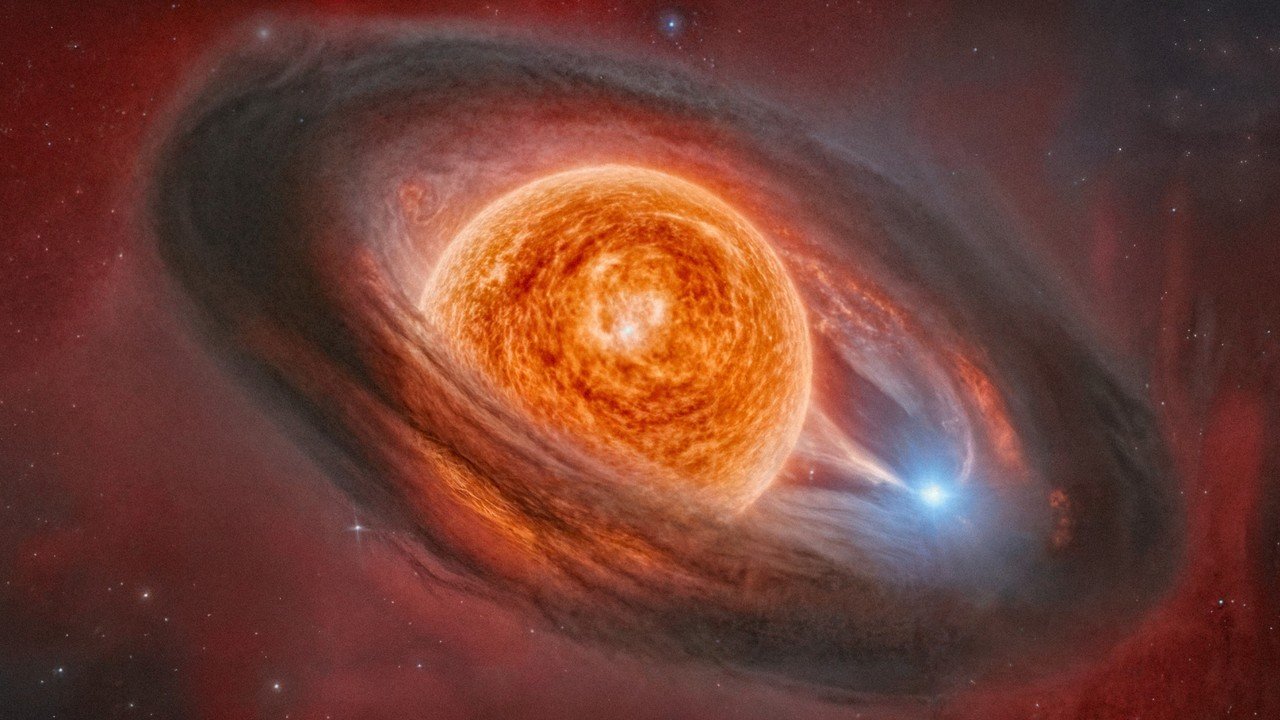
Unprecedented Scale in a Neighboring Galaxy (Image Credits: Cdn.mos.cms.futurecdn.net)
Astronomers recently documented a striking evolution in WOH G64, one of the largest known stars residing in the Large Magellanic Cloud.[1][2]
Unprecedented Scale in a Neighboring Galaxy
WOH G64 commands attention as a contender for the most massive and luminous star in the Large Magellanic Cloud, a satellite galaxy roughly 160,000 light-years from Earth. Its radius measures about 1,540 times that of the Sun, vast enough to engulf Jupiter’s orbit if positioned in our solar system.[1] For decades, researchers classified it as a red supergiant, one of the coolest and most extended stars known, steadily shedding mass through powerful stellar winds.[2]
This star’s history includes episodic ejections of gas and dust, forming expansive envelopes around it. Observations dating back to the 1980s revealed its red hue and pulsating brightness, varying by 1.5 to 2 magnitudes over roughly two years.[1] Such traits marked it as a prime subject for studying the final stages of massive stellar life cycles.
Captured in Real Time: The Rapid Shift
The transformation unfolded dramatically starting around 2011, when WOH G64 dimmed noticeably before recovering and surpassing its prior brightness in 2013 and 2014. During this peak, its surface temperature surged by more than 1,000 degrees Celsius, shifting the star’s appearance from deep red to a vivid yellow.[2][3]
Spectral analysis confirmed the change: titanium oxide features, hallmarks of cool red supergiants, faded away, replaced by forbidden emission lines indicative of hotter conditions. The star appeared to contract somewhat, with radius estimates dropping in some measurements from around 1,500 to 800 solar radii. By 2025, it faded again to less than half its recent peak brightness, dropping by about two magnitudes in under a year.[2]
Here are the key observed changes:
- Brightness dimming in 2011, followed by a surge in 2013-2014.
- Temperature increase exceeding 1,000°C, altering color to yellow.
- Spectral shifts from molecular absorption to emission lines.
- Recent 2025 fading beyond normal pulsation cycles.
- Potential size reduction during the heating phase.
Decades of Data Reveal the Puzzle
Researchers pieced together this story from over 30 years of brightness measurements across six all-sky surveys, beginning in 1992. New spectra and imaging from the European Southern Observatory’s Very Large Telescope Interferometer, using the GRAVITY instrument in 2024, provided high-resolution insights into its atmosphere.[2]
Gonzalo Muñoz Sánchez, lead author of the study published in Nature Astronomy, recalled the initial shock: “When we first saw the data, we thought we were observing a different star.”[2] The team’s analysis suggests WOH G64 may belong to a binary system, where interactions with a companion could trigger such instability, including partial ejection of its outer envelope.
Toward Cataclysm: Supernova or Alternative Fate?
This shift aligns with a theorized late-stage transition from red supergiant to yellow hypergiant, a fleeting phase just before core collapse. Yet uncertainties abound. Some experts question the full classification as a yellow hypergiant, noting persistent red supergiant spectral signatures in recent data.[2]
Possible outcomes include a type II supernova enriched by circumstellar material, direct black hole formation, or even a merger if binary dynamics dominate. “We cannot predict the future of WOH G64 due to the poorly constrained physical and orbital parameters,” the researchers noted.[1] Astronomer René Oudmaijer praised the compelling evidence of heating but urged caution on binary claims.
Key Takeaways:
- WOH G64’s changes offer a rare real-time view of extreme stellar evolution.
- Binary interactions may explain the instability over single-star models.
- Future explosions could light up the LMC sky, visible from Earth.
WOH G64’s saga underscores the unpredictable drama of massive stars’ endgames, challenging models and inviting continued scrutiny. As new observations roll in, this cosmic giant holds clues to the universe’s most violent events. What do you think lies next for WOH G64? Share your thoughts in the comments.