Sudden Discovery Shakes Up Dinosaur Lore (Image Credits: wikimedia)
Niger – Paleontologists revealed Spinosaurus mirabilis, a 95-million-year-old dinosaur species unearthed in the remote Sahara, distinguished by its dramatic scimitar-shaped crest on the skull.[1]
Sudden Discovery Shakes Up Dinosaur Lore
A local guide led researchers to fossil-rich sites in 2019, sparking an expedition that uncovered jawbones and teeth hinting at something extraordinary. Two years later, in 2022, the team returned to Jenguebi and Iguidi, recovering partial skeletons from several young individuals. These finds, embedded in river sediments alongside sauropod remains, painted a picture of lush, forested river systems far from any coast.[1]
The holotype specimen measured about 26 feet long, though all fossils came from immature animals, leaving adult dimensions a mystery. Led by University of Chicago paleontologist Paul Sereno, the group pieced together 3D models under solar power in camp, a moment Sereno described as profoundly emotional.[1]
Striking Anatomy Sets It Apart
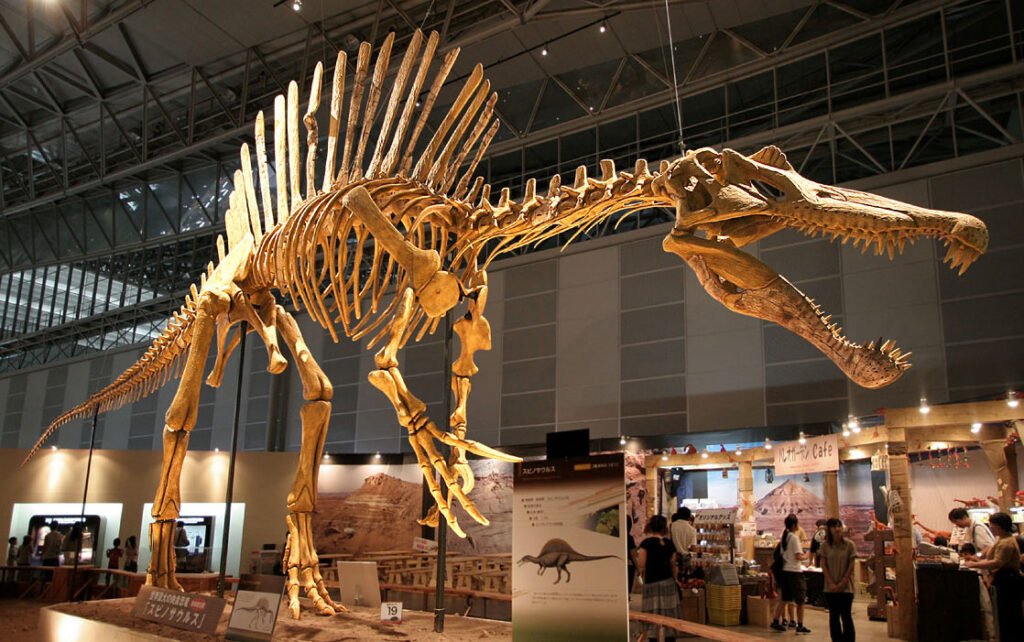
Spinosaurus mirabilis boasted a tall, curved crest resembling a scimitar sword, likely coated in colorful keratin with internal blood vessels for display or thermoregulation. Its jaws featured interlocking teeth that protruded outward, ideal for snaring fish much like modern crocodiles. Sail-like spines rose from the back, a hallmark of spinosaurids used for show and heat control.
- Tall, keratin-covered head crest with vascular structure.
- Interdigitating teeth for gripping slippery prey.
- Semi-aquatic build with sturdy legs for wading up to two meters deep.
- Back sails for display and temperature regulation.
These traits marked it as a “hell heron,” Sereno noted, stalking shallow waters for large fish in inland traps.[1]
Inland Hunter Challenges Coastal Narrative
Previous spinosaur finds, like Spinosaurus aegyptiacus from North African shores, suggested these dinosaurs hugged coastlines. Yet Jenguebi lay 310 miles inland from the ancient sea, and Iguidi stretched twice that distance. This inland setting amid forested rivers reframes spinosaurids as adaptable river dwellers, thriving 500 to 1,000 kilometers from shorelines.
| Feature | Spinosaurus mirabilis | Spinosaurus aegyptiacus |
|---|---|---|
| Habitat | Inland rivers | Coastal |
| Head Crest | Scimitar-shaped, pronounced | Less curved |
| Tooth Arrangement | Strongly interdigitating | Similar but varied |
The species lived during the Cenomanian stage of the Cretaceous, around 95 million years ago, just before spinosaurids vanished amid rising seas and climate shifts.[1]
Team Effort Yields Scientific Breakthrough
Sereno’s expeditions relied on trusted local partners, including the guide who first pointed to Jenguebi. “The local people we work with are my lifelong friends,” Sereno said, emphasizing shared stakes in Niger’s heritage. The research appeared in Science on February 19, 2026, capping over a century since the genus debuted in 1915.[1]
- Spinosaurus mirabilis lived 95 million years ago in inland Niger rivers.
- Its scimitar crest and fish-grabbing jaws highlight unique adaptations.
- The find proves spinosaurids ventured deep inland, altering habitat views.
This discovery expands spinosaur diversity, proving these giants roamed far beyond shores in pursuit of prey. It underscores how remote expeditions continue to reshape prehistoric narratives. What surprises might the Sahara yield next? Share your thoughts in the comments.