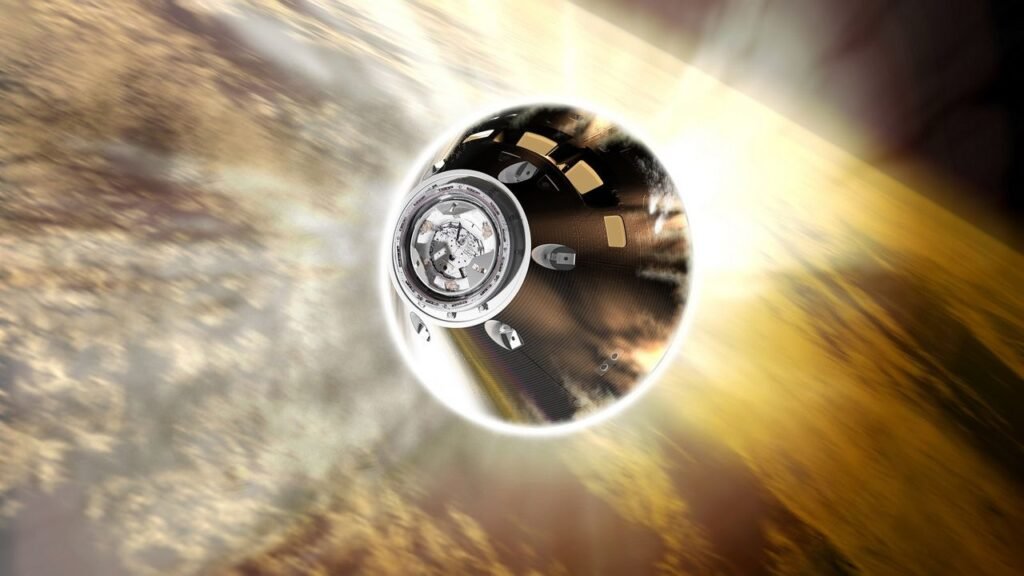
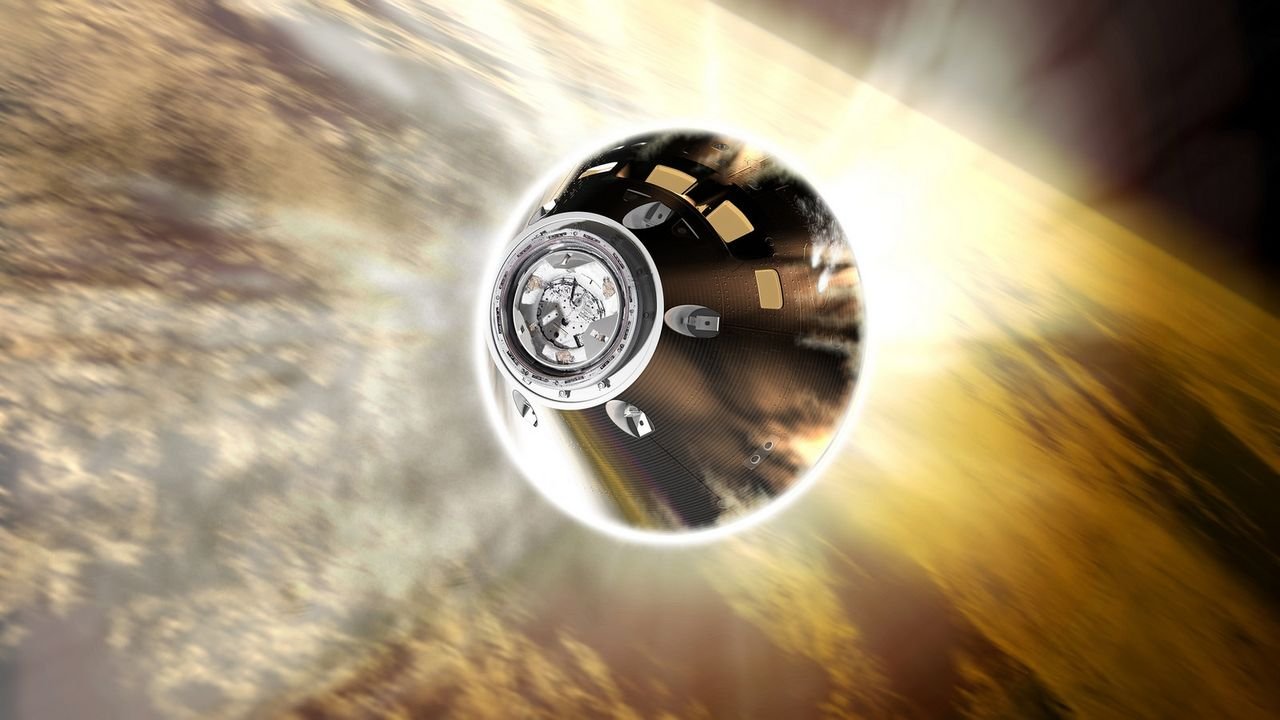
Ablation Anomaly Shocks Post-Flight Inspection (Image Credits: Cdn.mos.cms.futurecdn.net)
NASA engineers pinpointed unexpected damage on the Orion capsule’s heat shield after its fiery reentry from the uncrewed Artemis 1 lunar mission in December 2022.[1][2]
Ablation Anomaly Shocks Post-Flight Inspection
Teams discovered more than 100 locations where charred material had unexpectedly broken away from the heat shield. The 16.5-foot-wide shield, coated with Avcoat – a phenolic epoxy resin also used on Apollo capsules – underwent intense scrutiny at Kennedy Space Center.[1]
Orion had executed a skip-entry maneuver, dipping into Earth’s upper atmosphere to bleed off speed before a final plunge. This profile exposed the shield to prolonged lower heating rates, unlike pre-flight ground tests that simulated steeper conditions. Internal temperatures stayed in the safe mid-70s Fahrenheit range, confirming the capsule’s overall integrity.[2]
Post-mission analysis revealed the root cause: gases produced during Avcoat ablation could not vent adequately. Pressure built up within the material, leading to cracks and char liberation primarily in non-permeable zones.[1]
Rigorous Investigation Yields Clear Answers
NASA launched a comprehensive probe involving contractors, independent experts, and over 120 tests across specialized facilities. Arc jet simulations at Ames Research Center replicated reentry heating, while wind tunnels at Langley validated models.[2]
Key efforts included:
- Sampling 200 Avcoat blocks for microstructure analysis at Lawrence Berkeley National Lab.
- Real-time radiography during laser heating to observe cracking.
- Hypersonic tests confirming gas trapping in skip-entry conditions.
- Sensor data review from embedded thermocouples and strain gauges.
“We took our heat shield investigation process extremely seriously with crew safety as the driving force,” said Howard Hu, Orion Program manager at Johnson’s Space Center.[2]
An independent review team endorsed the findings, affirming ample margins for crewed flights with adjustments.
Trajectory Tweak: The Core Solution for Artemis 2
With Orion’s heat shield already installed for the upcoming crewed lunar flyby, replacement proved unfeasible. NASA opted for operational changes, shifting to a direct-entry profile.[3]
| Reentry Profile | Artemis 1 | Artemis 2 |
|---|---|---|
| Approach | Skip entry (multiple dips) | Direct steeper entry |
| Heating Duration | Prolonged in mid-range temps | Shorter exposure to issue zone |
| Peak Heat | Lower sustained | Higher but brief |
| Landing Range | Longer downrange | Shorter Pacific splashdown |
This steeper path limits time in the problematic temperature window, where gas buildup occurred. Lockheed Martin reproduced the flaw in tests and confirmed the fix preserves safety.[1]
Artemis 2, targeting April 2026 with astronauts Reid Wiseman, Victor Glover, Christina Koch, and Jeremy Hansen, will validate these measures during its 10-day mission.[3]
Confidence Builds Amid Scrutiny
Officials emphasize the data-driven rationale. “The Artemis II heat shield can keep the crew safe during the planned mission with changes to Orion’s trajectory,” NASA stated in its update.[3]
While a NASA Inspector General report noted ongoing risks for later missions like Artemis 3, the agency views Artemis 2 as a pivotal test. Minor Avcoat density tweaks inform future blocks, enhancing permeability.[1]
Key Takeaways
- Extensive testing confirmed gas venting as the culprit, now mitigated by profile shift.
- Artemis 1 data proved capsule safety, informing crewed confidence.
- Direct entry balances heat load for Orion’s Pacific Ocean recovery.
These steps underscore NASA’s methodical approach to lunar return challenges. As Artemis 2 nears, the fixes transform a test flight glitch into a stronger program foundation. What steps would you prioritize for deep-space safety? Share in the comments.