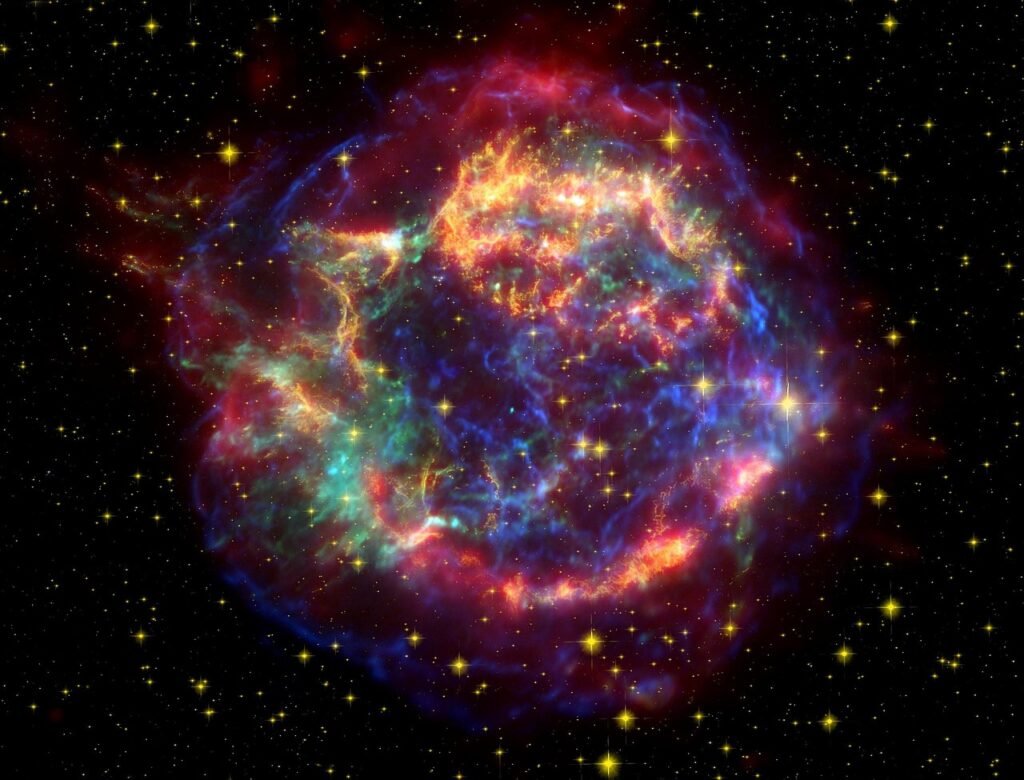
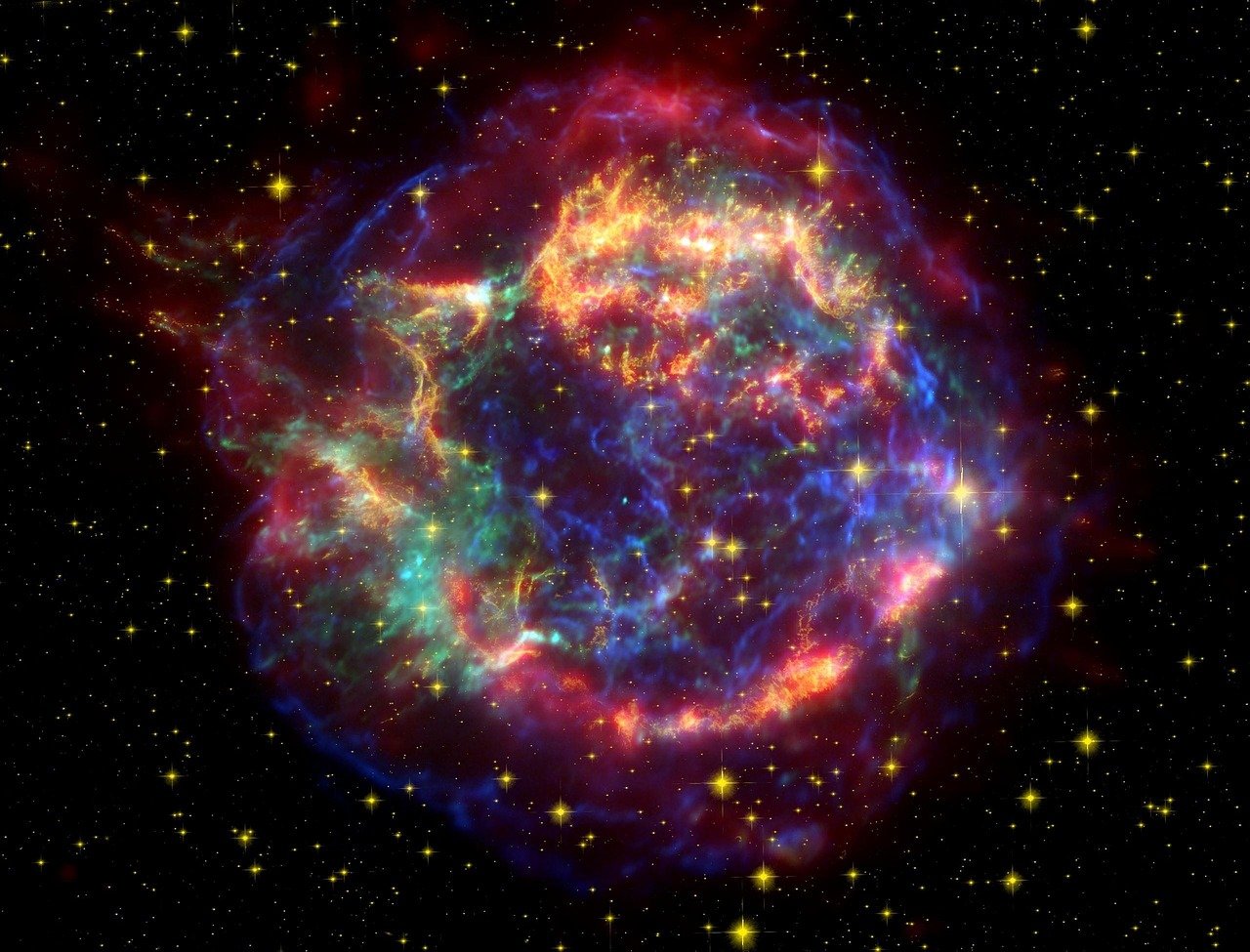
Radio Waves Lead to a Hidden Discovery (Image Credits: Pixabay)
Astronomers recently unveiled detailed images of supernova remnant G150.3+04.5, a sprawling cosmic structure lurking in the constellation Camelopardalis.[1]
Radio Waves Lead to a Hidden Discovery
Researchers first spotted G150.3+04.5 in 2014 during a survey at 6-centimeter radio wavelengths. The object appeared as an enclosed, oval-shaped shell roughly 2.5 degrees wide and 3 degrees high.[2] This marked the initial detection of the remnant, which had evaded earlier optical observations due to its faintness.
Radio astronomers published their findings, confirming the shell-like morphology through detailed mapping. Parts of the structure showed clear boundaries, distinguishing it from surrounding emission. The discovery paper highlighted its potential as a new supernova remnant candidate.[3]
Optical Views Reveal a Chaotic Landscape
New imaging efforts brought the remnant into visual light for the first time around 2022, showcasing its ethereal form amid dark nebulae. The shell spans over 2 degrees across the sky, creating a ghostly outline partially obscured by dust clouds like LDN 1400.[1][4] A chaotic complex of these nebulae complicates the view, adding layers of intrigue to the scene.
Photographers captured brighter regions of the remnant intertwined with uncatalogued HII nebulosity. The structure’s faint filaments blend with foreground dust, requiring extensive exposure times to resolve. These efforts produced mosaic images spanning multiple panels for comprehensive coverage.[5]
Unraveling Age and Distance Mysteries
Studies place the remnant’s age between 38,000 and 160,000 years, with a conservative lower limit of 1,000 years since no historical records exist.[6][7] Its distance remains uncertain, estimated from 0.7 to 4.5 kiloparsecs from Earth. These parameters suggest a dynamically young supernova remnant despite its large angular size.
Gamma-ray observations detected a hard GeV spectrum from the region, supporting its classification. The shell morphology aligns with models of expanding remnants interacting with interstellar medium. Further analysis ruled out older, faded interpretations in favor of recent activity.[8]
| Property | Details |
|---|---|
| Angular Size | ~2-3 degrees |
| Age Estimate | 38,000-160,000 years |
| Distance | 0.7-4.5 kpc |
Team Effort Lights Up the Remnant
A collaborative project amassed 378 hours of deep imaging to produce striking composites in hydrogen-alpha, oxygen-III, and RGB filters. Teams from around the world contributed data, overcoming the target’s low surface brightness.[1] The result highlighted the remnant’s intricate details against the backdrop of Camelopardalis.
- Andrea Iorio
- Ashley Brown
- Lorenzo Lilli
- Giampiero Lilli
- Jacopo Fallai
- Quinn Groessl
- Francisco Javier Pérez Olvera
- Francesco Morini
- George William Hoffman
- Robin Livermore
- Sara Santos
These images, featured on Astronomy Magazine, demonstrate the power of amateur-professional partnerships in astrophysics.
Key Takeaways
- G150.3+04.5 emerged from radio surveys in 2014 as a shell-type remnant.
- Optical imaging reveals interactions with dark nebulae like LDN 1400.
- Gamma-ray data confirms its youth, with ages under 160,000 years.
This supernova remnant serves as a window into stellar death throes, reminding us of the universe’s violent past. What aspects of cosmic remnants fascinate you most? Share in the comments.