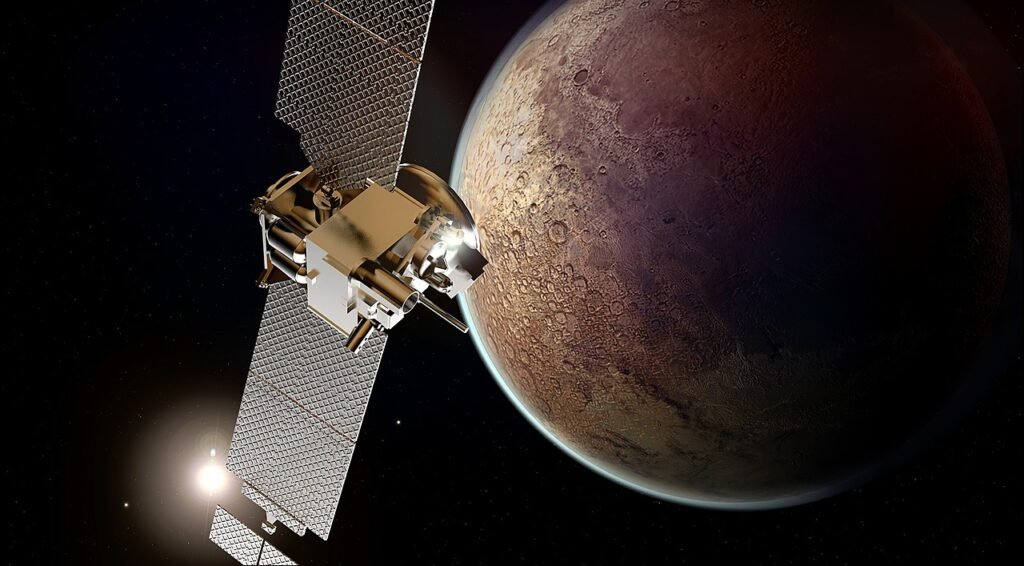

A New Era Beyond Robotic Scouts (Image Credits: Pixabay)
NASA’s vision for sending humans to Mars marks a pivotal shift from robotic exploration to boots-on-the-ground discovery, with plans targeting the 2030s.
A New Era Beyond Robotic Scouts
Exploration of Mars began with uncrewed probes, starting with Viking 1’s landing in 1976, which delivered the first close-up images and soil analyses from the Martian surface. For decades, rovers like Perseverance and orbiters such as the Mars Reconnaissance Orbiter gathered data on the planet’s geology, atmosphere, and potential for past life. These missions built a foundation of knowledge, revealing water ice deposits and ancient riverbeds that hint at a once-habitable world. Now, as NASA advances toward crewed flights, the focus turns to human capabilities that far surpass mechanical ones.
Astronauts will bring adaptability, intuition, and real-time decision-making to the Red Planet, enabling deeper investigations into questions that robots alone cannot fully resolve. The transition to human presence promises to accelerate scientific returns, transforming Mars from a distant target into a laboratory for humanity. Recent assessments, including a detailed report from the National Academies of Sciences, Engineering, and Medicine, outline how these pioneers might operate once they arrive.
The Rigors of the Interplanetary Voyage
The trip to Mars demands unprecedented endurance, lasting six to nine months aboard spacecraft like NASA’s Orion or SpaceX’s Starship prototypes. Crews will endure microgravity, relying on exercise regimens and radiation shielding to maintain health during the 140-million-mile journey on average. Communication delays of up to 20 minutes each way will force self-reliance, with no instant support from Earth-based teams. Once en route, astronauts might conduct experiments in zero gravity, testing plant growth or material behaviors for future deep-space travel.
Arrival involves precise orbital insertion and descent, potentially using retro-rockets and heat shields refined through years of testing. The National Academies report emphasizes the need for robust landing systems capable of delivering habitats and supplies safely to the surface. These elements ensure the crew emerges ready to explore, rather than merely survive the transit.
Establishing a Foothold on the Surface
Upon touchdown, likely in regions like Jezero Crater rich in ancient sediments, the first order of business involves deploying pre-positioned habitats and setting up life-support systems. Inflatable modules and 3D-printed structures from Martian regolith could form the basis of a temporary base, protecting against dust storms and extreme cold. Astronauts will don pressurized suits for excursions, navigating the rusty terrain while monitoring for hazards like sharp rocks or sudden temperature drops.
Daily routines will blend maintenance with exploration, such as powering solar arrays or extracting water from subsurface ice for drinking and fuel production. The report highlights collaborative efforts with international partners, including the European Space Agency, to share resources and expertise. This setup allows for stays of 30 days or more, balancing risk with the rewards of on-site research.
Core Activities: Science and Survival Intertwined
Scientific objectives drive the mission, with astronauts collecting samples from diverse sites to analyze for signs of ancient microbes – tasks that rovers have primed but humans can execute more efficiently. Field geology will involve drilling into lava tubes or mapping volcanic features, providing clues about Mars’s dynamic history. Biomedical studies on crew members will track the effects of low gravity and isolation, informing future long-duration flights.
To organize these efforts, missions incorporate structured protocols:
- Geological surveys to document rock formations and mineral deposits.
- Atmospheric sampling to measure dust composition and weather patterns.
- Biological experiments, including testing microbial growth in simulated Martian soil.
- Resource utilization trials, like producing oxygen from carbon dioxide in the air.
- Human factors research to assess psychological resilience in alien environments.
Such activities not only advance knowledge but also pave the way for sustainable presence on Mars.
Overcoming Hurdles for Lasting Impact
Challenges abound, from radiation exposure during transit to the psychological strain of isolation on a barren world. NASA addresses these through innovations like advanced propulsion for shorter trips and AI-assisted habitats that reduce workload. The National Academies report calls for integrated testing on Earth analogs, such as Antarctic outposts, to simulate real conditions.
International collaboration amplifies progress, with contributions from agencies worldwide enhancing spacecraft design and mission planning. As these elements coalesce, the 2030s mission stands as a testament to human ingenuity, extending our reach across the solar system.
Key Takeaways
- NASA targets the 2030s for initial crewed landings, building on decades of robotic data.
- Astronauts will prioritize science like sample collection while establishing basic infrastructure.
- Technological advances in habitats and propulsion are crucial for mission success and future expansions.
The prospect of humans walking on Mars redefines exploration, offering insights into our cosmic neighborhood and humanity’s potential beyond Earth. What aspects of a Mars mission intrigue you most? Share your thoughts in the comments.