You probably grew up thinking lakes are supposed to be blue or maybe murky green on a bad day. Then you stumble across a picture of a neon-pink lagoon or a blood-red salt lake that looks more like Mars than Earth, and your brain does a double-take. These places are real, and they are quietly rewriting what you think water is supposed to look like. Color-changing lakes are not magic, and they are not pollution horror stories either. When you look closer, you find a wild partnership between tiny microbes, stubborn minerals, and shifting seasons. In some lakes, microscopic algae act like living paint, turning the water pink or red as salinity and sunlight change. In others, minerals crystallize and rearrange the surface into a surreal patchwork every summer. As you move through these eight lakes, you are really touring eight very different chemistry experiments that just happen to be big enough to see from space.
Lake Hillier, Australia – The Bubblegum-Pink Microbial Lab
When you first see Lake Hillier, it feels almost fake, as if someone dropped a giant bottle of strawberry milk into the middle of a forested island. You find this tiny lake on Middle Island off Western Australia, glowing a consistent bubblegum pink right next to deep-blue ocean water. Unlike many other colorful lakes, Hillier’s water stays pink even when you scoop it into a bottle, a clue that you are looking at pigments built into living cells rather than a trick of light or sediment. If you could zoom in, you would see salt-loving microbes doing the heavy lifting. Algae such as Dunaliella and certain halophilic bacteria pack their cells with protective pigments – similar in spirit to the carotenoids that help flamingos turn pink. These pigments help the microbes survive brutal salinity and intense sunlight, and to your eyes they add up to a dense, opaque pink. Scientists have identified a whole community of pigment-rich “polyextremophile” microbes in Hillier, and they are still working out how each one contributes to that electric color. For you, the bottom line is simple: this lake is like a gigantic, naturally occurring culture flask full of color-making specialists.
Lake Retba, Senegal – A Pink Lake That Breathes With the Seasons
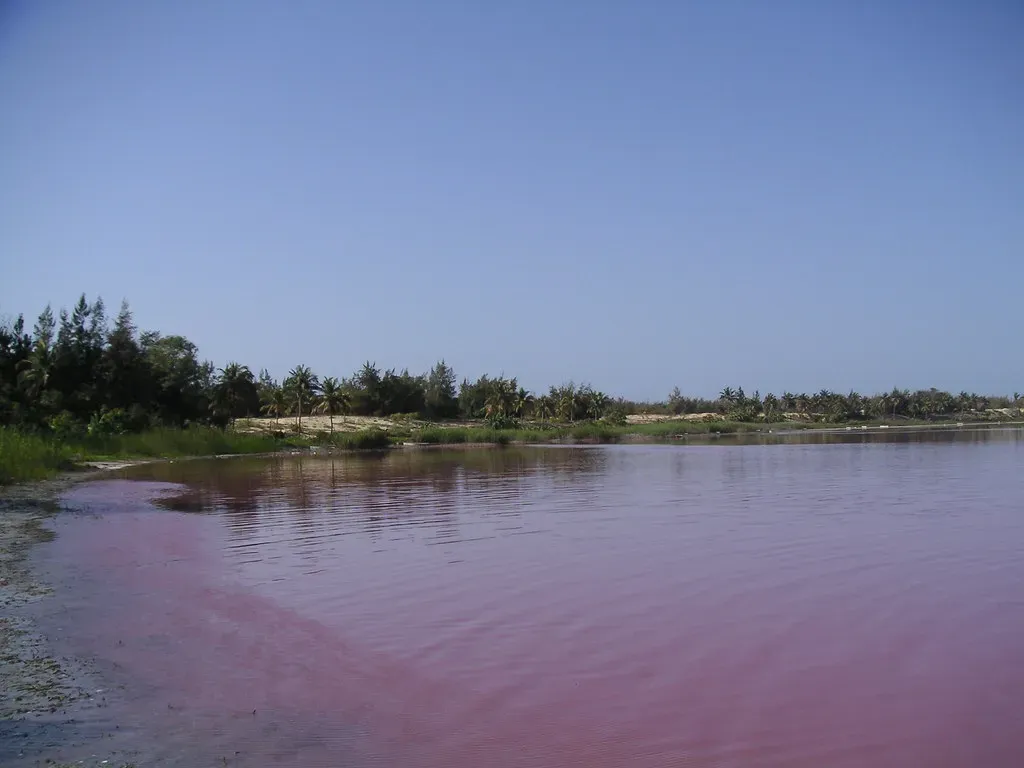
If Lake Hillier is the unwavering neon show-off, Lake Retba (Lac Rose) in Senegal is more moody and alive. When you visit during the dry season, the water can turn a strong rose-to-mauve shade, especially on bright, still days. In the wet season, that same lake may look more ordinary, with the pink fading as fresh rainwater dilutes the salt and the microbes relax their pigment production. You are watching the lake literally change personality with the weather. Here, too, salt-loving microorganisms are your main color artists. As the water becomes extremely salty, certain halophilic bacteria and algae ramp up red and orange pigments to protect themselves from light and osmotic stress. Those pigments tint the entire water column, and the effect intensifies when evaporation is high and the lake is almost syrup-thick with brine. At the same time, massive salt harvesting around the lake constantly exposes salty surfaces where these microbes can cling and grow, creating a living interface between geochemistry and biology. When you stand on the shore, you are not just seeing pink water; you are seeing a seasonal tug-of-war between rain, sun, salt, and microbial survival.
Laguna Colorada, Bolivia – A High-Altitude Red Cauldron
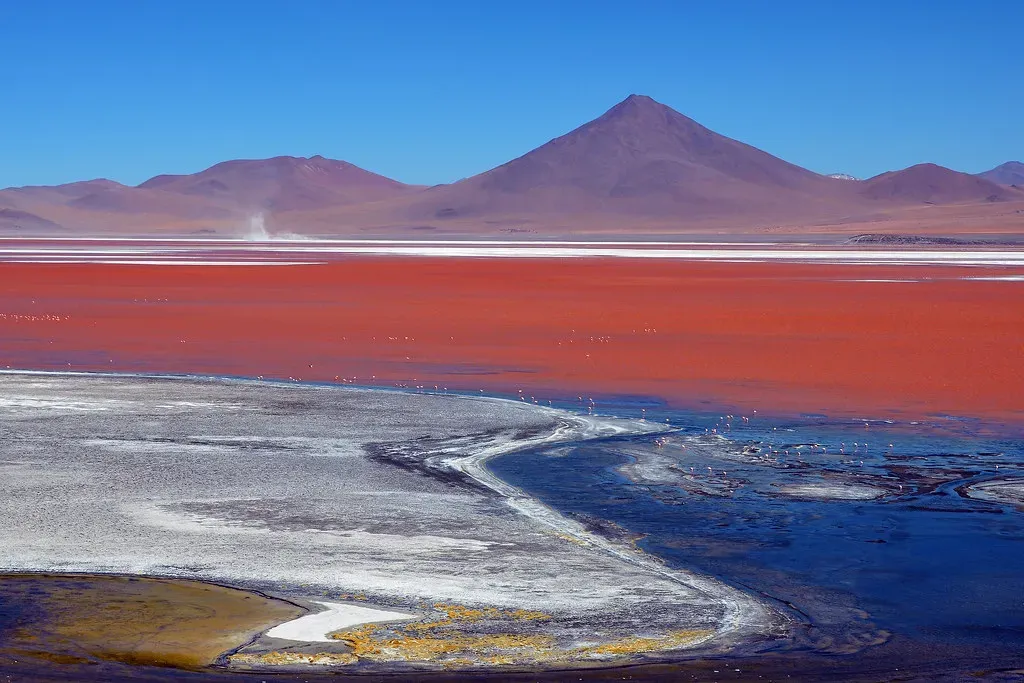
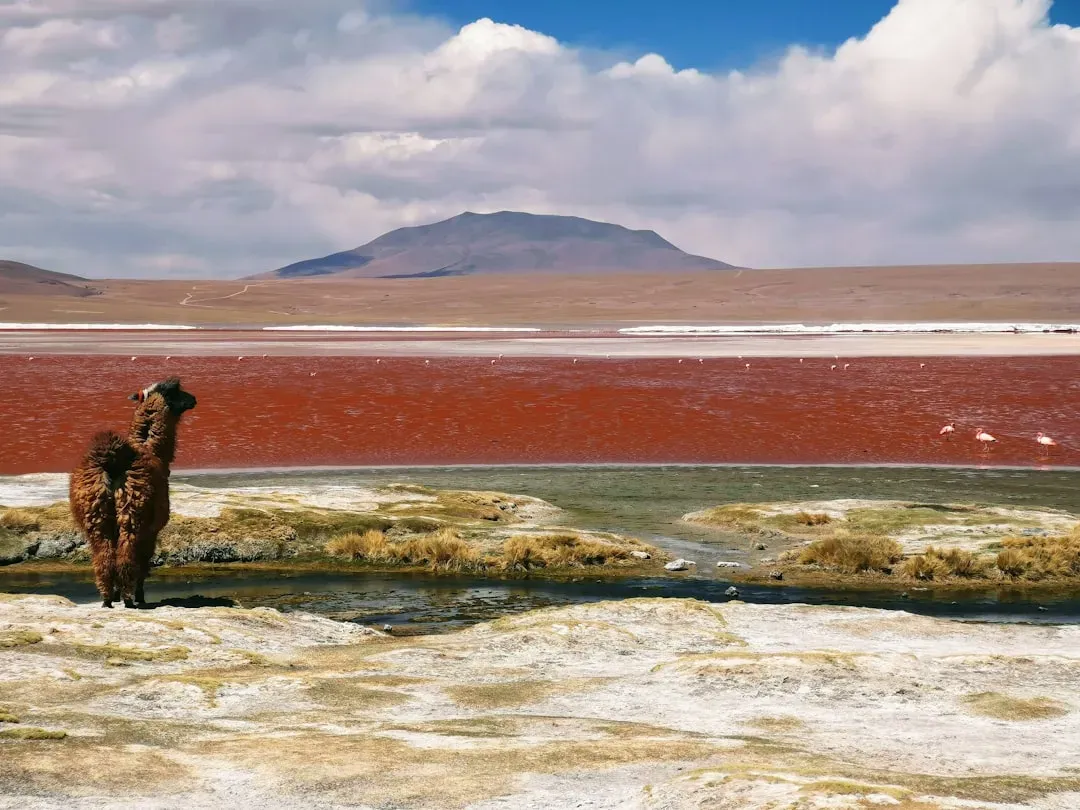
High up on the Bolivian Altiplano, you step out of a vehicle, catch your breath in the thin air, and then lose it again when you notice the lake in front of you. Laguna Colorada often looks like it has been filled with diluted brick-red paint, framed by white mineral crusts and dark volcanic peaks. This is not just scenic; it is a concentrated lesson in how extreme environments push life and minerals into bright, visible balance. When you look across the surface, you are seeing red-pigmented algae and cyanobacteria thriving in hypersaline, mineral-rich water. As sunlight, temperature, and wind shift, these microbes adjust how much pigment they produce, which means the intensity of the red can subtly change through the day or across seasons. Mineral sediments and dissolved salts, including borax and other compounds, add white and pale tones along the shore, setting up sharp color contrasts that make the red even more striking. Flamingos feed on the very microorganisms that tint the lake, turning the entire scene into a feedback loop where life colors the water, and the water feeds life that carries those colors into its own feathers.
Lake Natron, Tanzania – Where Chemistry Turns Water into a Warning Light
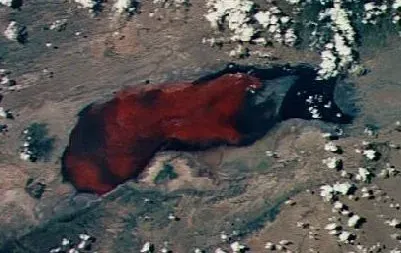
When you see satellite images of Lake Natron, it almost looks like someone spilled rust and lipstick across northeast Tanzania. Up close, the lake can range from orange to deep crimson, broken by geometric salt flats and shallow pools. The atmosphere here is intense: hot air, a harsh soda smell, and a shimmering surface that feels more like a chemical plant than a typical lakeside retreat. If color could shout at you, this lake would be yelling. The secret is in the lake’s extreme alkalinity and salinity. Volcanic ash and mineral-rich inflows load Natron with sodium carbonate and other salts, creating a caustic soda lake where only specialized life survives. As water evaporates, salinity skyrockets and communities of salt-loving cyanobacteria bloom, producing pigments that shift the water toward red and orange. At the same time, evaporating brines crystallize into white and gray salt crusts that frame these colors. You may have seen dramatic photos of calcified birds along the shore, which highlight just how unforgiving this chemistry can be for most animals. Yet, within that harshness, millions of tiny microbes quietly paint the lake every dry season.
Spotted Lake, Canada – A Mineral Mosaic That Appears Every Summer
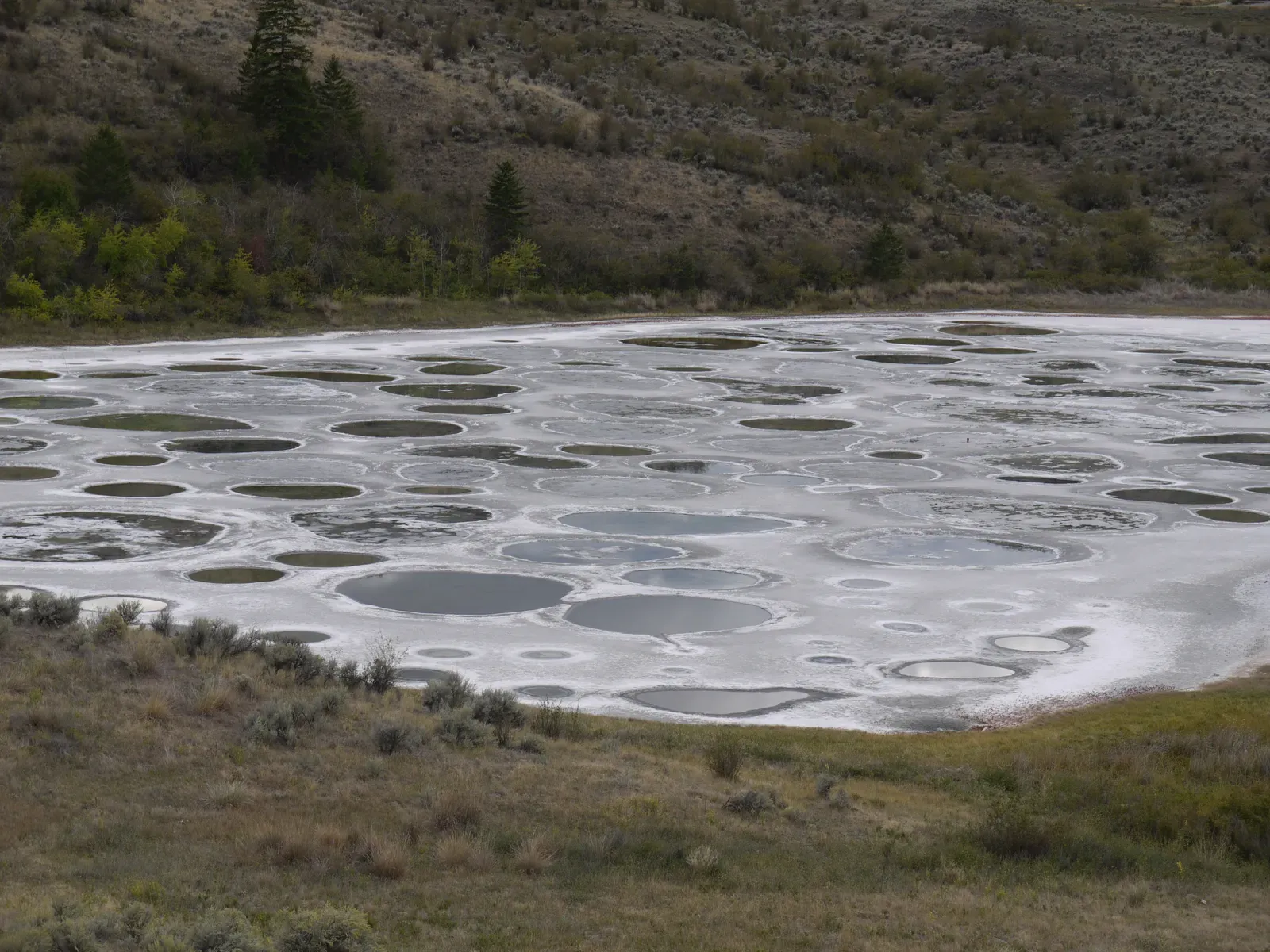
Imagine driving through British Columbia and suddenly spotting what looks like a giant painter’s palette lying in the valley. In summer, Spotted Lake near Osoyoos shrinks and transforms into a field of circular pools, each one a different shade of yellow, green, white, or blue. From a distance, it feels unreal, as if a digital artist edited the landscape without telling nature. You are literally watching a lake turn into a patchwork diagram of its own chemistry. This lake is so rich in minerals – magnesium sulfate, calcium, sodium salts, and others – that as water evaporates in the heat, separate pools concentrate different mixes of dissolved solids. Those variations control which minerals crystallize or remain in solution, and that in turn sets the color of each “spot.” One pool might be milky white from dense mineral crust, another vivid green from the way dissolved salts interact with light, and another pale yellow as certain compounds dominate. Season after season, the pattern changes as rainfall, temperature, and evaporation fight it out. When you walk the edge (respectfully, since it is also a culturally important site), you are looking at a living infographic, drawn not with ink but with ions.
Mono Lake, USA – An Alkaline Microbe Factory with Shifting Hues
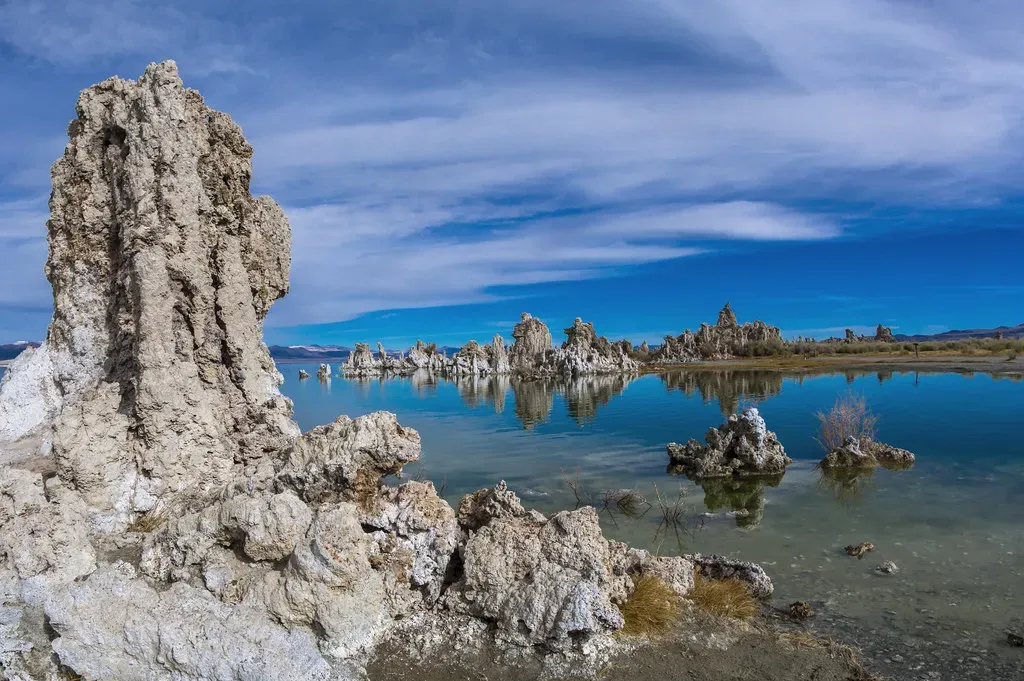
At first glance, Mono Lake in California’s Eastern Sierra grabs your attention with its strange limestone towers, the tufa spires that jut out of the water like some eroded alien city. Then, as light changes across the day and seasons, you start to notice the water itself: sometimes steel blue, sometimes a more opaque greenish tone, especially during heavy algal growth. You are standing in a basin where water has no outlet, so every drop that flows in leaves its dissolved minerals behind when it evaporates. Mono Lake is highly alkaline and salty, which shapes what can live there. Dense populations of algae and photosynthetic microbes bloom when conditions are right, thickening the water with organic pigments that push its color away from clear blue. Wind-driven mixing, runoff pulses from snowmelt, and temperature changes all shuffle nutrients and light through the lake, so you get different colors at different times and places. Brine shrimp and alkali flies feed on these microbes, creating a whole food web balanced on chemistry that would kill most freshwater organisms. If you ever doubted that microbes could control an entire ecosystem’s mood and palette, this lake will change your mind.
Lonar Crater Lake, India – When a Meteorite and Microbes Team Up
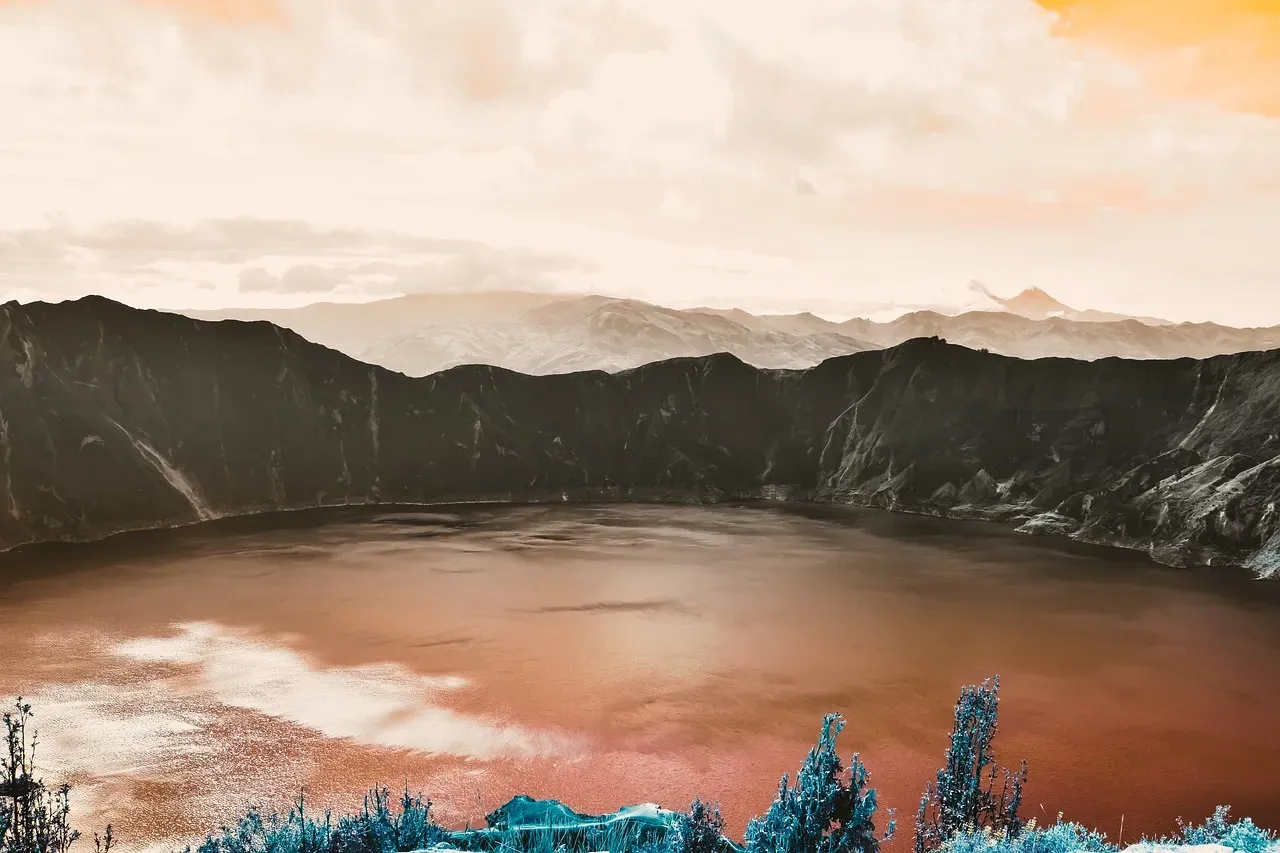
Lonar Crater Lake in Maharashtra looks like something that should be on another planet: a circular bowl formed by an ancient meteorite impact, filled with alkaline water that sometimes surprises you by turning a rosy or reddish shade. For years, the lake was better known for its unique geology and greenish water, but more recently you may have seen photos where it suddenly looked like a diluted version of a pink salt lake. That sudden shift is your reminder that chemistry and biology are never really “finished” in lakes like this. When water levels drop, salinity and alkalinity rise, giving salt-tolerant microbes a major advantage. In certain years, blooms of pigment-producing microorganisms take off, and the entire lake shifts toward pink or red tones. Changes in inflow, evaporation, and temperature can all tip the lake’s balance from a more typical greenish hue to something much more dramatic. If you visit at different times, you may catch the lake in very different moods – from a standard-looking crater lake to a softly tinted alien eye peering up from the impact basin. You are basically watching a natural experiment that began with a violent cosmic event and is still evolving through microscopic decisions.
Great Salt Lake, USA – A Giant, Living Gradient of Color
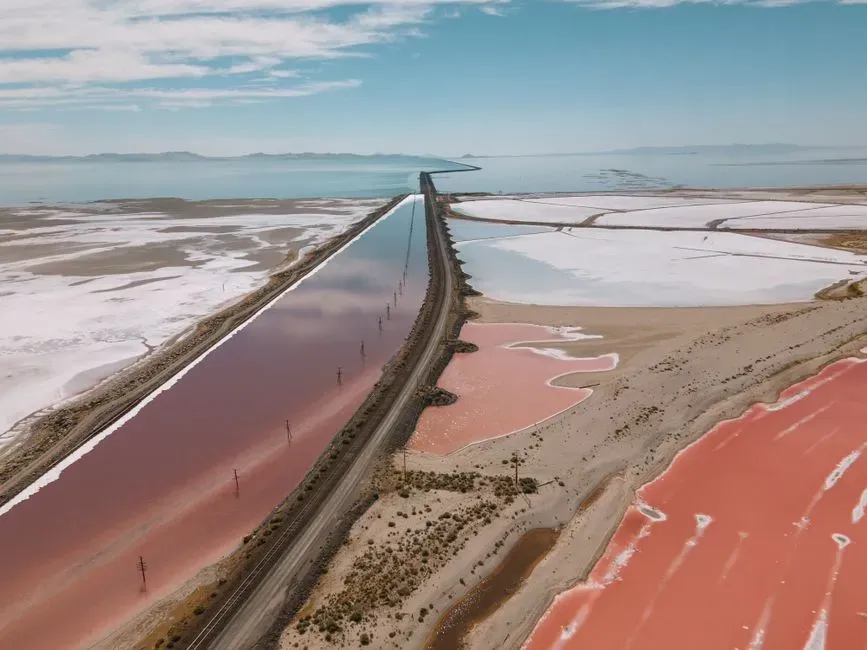
If you fly over the Great Salt Lake in Utah, you might notice something strange: one part of the lake looks deep blue-green, another part is startlingly pink or red, almost like a dye spill. That sharp line is not a camera trick; it often follows human-made causeways that split the lake into sections with very different salinity. From your viewpoint, you are seeing one of the clearest examples of how salt concentration and microbes hook up to repaint an entire landscape. As water becomes saltier, especially in isolated arms of the lake, salt-loving microorganisms such as certain algae and halophilic bacteria dominate. They produce red and orange pigments that protect them from intense sunlight and salt stress, turning the brine itself into colored liquid. Where the water is less salty, different algae and plankton communities keep the color closer to blue-green. Seasonal inflows from rivers, multi-year droughts, and evaporation patterns all shift these boundaries, so the exact hues and locations change over time. When you stand on the shore or look out from a plane window, you are not just seeing pretty colors; you are seeing invisible salt gradients made visible by armies of microscopic painters.
Conclusion – What These Lakes Quietly Teach You About Water and Life
As you move from a neon-pink Australian island to a red Bolivian plateau, from a spotted Canadian basin to a salty Utah giant, you start to see a pattern. Water does not just sit there waiting to reflect the sky; it negotiates constantly with microbes, minerals, and climate. When salinity spikes, pigments bloom. When minerals crystallize, surfaces rearrange into patterns you can see from miles away. Every unusual color is a signal that chemistry and biology have pushed each other into some extreme but surprisingly stable alliance. If you ever get the chance to visit one of these lakes, you will feel how strange it is to stand at the edge of something that looks so wrong and yet is completely natural. You are looking at places where life has bent the rules just enough to survive and, in the process, turned survival into spectacle. Next time you pass a “normal” blue lake, you might find yourself wondering what quiet chemistry is happening below the surface – and how close it is to tipping into something extraordinary. Which of these lakes would you be brave enough to stand beside first?