You probably grew up thinking the night sky was a mostly solved puzzle: planets, stars, galaxies, the occasional meteor, case closed. Then you start digging into modern astronomy and realize something unsettling: even with giant telescopes, space probes, and supercomputers, there are lights in the sky that still refuse to fit neatly into any box. They flicker, flash, pulse, or smear across the heavens in ways that keep professionals staring at screens at three in the morning.
In this article, you’ll walk through seven of the most intriguing and still-not-fully-explained light phenomena out there. You’ll see how far scientists have come, where they’re still stuck, and why the honest answer to “what is that?” is sometimes “we’re not totally sure yet.” Think of this as a guided tour of the places where the universe still feels wild, where your sense of mystery gets to survive high school physics and a thousand science documentaries.
1. The Bizarre Dimming of Tabby’s Star
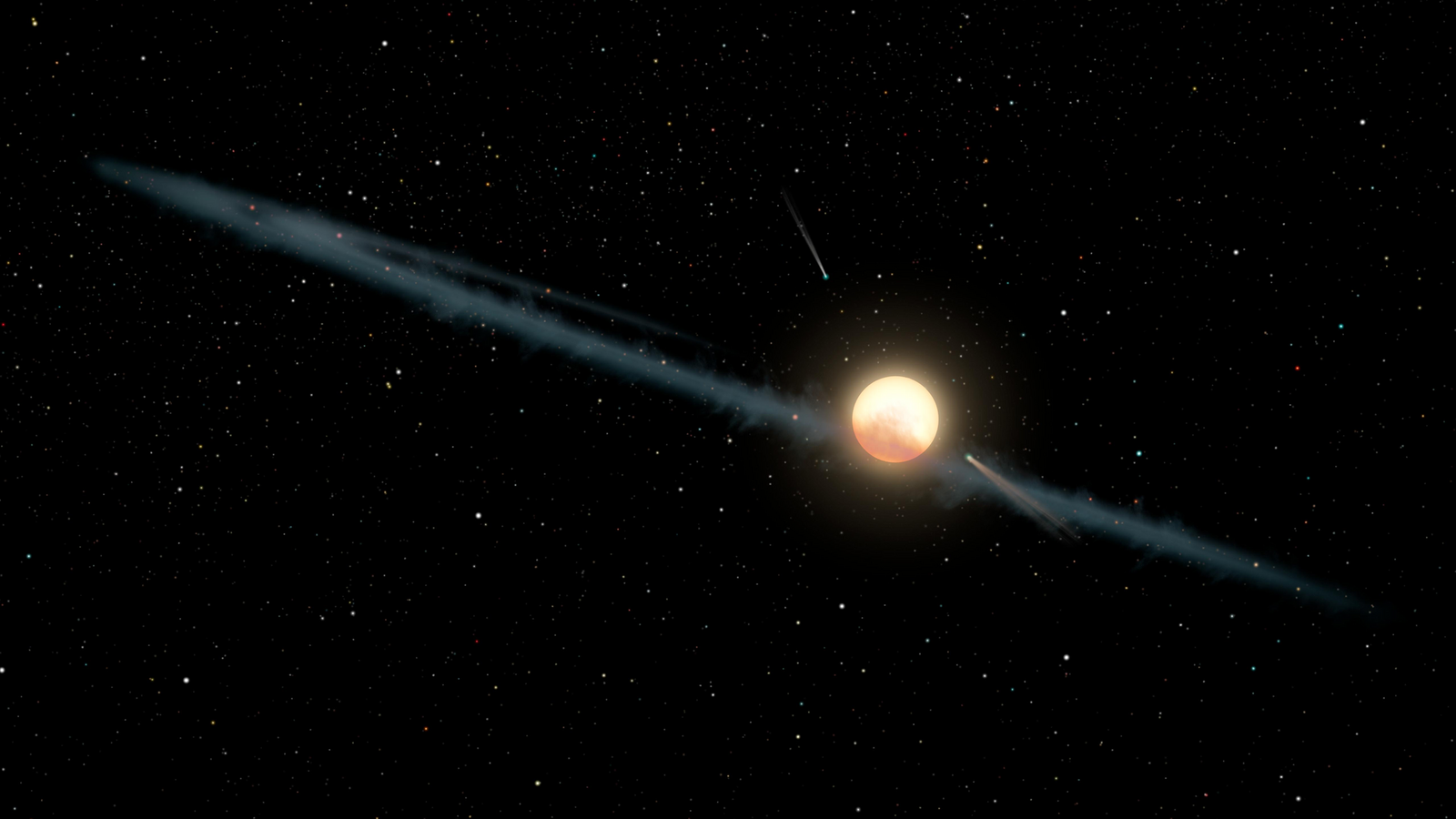
If you had to pick one star that behaves like it’s trying to gaslight you, it would be Tabby’s Star. When you look at its light curve – the graph of how bright it is over time – you don’t see the neat, regular dips you’d expect from planets passing in front. Instead, you get chaotic plunges, sometimes blocking more than a fifth of the star’s light, lasting days to weeks, with no steady rhythm you can count on. For a star that otherwise looks like a pretty normal main sequence star, that’s like watching a supposedly calm, predictable lighthouse suddenly blackout in random, dramatic fits.
You’re told now that the leading explanation involves clouds of dust with different particle sizes drifting around the star, dimming different colors of light by different amounts. That at least fits the wavelength measurements better than early, wilder ideas. But even with this dust explanation, you’re still left with a big question: why is this dust arranged so strangely, and why is it producing such complex, long-term behavior? You’re not looking at a closed case; you’re watching a crime drama where the main suspect kind of fits the evidence, but a few stubborn details keep nagging at you.
2. Fast Radio Bursts: Millisecond Flashes from Nowhere
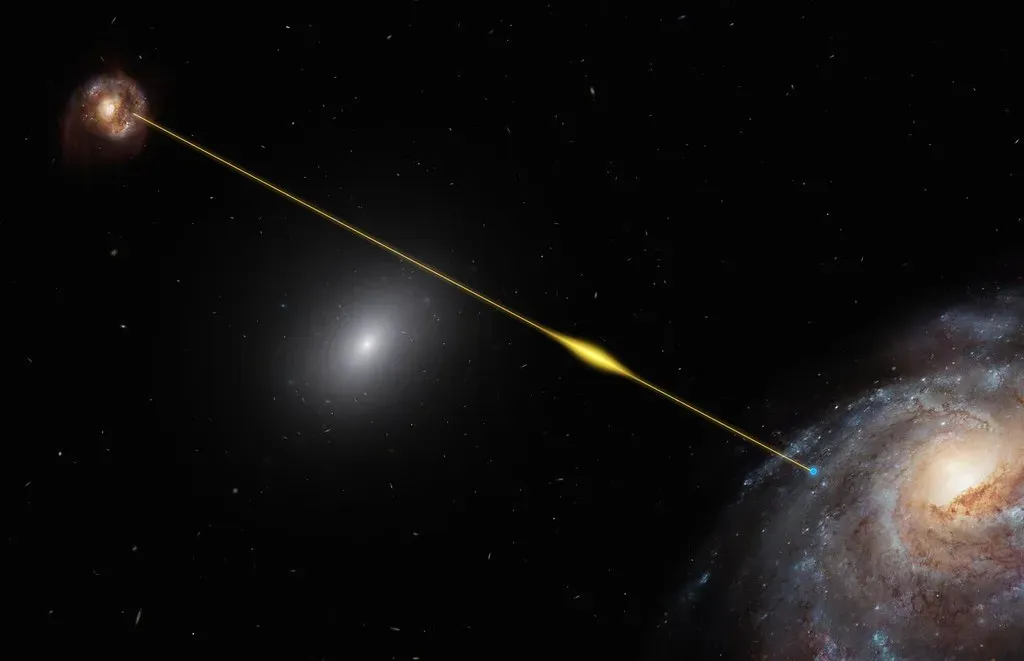
Imagine you’re listening to static on a radio tuned to deep space, and for a split second, the universe shouts at you. That’s essentially what a fast radio burst feels like: a millisecond-long spike of radio energy that briefly outshines entire galaxies at those wavelengths. You barely have time to register that the signal is there before it’s gone, often forever, leaving you scrambling through data logs trying to figure out what just happened. Some of these bursts repeat from the same spot in the sky, while others seem like one-off cosmic drive-bys.
You can read about leading theories pointing toward magnetars – ultra-magnetized neutron stars – as prime suspects, maybe cracking or flaring in violent “starquakes.” New telescopes are tracing some bursts back to the outskirts of ancient or quiet galaxies, places that don’t look like the obvious homes of young, explosive stars. That mismatch forces you to admit you probably aren’t seeing just one simple phenomenon. When you follow the science, you can say magnetars are strongly favored, but you still can’t honestly claim you know exactly what every fast radio burst is. You’re watching a mystery get narrower, not disappear.
3. STEVE: The Strange Purple Ribbon Beside the Auroras
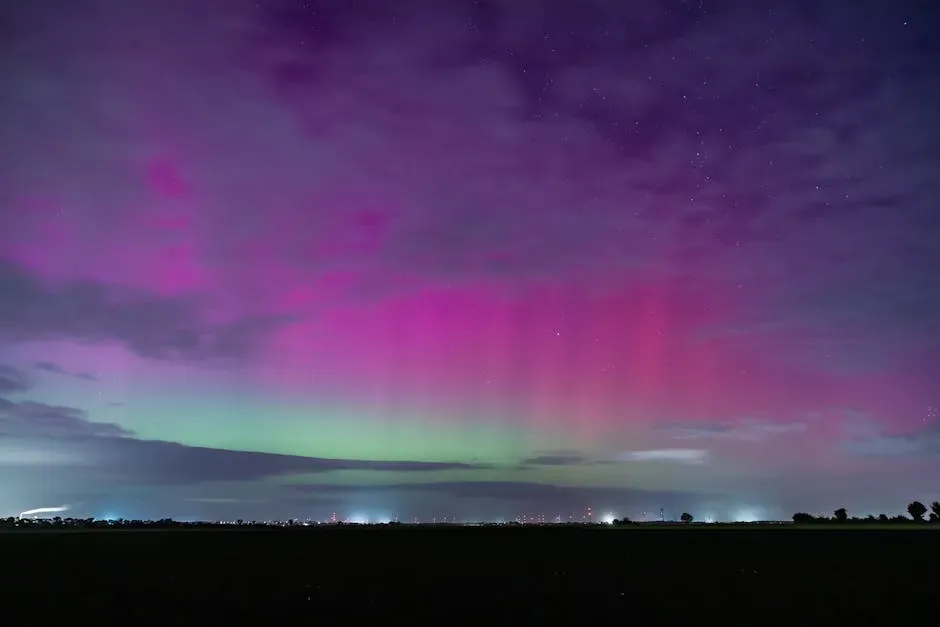
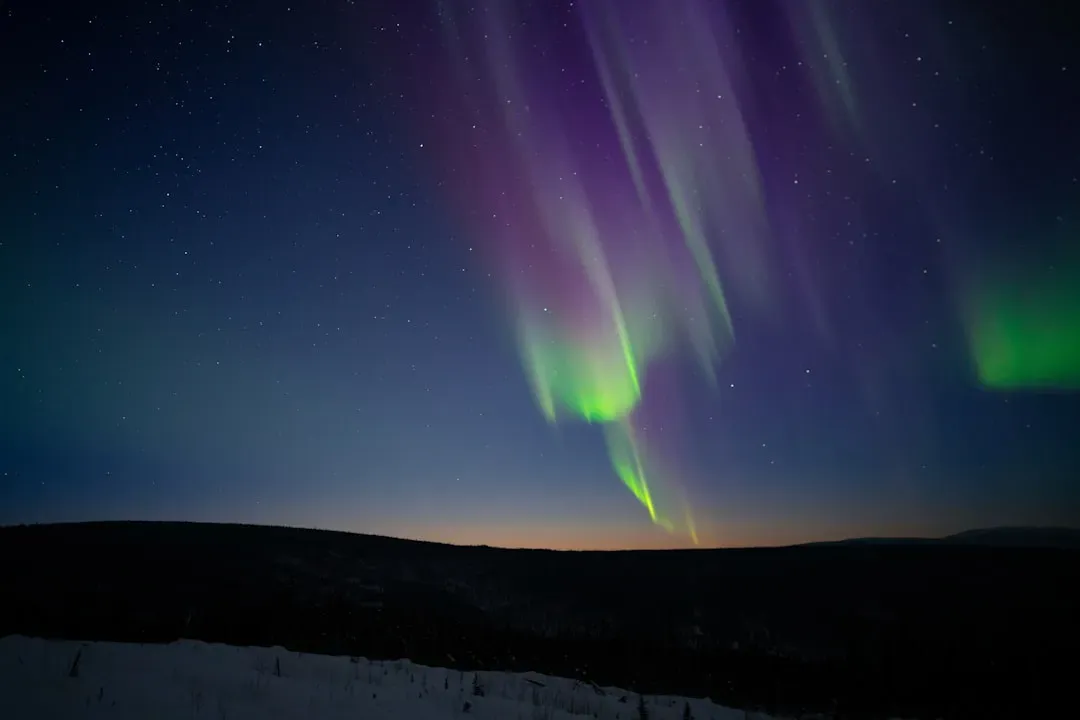
The first time you see photos of STEVE, you might assume someone went a bit too far with the saturation slider. Instead of the usual shimmering green curtains of the aurora, you get a narrow, purple-white band stretching across the sky, sometimes with a green, picket-fence pattern underneath. At a glance, it feels like a glitch – something your brain insists must be a camera artifact or a light leak. Then you find out pilots, photographers, and citizen scientists have been capturing this thing for years, and satellites have measured screaming-hot flows of plasma where it appears.
You’re told that STEVE is not a “normal” aurora, even though it often shows up nearby. It seems to be tied to intense electric fields and rapid flows of charged particles in the upper atmosphere, and you can read about temperatures of thousands of degrees and plasma racing along at kilometers per second. Yet, you still do not have a clean, textbook-ready mechanism that explains why STEVE takes this distinct shape and color, or why it sometimes appears without strong traditional aurora. You’re left with an oddly personal feeling: if you went to a dark, high-latitude sky and watched for hours, you might literally see an atmospheric phenomenon that scientists are still in the middle of figuring out.
4. Transient Luminous Events: Sprites, Elves, and Blue Jets
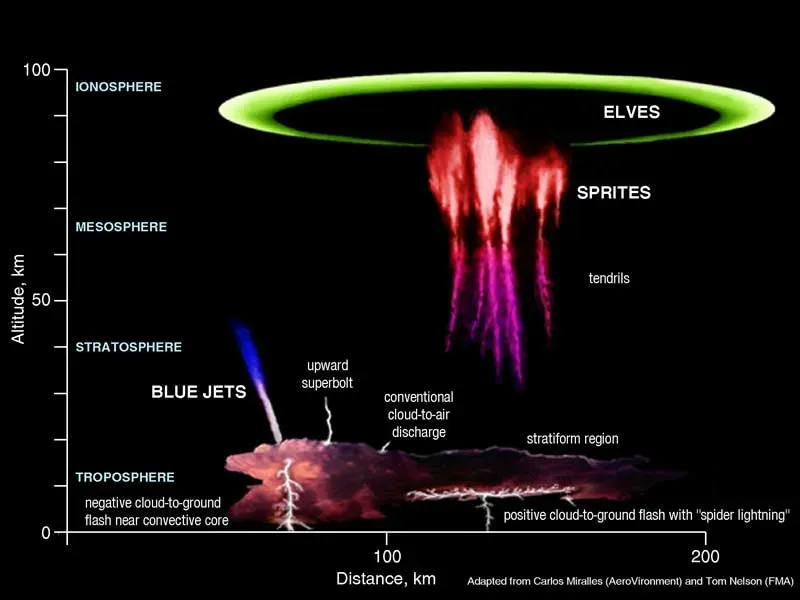
You grow up with a simple picture of lightning: bolts that blast from clouds to ground or from cloud to cloud. Then you learn that high above thunderstorms, in the thin, cold upper atmosphere, there’s a secret lightning zoo that your eyes almost never glimpse. Sprites bloom like red jellyfish tens of miles tall, elves spread as huge expanding rings of light, and blue jets launch narrow beams upward from the tops of clouds. These are called transient luminous events, and for decades, pilots reported strange flashes above storms that many people just shrugged off as exaggerations.
Now that fast cameras and satellites have confirmed these events in detail, you can finally see them yourself in photos and videos. You’re told that they’re triggered by powerful lightning strokes below, discharging electric fields into the upper atmosphere in ways that excite different gases and create those eerie shapes. But you still run into open questions: exactly how do these events shape the chemistry of the high atmosphere, how frequently do they really occur, and do they vary significantly from planet to planet? You’re forced to admit that even the lightning on your own world still has corners that feel more like science fiction than settled science.
5. Spooky Transient Objects: Lights That Appear and Vanish

If you stare long enough at the sky with powerful telescopes, you start seeing lights that don’t stay put long enough to be comfortably cataloged. These are optical transients: objects that brighten suddenly, fade, and sometimes never return in the same way again. You know about well-behaved examples like supernovas, but there’s a more puzzling category of short, faint, or oddly shaped flashes that show up in old photographic plates or modern sky surveys and then stubbornly refuse to match any neat pattern. In some studies, a few objects even appear and later seem completely absent in follow-up observations, leaving astronomers wondering if they’re dealing with extreme variability, rare explosions, or even errors they still don’t fully understand.
When you follow this topic, you notice that astronomers are careful with their language. No one reputable jumps straight to exotic explanations; instead, they talk about possibilities like flaring stars, unusual stellar deaths, or instrument artifacts. But when a transient shows up that doesn’t match typical supernova behavior or known flare stars, you can feel the genuine curiosity. You’re reminded that sky surveys are like time-lapse security cameras for the universe, and every once in a while, the footage contains a shadow you can’t yet identify. You’re watching a field where better instruments and machine learning are constantly turning up things that force you to rethink what “normal” behavior in the cosmos really looks like.
6. The Green and Red Glows of Airglow
On a perfectly dark, moonless night far from towns and cities, you might notice something subtle: the sky itself has a faint greenish or reddish sheen, even when no aurora is active. That’s airglow – a permanent, gentle shining of the upper atmosphere caused by atoms and molecules releasing energy they picked up from sunlight and chemical reactions. To your camera, with a long exposure, this can look like ghostly bands or ripples stretched across the sky, almost like a phantom aurora quietly painted over the stars.
Scientists can explain the broad strokes: oxygen atoms, for example, can emit that soft green light after they have been excited during the day and slowly return to a lower energy state at night. But once you start looking in detail, the story gets messier. The brightness and patterns of airglow fluctuate with solar activity, atmospheric waves, and even weather systems lower down in the atmosphere, in ways you don’t fully predict yet. You’re watching a reminder that even the “empty” sky above you is a dynamic, glowing fluid, with ripples and waves that carry information about the invisible machinery of your planet’s environment.
7. Odd Light Curves from Distant Exoplanets and Their Systems
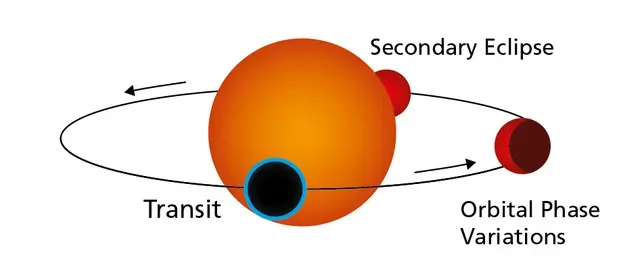
When you hear that astronomers discover exoplanets by watching stars dim slightly on a regular schedule, it sounds straightforward: planet passes in front, star gets a tiny bit fainter, repeat. But when you dig into the data, you find systems whose light curves look like they were drawn by someone with a shaky hand and a wild imagination. Some stars show dips that vary in depth and timing, hinting at swarms of dust, disintegrating worlds, or complex rings of debris. Others reveal exomoons or warped planetary rings that twist the light pattern in ways that still stretch current models.
From your perspective, you’re watching shadows of worlds and rubble flicker across faraway suns, and sometimes the pattern is too strange to fit existing categories. Astronomers propose ideas like evaporating planets shedding dusty tails, planetesimal breakups, or clumps in giant ring systems, but often they can only say what seems plausible rather than what’s definitively proven. You’re looking at flickers of light that hint at hidden architectures – shattered worlds, crowded asteroid belts, or exotic moon systems – that you can’t yet image directly. It’s like pressing your ear to a wall and trying to reconstruct an entire conversation from muffled sounds alone.
Conclusion: Living with Cosmic Mystery
When you step back from all these strange lights – the chaotic dimming of Tabby’s Star, the millisecond screams of fast radio bursts, the purple arc of STEVE, the towering sprites and elves, the vanishing transients, the ghostly airglow, and the tangled shadows of distant worlds – you start to notice a pattern. You’re not living in a universe that politely reveals itself in one clean textbook edition; you’re living in a universe that keeps tossing you puzzles faster than you can solve them. Every time new technology sharpens your vision, you don’t just get answers, you get a fresh wave of “what on Earth is that?” moments, except they usually aren’t on Earth at all.
If you’re honest, that mix of partial understanding and stubborn mystery is exactly what keeps astronomy alive for you. The lights that science cannot fully explain yet are not embarrassments; they’re invitations. They tell you that it’s still possible, even in 2026, to walk outside, look up, and be seeing phenomena that your species is only just starting to understand. So the next time you notice a strange glow, a flicker, or a ribbon of color in the sky, ask yourself: are you just witnessing a familiar process in a new light, or are you catching the first hint of the next big cosmic riddle you have not solved yet?