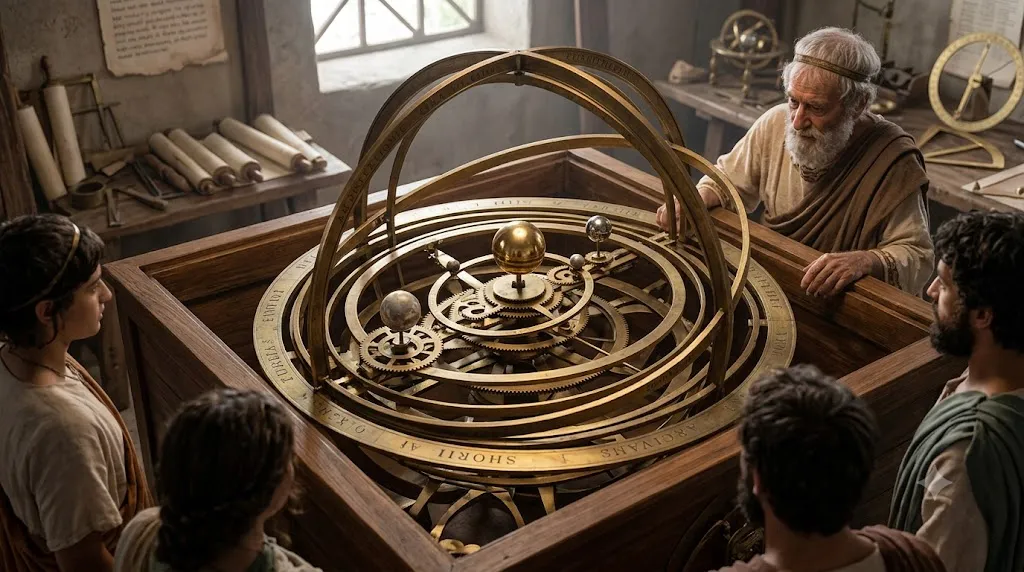
Most people assume gears are a European invention, born in medieval clock towers with monks squinting over brass wheels. Then a diver pulls a corroded green lump off the seafloor near a tiny Greek island, someone finally runs it through an X-ray scanner two thousand years later, and the whole story falls apart.
What’s hiding inside that lump isn’t a fluke or a lucky one-off. It’s the last surviving thread of an entire lost engineering culture, one that built astronomical computers, automated theaters, and navigation devices while the rest of the world was still figuring out the wheelbarrow. Here’s what the evidence actually shows, and why it should make you rethink everything you assumed about ancient “primitive” technology.
#1 – The Antikythera Mechanism’s 30-Plus Interlocking Gears
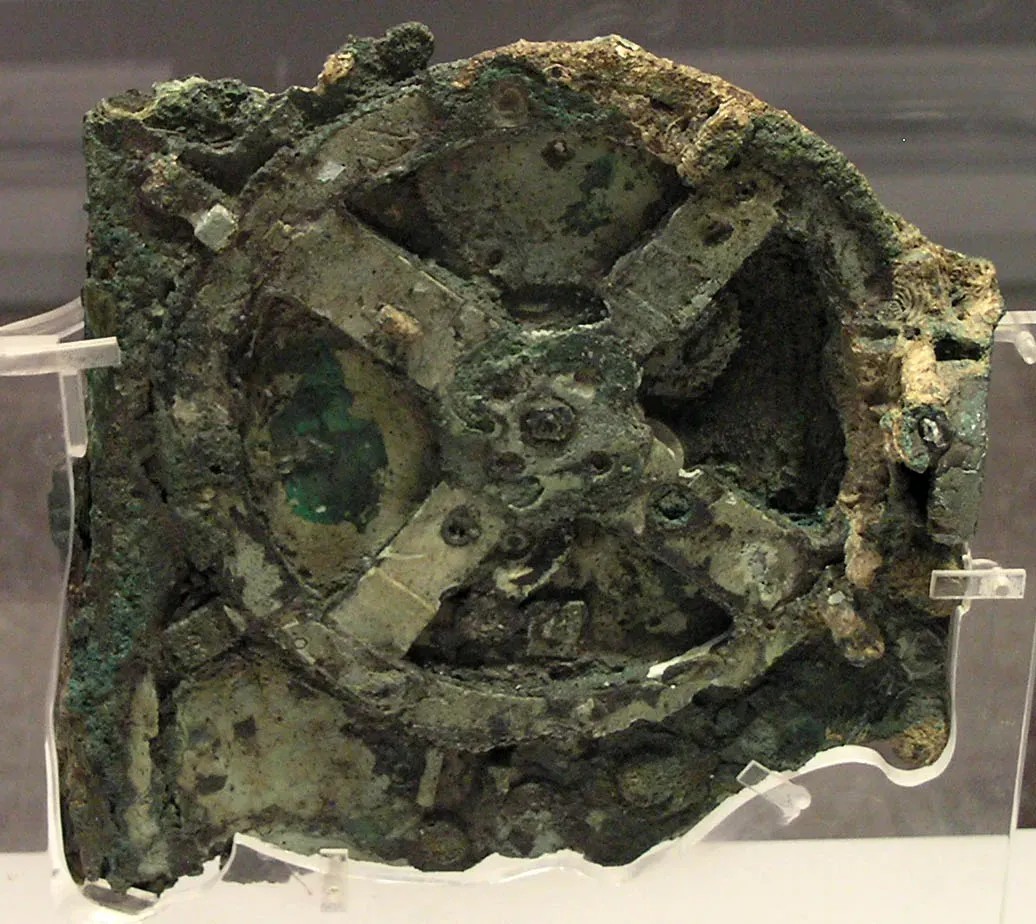
Divers found it in 1901, buried in a Roman-era shipwreck off the island of Antikythera, and for decades it sat in a museum drawer looking like a rusted-out chunk of nothing. Then X-ray tomography cracked it open without touching it, revealing at least 30 meshing bronze gears with triangular teeth cut to tolerances that rival 18th-century clockwork.
The kicker is a differential gear arrangement tucked inside the lunar mechanism, a design historians insisted wasn’t invented until the 1500s. Literary sources describe Archimedes building similar devices two full centuries before this ship ever sailed, which means the surviving example wasn’t a first attempt. It was the tail end of a tradition already refined by generations of workshops around Rhodes or Syracuse.
Fast Facts
- Found in 1901 by sponge divers off the tiny island of Antikythera, between Crete and mainland Greece
- Pulled from a Roman-era shipwreck that sank sometime between roughly 70 and 50 BC
- At least 30 bronze gears survive today, though reconstructions suggest the original held even more
- Now housed at the National Archaeological Museum in Athens
- Widely regarded as the world’s oldest known analog computer
Finding a thing like this is like finding a jet plane in the tomb of King Tut.
Derek de Solla Price
#2 – Archimedes’ Reported Planetarium
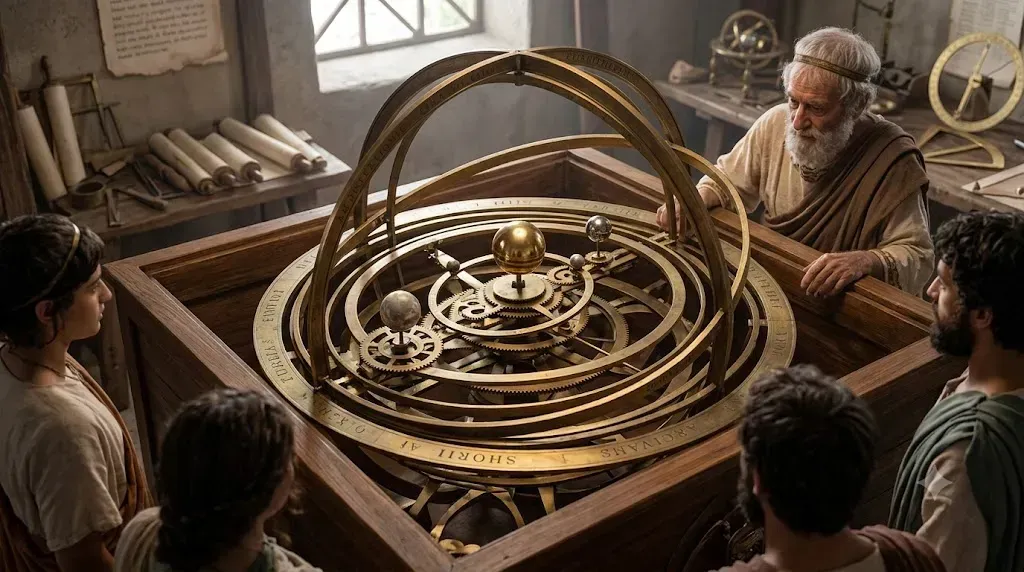
Ancient texts describe Archimedes building a geared bronze sphere that tracked the motions of the Sun, Moon, and five known planets at once. Cicero actually saw one of these devices with his own eyes, kept as a family heirloom after Rome sacked Syracuse in 212 BC and hauled the general’s spoils home.
No physical fragment of that sphere has ever turned up, but the descriptions line up almost exactly with the gear ratios later pulled from the Antikythera wreck. That match is the uncomfortable part. It means this kind of astronomical gearing was already functional and admired more than a hundred years before the only surviving copy sank to the bottom of the sea.
#3 – Ctesibius’ Rack-and-Pinion Water Clock
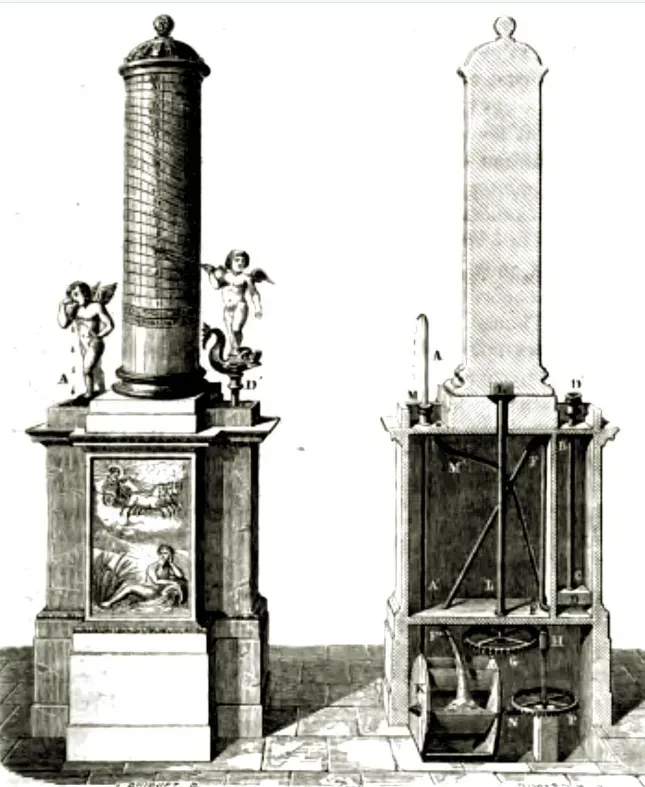
Around 270 BC, an engineer named Ctesibius in Alexandria built a water clock unlike anything before it. Vitruvius later described how it used rack-and-pinion gearing to turn the slow, steady drop of a float into smooth rotary motion driving dials and moving figures.
That’s an entire century before the Antikythera Mechanism existed, and Roman writers who mention it don’t treat it like some miraculous breakthrough. They write about it the way you’d describe a normal household appliance. Toothed gearing wasn’t a novelty anymore by this point. It was just how serious engineers solved problems.
#4 – Hero of Alexandria’s Gear-Driven Automata

Hero of Alexandria’s first-century AD writings read like a catalog of things that shouldn’t exist yet. He details automata powered by hidden gear trains, including what is essentially an ancient vending machine and elaborate self-moving theatrical scenes that performed entire mini-plays for an audience.
His technical manual, the Mechanica, works out precise gear ratios for lifting heavy loads with minimal human effort. Small bronze gears matching his descriptions have actually turned up at Mediterranean archaeological sites, so this isn’t just flattering fiction. Precision gearing had quietly become a standard engineering tool by the Roman period, even as the flashiest astronomical machines vanished from the record.
#5 – Worm-Drive Mechanisms Attributed to Archimedes
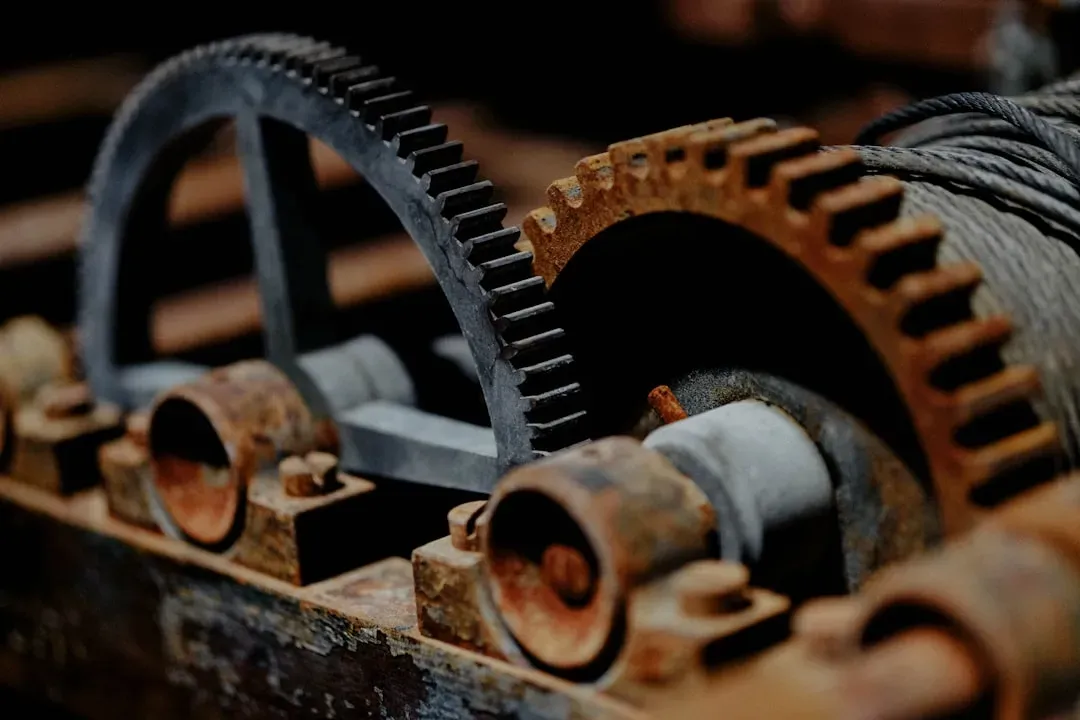
Archimedes is also credited with inventing the worm gear, somewhere around 250 BC, for use in war engines and astronomical models alike. The screw-like design packed a huge reduction ratio into a tiny footprint, which is exactly the kind of trick you need when bronze is expensive and space is tight.
Not a single physical example has survived, but the math behind it lines up with mechanisms that reappear in Byzantine and later Islamic engineering. That gap between the idea and the artifact says something painful about ancient technology in general. Bronze was too valuable to leave lying around, so brilliant machines got melted down the moment they stopped being useful.
#6 – Early Differential Gearing in the Antikythera
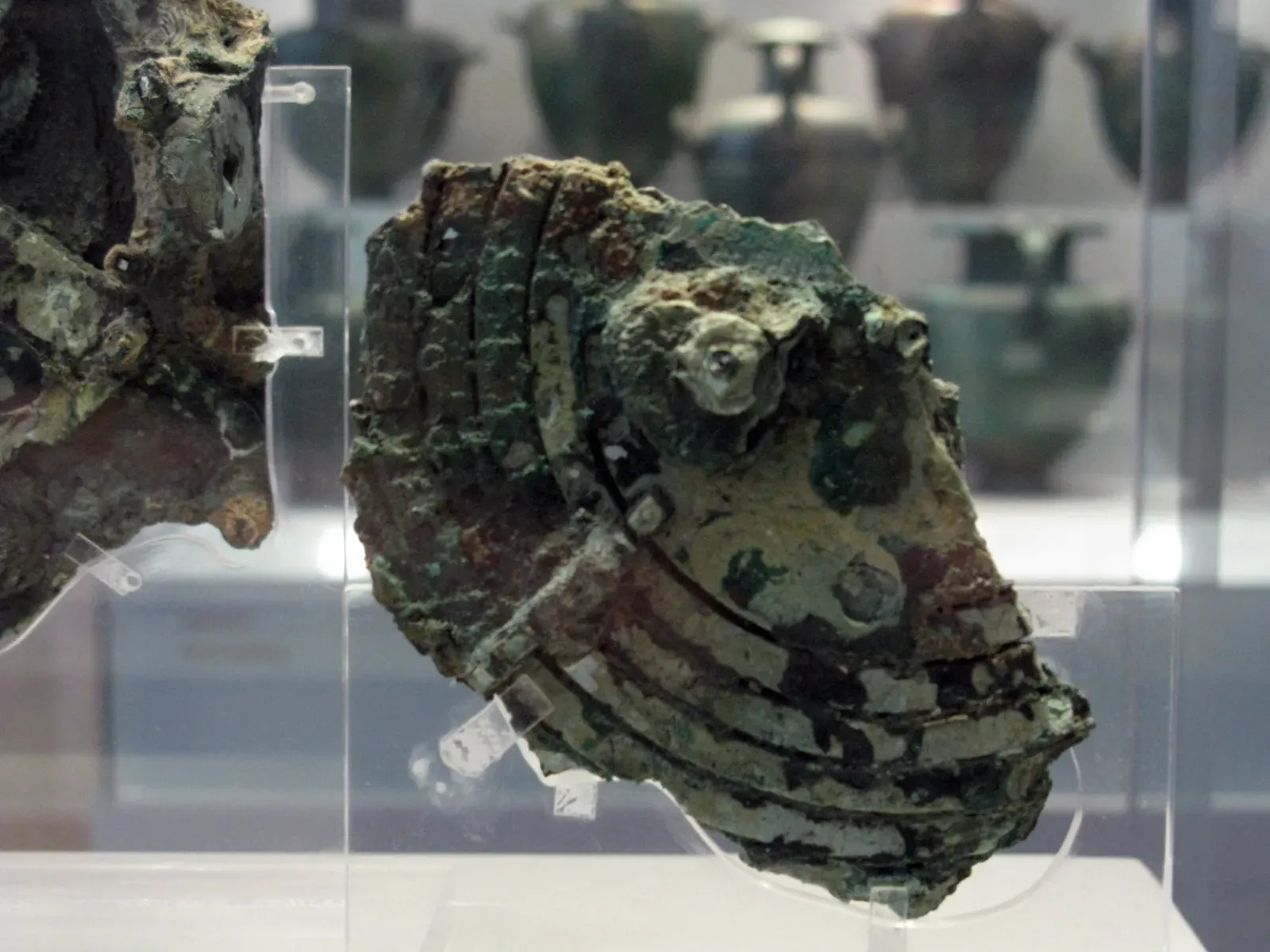
The Antikythera Mechanism’s lunar train doesn’t just track the Moon, it corrects for the Moon’s actual, irregular orbital speed using a pin-and-slot epicyclic system. That’s a mechanical solution to a problem modern engineers would normally reach for trigonometry to solve.
Modern reconstructions confirm it works, and it works well, within the observational limits the ancient Greeks actually had. This is the earliest known device anywhere in the world built to handle variable motion mechanically. Something that sophisticated doesn’t show up by accident, which means earlier, cruder versions almost certainly existed and simply corroded into nothing.
#7 – Small Bronze Gears from Chinese Tombs
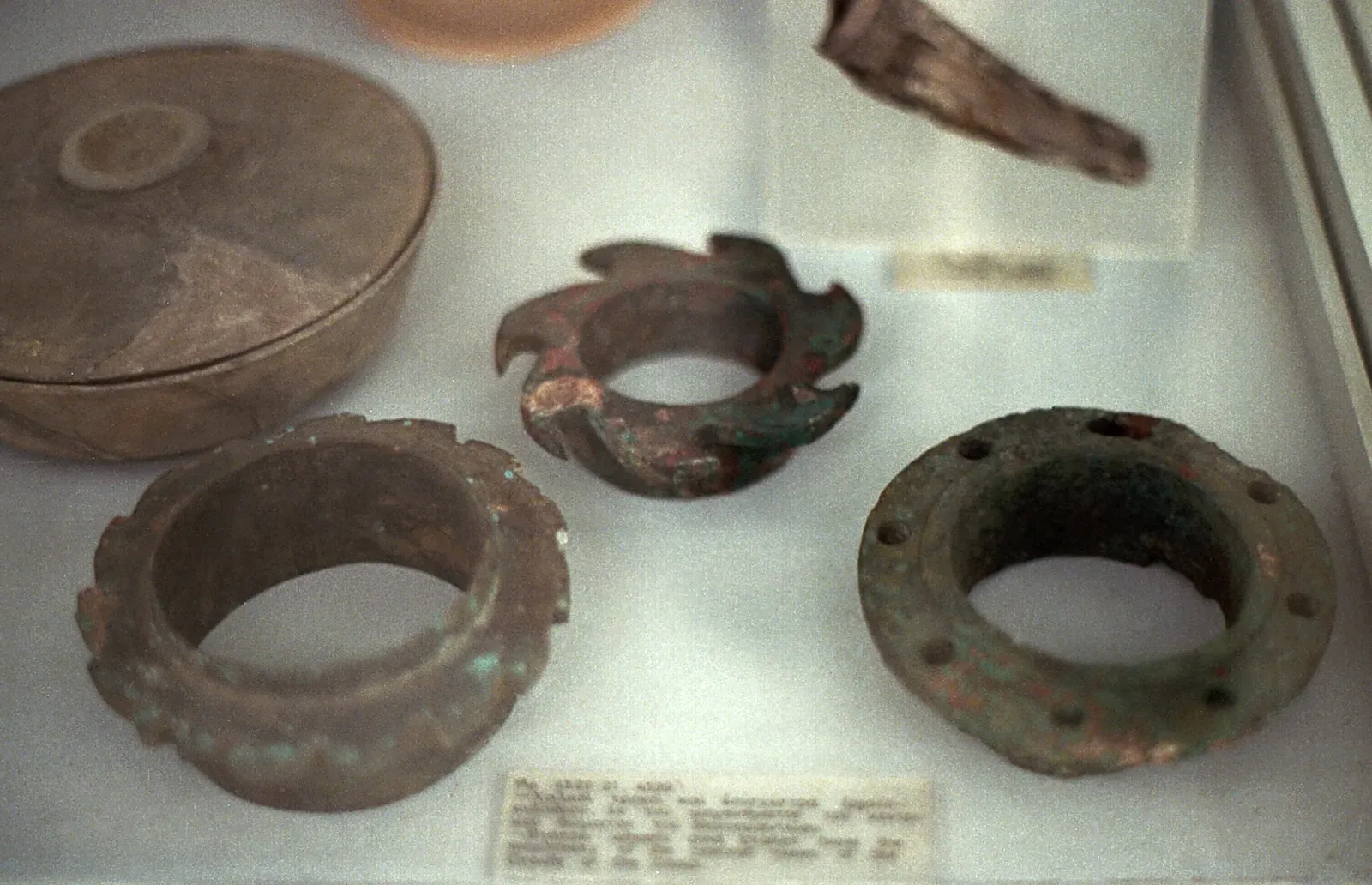
On the opposite side of Eurasia, Han-era tombs dated between 200 BC and 50 AD have produced tiny bronze gears and ratchets, some with surprisingly advanced chevron or double-helical tooth patterns. These aren’t crude scraps either.
Their small size suggests they were built for delicate instruments rather than heavy machinery, which raises an uncomfortable question historians still argue over. Did this knowledge travel along early trade routes from the Mediterranean, or did two separate civilizations independently stumble onto precision gearing at roughly the same moment in history?
Quick Compare
- Location: Mediterranean workshops in Greece vs. Han Dynasty tombs in China
- Estimated dates: roughly 150-100 BC vs. 200 BC-50 AD
- Scale: a full astronomical computer vs. small precision instruments and ratchets
- Tooth design: hand-cut triangular teeth vs. chevron and double-helical patterns
#8 – The South-Pointing Chariot’s Differential
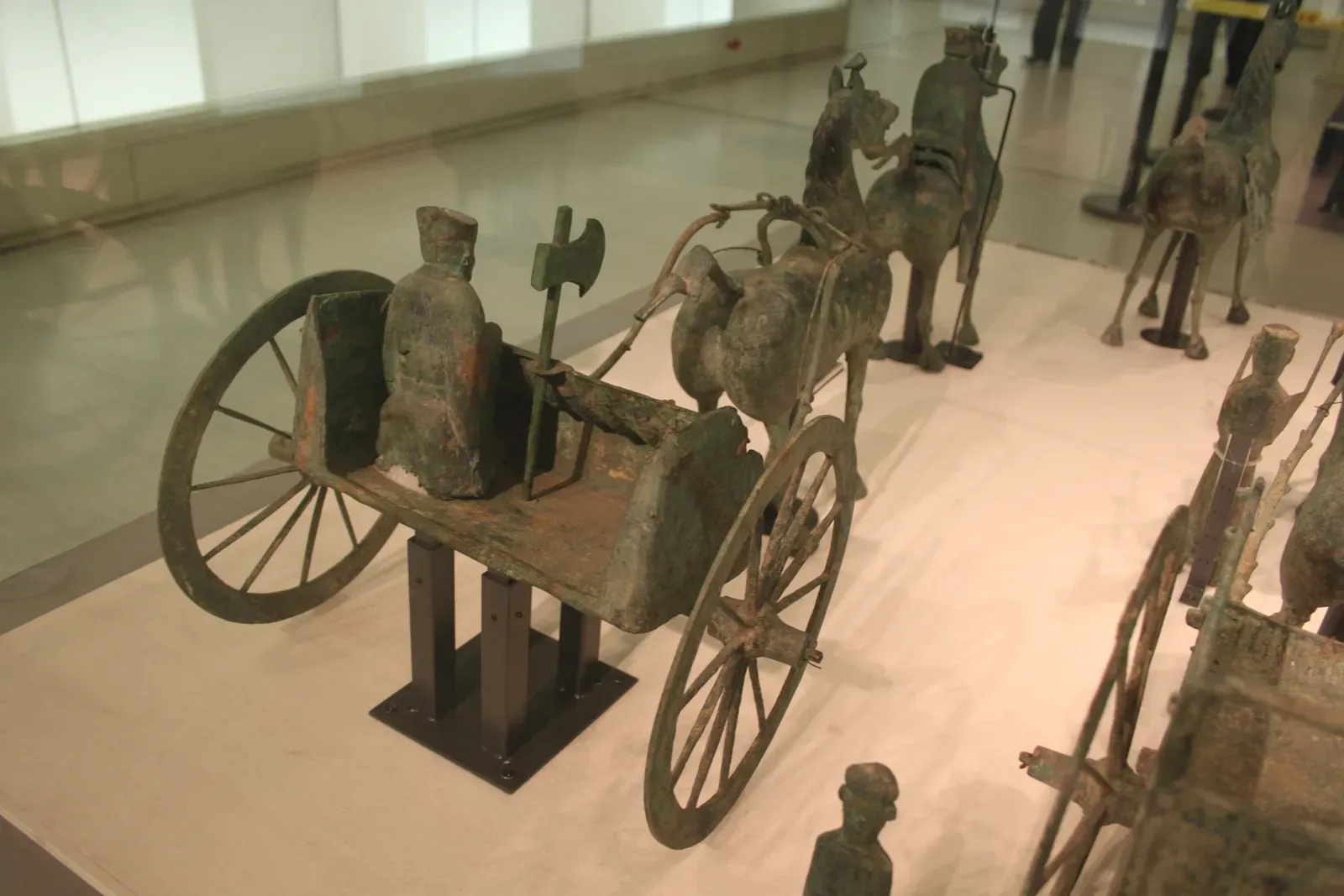
Chinese records describe a south-pointing chariot that used a geared differential system to keep a mounted figure’s arm pointed south no matter how sharply the cart turned. Some attributions push the concept back into the first millennium BC, though the physical evidence we actually have is later.
Later reconstructions confirm the principle genuinely works using bronze components similar to what turns up in Mediterranean finds. This was practical, load-bearing engineering built for navigation, not decoration. Whether it grew independently or borrowed ideas from further west is still an open, and honestly kind of thrilling, historical argument.
#9 – Literary Mentions of Multiple Planetaria
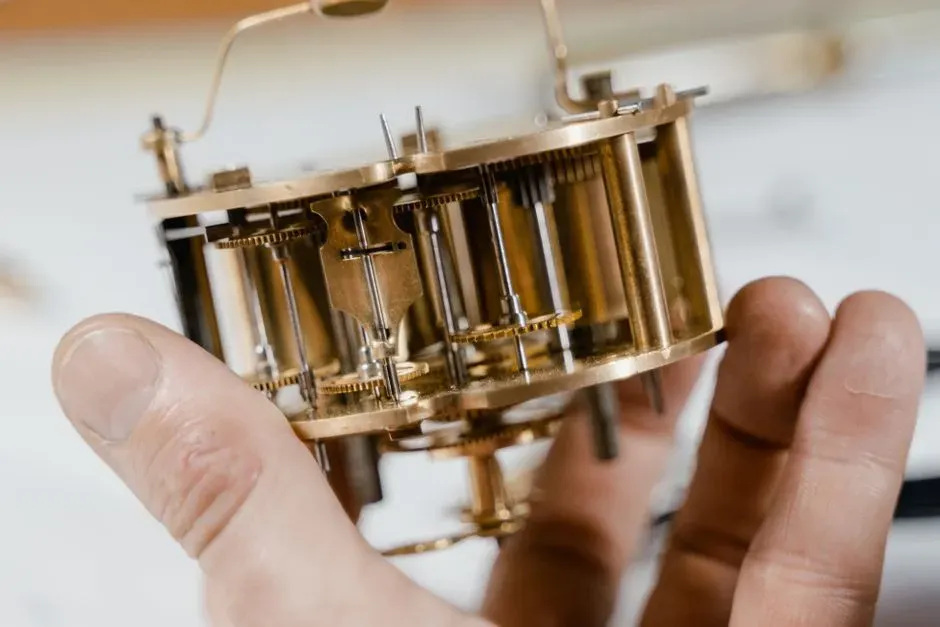
Classical authors don’t just mention one impressive geared planetarium. They reference several, owned by wealthy Romans and Greeks who used them for teaching and public display rather than treating them as party tricks.
That repetition matters. It points to a small but genuinely active production tradition, not one isolated genius who got lucky once. Most of those machines almost certainly ended up melted down for their metal once the novelty wore off, which is exactly why the Antikythera wreck is the only physical trace left of what was probably a whole minor industry.
#10 – Byzantine Geared Calendar Fragments
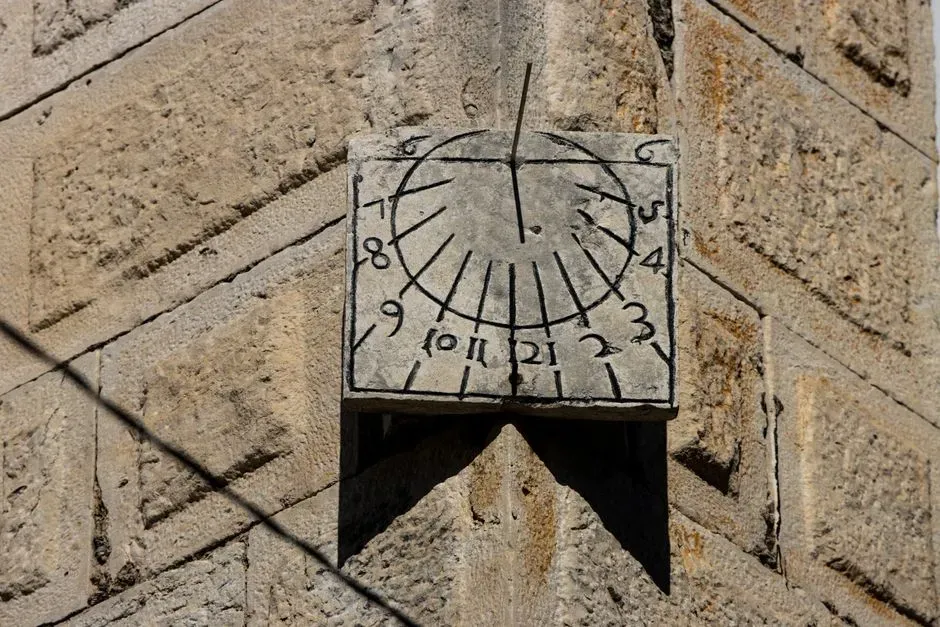
A sixth-century AD Byzantine sundial-calendar survives with four gears modeling solar and lunar positions, and it’s the next clearest physical evidence of this tradition after the Antikythera itself. There’s a real, tangible gap of centuries between the two objects.
What’s telling is how much simpler the Byzantine device is compared to its Hellenistic ancestor. The knowledge clearly survived the fall of the classical world, but it survived in a diminished, stripped-down form. Nothing else this sophisticated shows up again for a long stretch of the early medieval period.
At a Glance
- Dated to the late 5th or first half of the 6th century AD
- Only four fragments survive: a sundial plate, a suspension arm, a Moon disc with gear, and an arbor with a ratchet and two gear wheels
- Could display the time in 16 different cities, from Constantinople to Rome
- Ranked as the second-oldest known geared mechanical device after the Antikythera Mechanism
- Now on display at the Science Museum in London
#11 – Islamic Astrolabe Calendar Drives

Early Islamic astrolabes carry geared calendar mechanisms that trace directly back to Greek sources through careful translation work. Al-Biruni’s tenth-century writings build openly on designs that are clearly older, acknowledging the debt rather than hiding it.
The oldest complete surviving geared machine in this exact lineage dates to 1221 AD in Persia, and it’s a genuine bridge connecting the ancient and medieval mechanical worlds. This is the proof that the tradition never actually died. It migrated, got translated, and kept adapting long after Rome fell.
#12 – The Lost Hellenistic Workshop Tradition
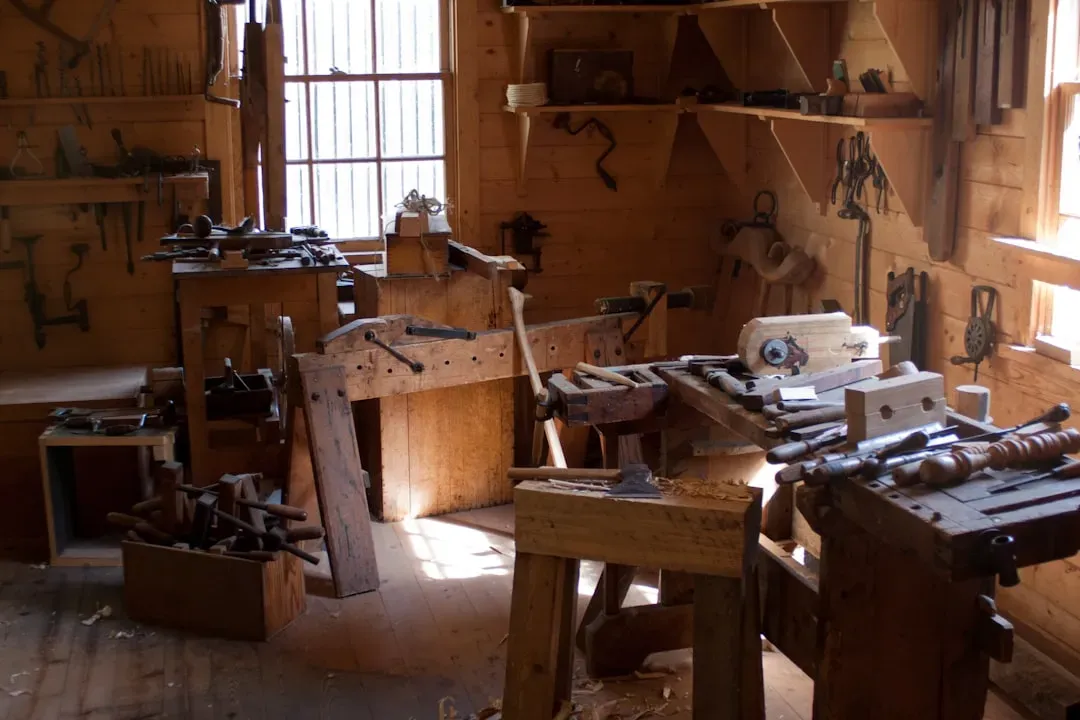
Put the archaeology and the ancient texts side by side and one conclusion becomes hard to avoid: specialized workshops were producing sophisticated geared instruments for centuries before the Antikythera ship ever left port. This wasn’t a fluke invention. It was a craft.
Most of these devices were almost certainly prestige items or teaching tools, expensive enough to matter and fragile enough to rarely survive being recycled for their bronze. The Antikythera Mechanism is simply the one that got lucky, sinking to the bottom of the sea instead of a furnace. Its rediscovery didn’t just add a footnote to history. It quietly rewrote the timeline of mechanical engineering by more than a thousand years.
Why It Stands Out
- Points to organized workshops at work, not a single lucky genius
- Explains why so few examples survive: bronze was constantly melted down and reused
- Shows the tradition spanned centuries, from Archimedes’ era through the Roman period
- Forces historians to push the timeline of precision mechanical engineering back by over a thousand years
The Bottom Line

Here’s the part that should genuinely bother you: we only know any of this because one ship sank at the wrong time and one lump of corroded bronze happened to survive two thousand years underwater. Every other geared masterpiece described by Cicero, Vitruvius, and Hero almost certainly ended up in a furnace, melted down for scrap the moment it stopped impressing dinner guests.
That’s not ancient history being generous to itself. That’s us getting extraordinarily lucky once, and then assuming luck equals rarity. The honest, uncomfortable takeaway is that the Hellenistic world was almost certainly full of machines this advanced, and we’ve simply lost nearly all of them. I’d bet money there’s at least one more Antikythera still sitting on a seafloor somewhere, waiting for the wrong storm to finally give it up.