For most of human history, matter seemed boringly predictable. Metals melted, water boiled, rocks cracked, and that was about it. Only in the last few decades have we started pushing matter into truly extreme corners of temperature, pressure, and field strength – and the universe has started to answer back with some very weird behavior.
We are now squeezing, freezing, frying, and shocking materials in ways that used to exist only in stars, neutron stars, or deep inside planets. What used to be abstract physics on a blackboard has become stuff you can actually grow in a lab, hold in a tweezers, or wire into a device. Some of these materials act like they have negative mass, some conduct electricity only at the edges, some remember where they have been stretched, and some become invisible to certain waves.
In this article, we will look at twelve of the strangest materials that only reveal their true personality under extreme – but now human-made – conditions. You will see how pushing matter to its limits is not just a party trick for physicists; it is quietly rewriting what we think is possible for electronics, energy, and even future computing.
#1: Graphene at Magic Angles – When Carbon Acts Like a Superconductor
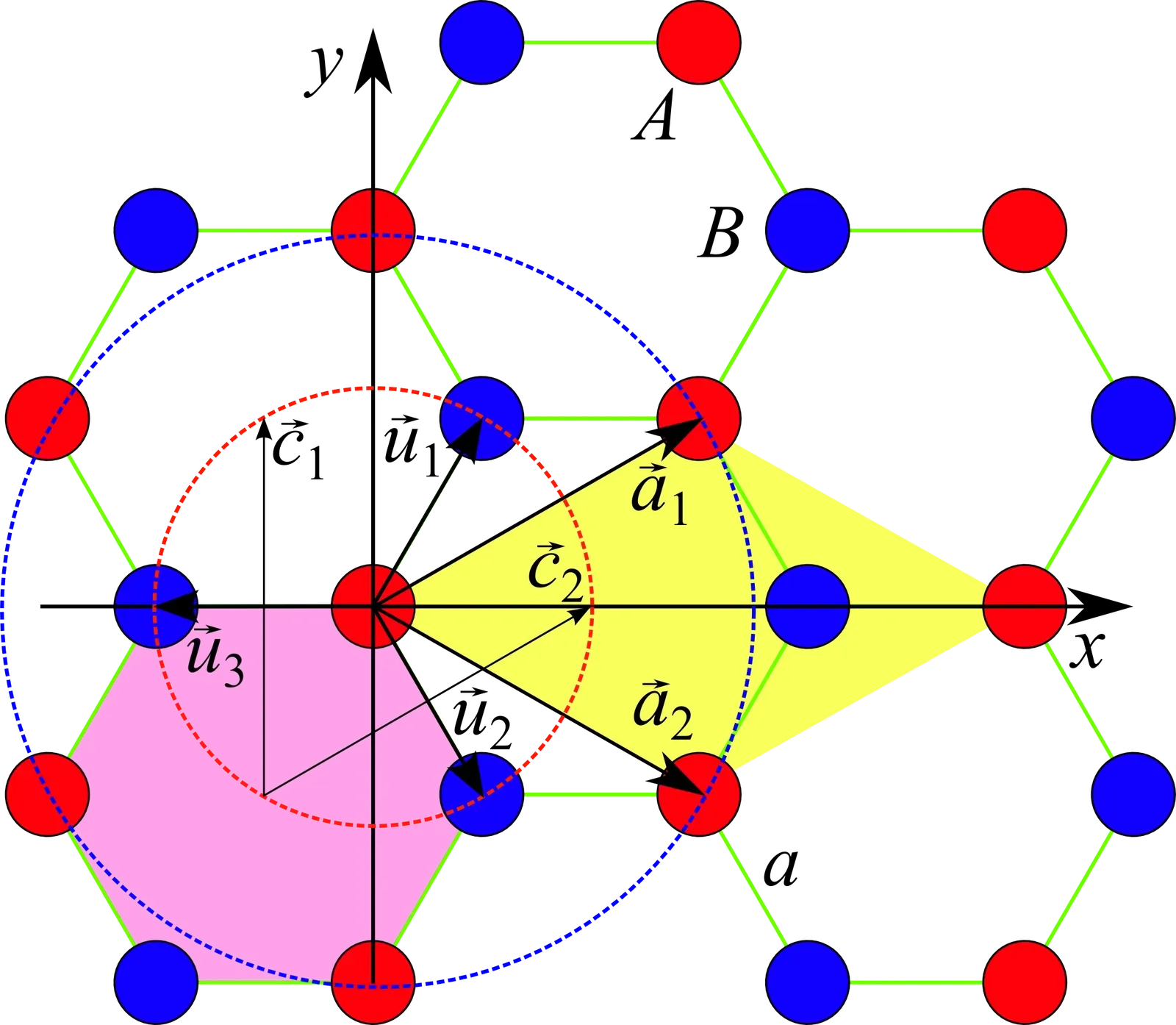
Everyone has heard the hype: graphene is a single sheet of carbon atoms, stronger than steel and a superb conductor. That is already impressive, but the truly weird behavior only shows up when researchers stack two graphene layers and twist them by a tiny “magic” angle of roughly a little more than one degree. At that precise misalignment, electrons stop behaving like simple particles and start acting like a strongly interacting fluid.
Under those conditions, and at very low temperatures, this twisted bilayer graphene can flip from being an insulator to being a superconductor, simply by changing how many electrons you pack in with an applied voltage. It is as if you could turn copper wiring into a perfect, lossless superconductor, then into a non-conducting plastic, just by sliding a dimmer switch. That tunability only shows up because the interference between the two layers creates a huge, slow “moiré” pattern that reshapes the electronic landscape.
What makes this so remarkable is that the same material – carbon atoms in hexagons – can look like a metal, an insulator, or a superconductor depending on a twist angle that we could not even control thirty years ago. Precision stacking tools, cryogenic labs, and ultra-clean fabrication now let scientists fine-tune that angle to fractions of a degree. The result is a laboratory for exploring exotic phases of matter that might one day help design higher-temperature superconductors or completely new kinds of electronic devices.
- Normal graphene: excellent conductor, but fairly conventional.
- Twisted at magic angle: correlation-driven insulating and superconducting phases.
- Key requirement: ultra-clean samples and ultra-low temperatures.
#2: Topological Insulators – Materials That Conduct Only at the Surface
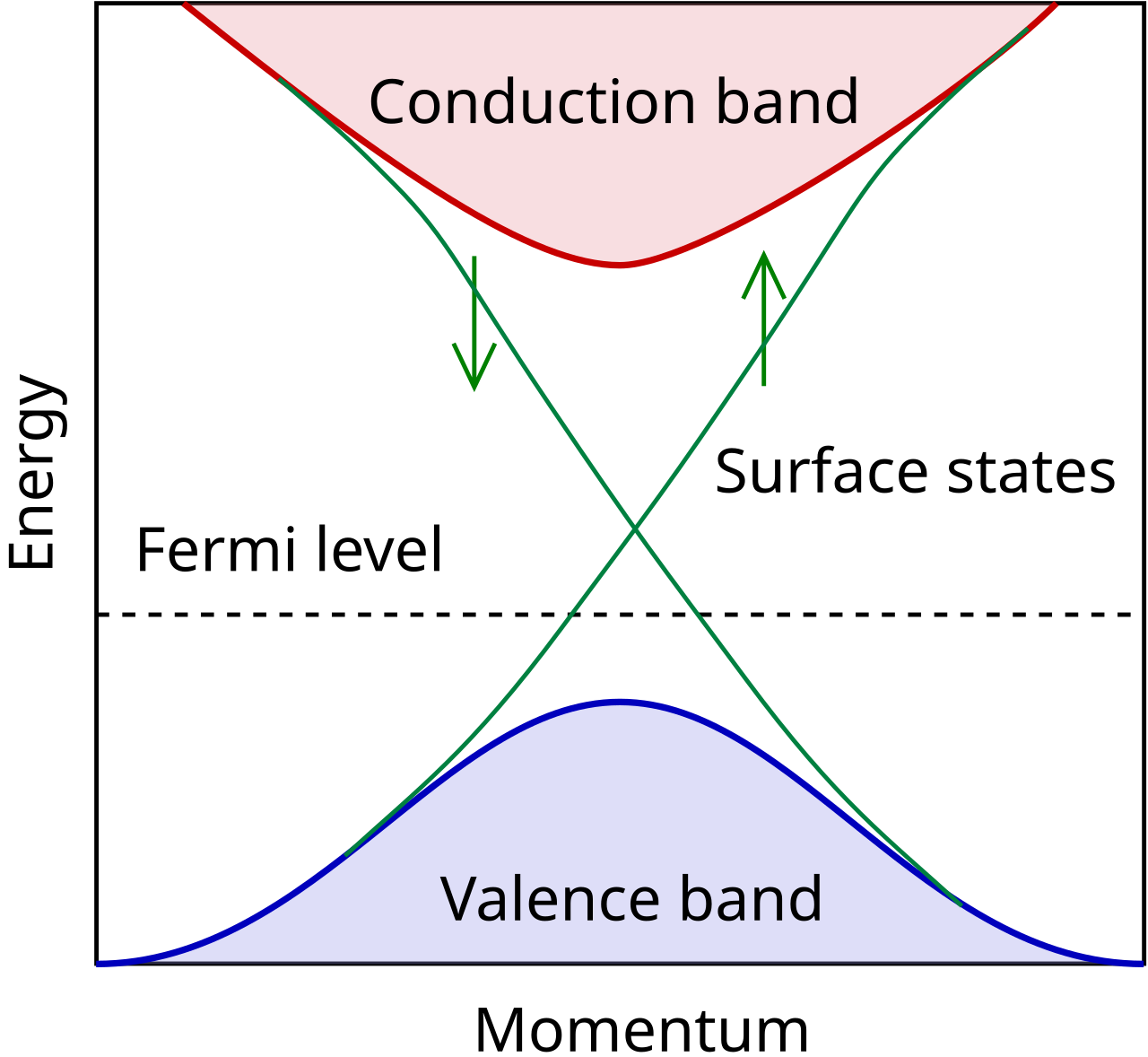
Imagine a brick that is completely insulating inside, but whose surface behaves like a sheet of metal no matter how you scratch or dent it. That is the strange world of topological insulators. In ordinary conditions they look like slightly odd semiconductors, but under carefully controlled temperatures and with high-quality crystal growth, their “topological” nature comes out: electricity can flow on their surfaces in robust, quantized ways that are strikingly hard to destroy.
This behavior is not due to chemical composition alone; it is tied to deep, abstract properties of the electrons’ wavefunctions. The interior has an energy gap like an insulator, while the surface hosts conductive states that are protected by the material’s topology and symmetry. You can rough up the surface, add some impurities, or bend the crystal, and the conducting state stubbornly persists, as long as you do not break certain symmetries too violently.
We needed precise thin-film growth, ultra-sensitive spectroscopic tools, and very low temperatures to even prove these materials behave this way. Now that we can, they are being hailed as building blocks for fault-tolerant quantum devices and spin-based electronics. You would never guess from a room-temperature chunk on a bench that, cooled and treated right, its surface electrons behave almost like massless relativistic particles skimming along the edges.
#3: High-Temperature Superconductors – Electrical Highways With No Toll Under a Narrow Window
Superconductors are already strange: below a certain critical temperature, they carry electric current with zero resistance. Traditionally, that temperature was so close to absolute zero that they seemed more like physics curiosities than practical materials. Then came the so-called high-temperature superconductors, based on copper-oxide and iron-based compounds, which suddenly started superconducting at temperatures that liquid nitrogen can reach, not just liquid helium.
Here is the catch: these same materials behave completely differently just a few tens of degrees hotter or at slightly different compositions. Above their critical temperature, many of them turn into what physicists call “strange metals” – conducting, but not following the usual rules that most metals obey. The transition from this odd metallic state to superconductivity is still one of the biggest unsolved problems in condensed matter physics.
The wild part is how picky they are. Superconductivity appears only when the material is doped to a narrow range of charge carrier density, cooled below a specific temperature, and kept under specific pressures or strain. Outside that little window, the same crystal might be an insulator or a regular metal. We now have large high-field magnets, intense pressure cells, and advanced crystal growth methods that let us map this complex phase diagram in detail, something that was just not possible a few decades ago.
- Superconducting only in a narrow band of temperature and composition.
- Above that, they often turn into “strange metals” with unusual resistance behavior.
- Modern high-pressure and high-field labs are crucial to exploring their full behavior.
#4: Metallic Hydrogen – A Possible Super-Material Born in Crushing Pressures
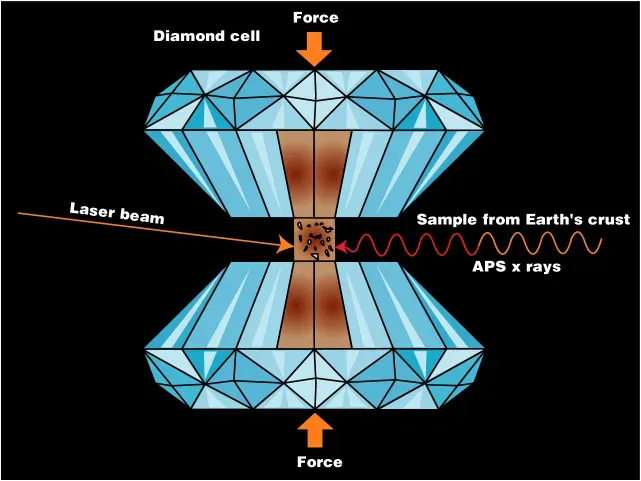
Hydrogen seems as simple as it gets: the lightest element, a gas at room temperature, burning cleanly with oxygen. But under gigantic pressures, hydrogen is predicted to turn into a metallic state, where its electrons are free to move like those in a metal. Those pressures are not just high; they are comparable to the conditions in the cores of giant planets like Jupiter, hundreds of gigapascals or more. Only in the last decade or so have diamond anvil cells and laser compression techniques reached that territory with any reliability.
There is evidence that under these crushing conditions and cryogenic temperatures, hydrogen reflects light like a metal and may even become superconducting. If metallic hydrogen could be made stable at lower pressures (which is still very uncertain), it would be an extraordinary material for high-energy-density storage or powerful superconducting magnets. For now, the metallic phase is fleeting and trapped inside microscopic high-pressure chambers.
The weird behavior is deeply tied to conditions we simply could not generate in the lab until recently. Traditional metal presses or shock experiments either failed to reach those pressures or destroyed the sample too quickly. With modern diamond anvil cells, precision laser heating, and ultra-sensitive optical probes, we can finally watch hydrogen morph from a transparent, molecular solid into a reflective, possibly metallic phase. It is like briefly holding a piece of the inside of Jupiter between two diamonds.
#5: Programmable Metamaterials – Solids That Change Reality for Waves
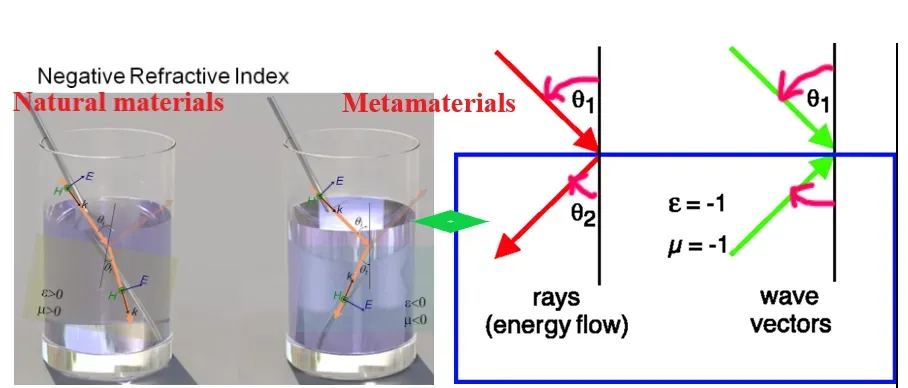
Metamaterials are not weird because of what they are made of, but because of how they are structured. At a glance they may be plastic or metal, but inside they contain repeating patterns engineered on scales smaller than the wavelength of light, sound, or other waves they are meant to manipulate. Until modern nanofabrication and 3D printing arrived, making such structures precisely enough simply was not feasible.
Under normal conditions, a block of plastic just bends light in a straightforward way. Arrange tiny resonators or holes inside it with nanometer precision, and suddenly that same block can bend microwaves backwards, focus sound around an object, or act almost like it has a negative refractive index. “Negative” here does not mean some magical new matter; it means the effective response of the material to a wave can be opposite to what you see in everyday life.
A newer twist is programmable metamaterials, where the internal pattern can be reconfigured using electric signals, mechanical strain, or embedded actuators. Under those driven conditions, a single sheet can switch from being a lens to a cloaking device, or from absorbing sound to reflecting it. Without modern computer-controlled fabrication and microcontrollers, these tunable, strange behaviors would remain in theoretical diagrams instead of real devices on lab benches.
- Behavior is dominated by internal structure, not just chemical composition.
- Can exhibit “effective” negative index or cloaking effects for certain waves.
- Programmable versions change their wave behavior on demand.
#6: Memory Metals and Shape-Memory Alloys – Solids That Remember Their Form
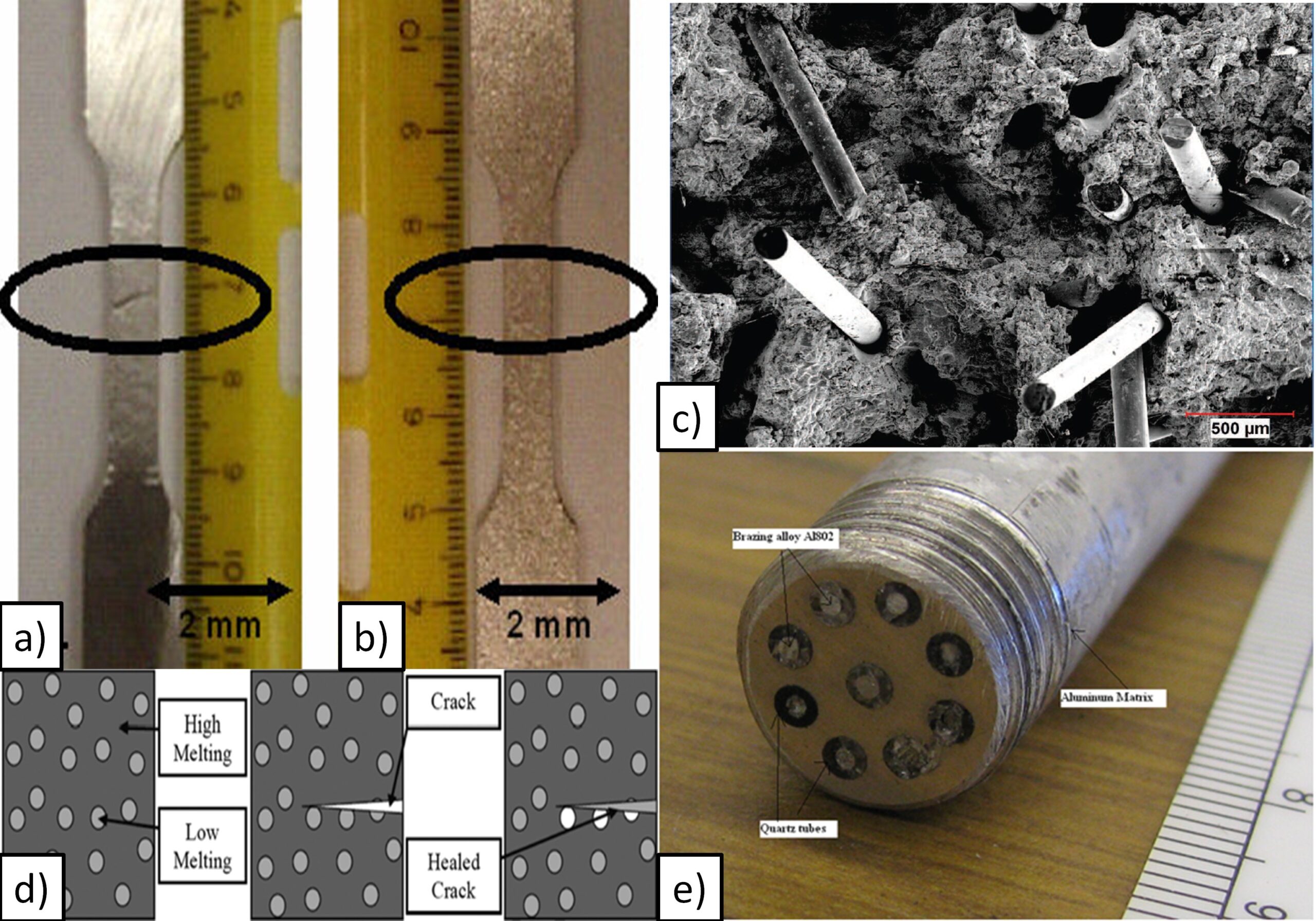
Shape-memory alloys, like certain nickel-titanium compositions, look like ordinary metals until you treat them in very specific ways. Bend a wire made of such an alloy at room temperature and it will happily deform. Then heat it above a particular transformation temperature, and it suddenly snaps back to its original shape as if it remembered how it was made. That reversible, almost biological behavior depends on subtle solid-state phase transformations that only occur within precise temperature and stress ranges.
On a microscopic level, these materials switch between different crystal structures – often called martensitic and austenitic phases – in a coordinated, reversible way. That transformation gives them their “memory” and their odd ability to undergo large strains without permanent damage. But it is quite picky: outside the right temperature window or under too much stress, they behave like normal alloys and may just deform or break.
We can now tweak the composition, grain size, and heat treatment with remarkable control, dialing in transformation temperatures tailored for medical stents, actuators, or earthquake dampers. Advanced imaging methods also let us watch the phase boundaries move inside a solid as it cycles between shapes. It makes a simple metal wire feel almost alive, but only because we have learned to hit its very specific sweet spots of temperature and load.
#7: Ultrafast Phase-Change Materials – Glasses That Flip in a Trillionth of a Second
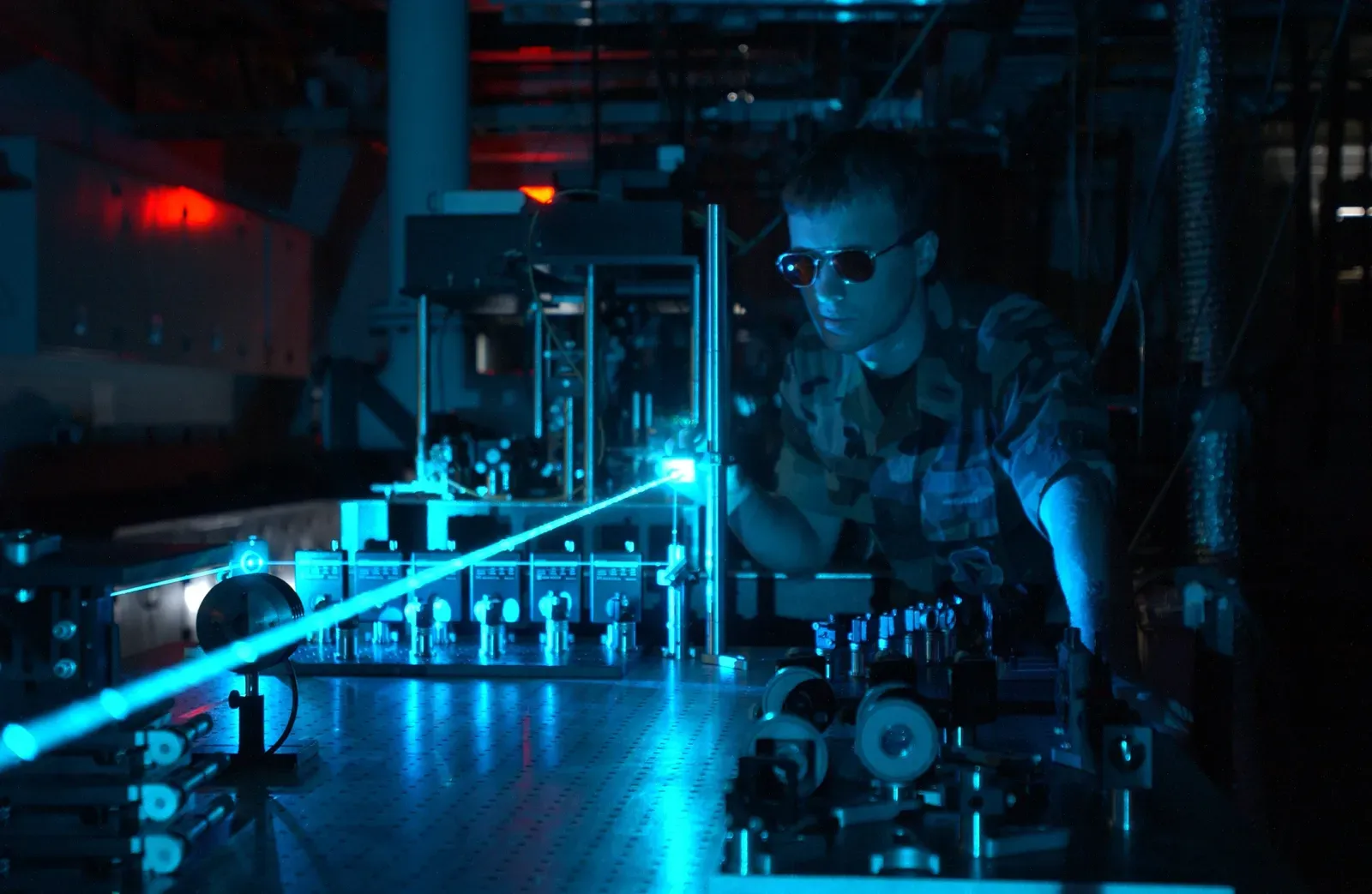
Modern data storage quietly relies on a very strange trick: certain materials can be rapidly switched between a crystalline state and an amorphous, glassy state just by pulsing them with heat or light. Phase-change materials based on germanium, antimony, and tellurium do exactly this. At room temperature, they look like fairly dull solids. Blast them with a carefully tuned laser pulse or electric current, and within nanoseconds they can melt and re-freeze or crystallize in a controlled fashion.
Their electrical resistance and optical reflectivity change dramatically between these states, which is perfect for encoding digital ones and zeros. What is surprising is how sensitively this depends on the exact pulse duration, intensity, and cooling rate. Make the pulse too long or too weak, and you get partial crystallization or slow drift. Hit the right ultrafast timescale – billionths to trillionths of a second – and these atoms reorganize in a concerted, reproducible way.
This regime was inaccessible until we had lasers and electronics capable of such fast, precise pulses. Combined with time-resolved X-ray and electron diffraction, researchers can now watch these atoms essentially rearrange in real time. To me, this is one of the clearest examples where advancing our control over time and energy scales reveals materials behavior that would have remained invisible in a slower, more old-fashioned lab.
- Switch between amorphous and crystalline states with ultrafast pulses.
- Resistance and reflectivity change by large factors between states.
- Critical behavior only appears on nanosecond and picosecond timescales.
#8: Time-Crystal Phases – Matter That “Ticks” Without Using Energy
Time crystals sound like pure science fiction: states of matter that repeat in time, like a ticking clock, without consuming energy in the usual way. In practice, the systems where we see time-crystal–like behavior are carefully driven quantum materials or arrays of interacting spins under periodic external fields. At room temperature, the same objects are just boring solids; under tuned microwave or laser driving at ultralow temperatures, they start to exhibit a kind of time-order that repeats at multiples of the driving period.
These are not crystals in real space, but in time. The pattern only emerges when the system is periodically pushed, yet its response locks into a rhythm that is different from the forcing frequency, and robust against small disturbances. It is a subtle effect that requires isolation from the environment, finely tuned interactions, and sophisticated detection techniques. You would never stumble on it by accident; it is the result of a collision between theoretical ideas and increasingly powerful experimental platforms.
What makes time crystals fascinating is not that we want to build wristwatches out of them. It is that they expand our idea of what “phases of matter” can even mean. They may find roles in quantum information processing, where robust, repeating patterns in time can help protect delicate quantum states. But they only appear thanks to a modern toolbox of ultracold atoms, ion traps, and engineered spin systems that simply did not exist for earlier generations of researchers.
#9: Extreme 2D Materials and Heterostructures – Lego Bricks for Quantum Behavior
Graphene gets most of the headlines, but the real revolution is broader: we can now peel off and stack incredibly thin layers of many different crystals like atomically thin Lego bricks. Molybdenum disulfide, hexagonal boron nitride, tungsten diselenide – each of these two-dimensional materials behaves normally in bulk, but when you isolate a monolayer and combine it with others at specific angles and strains, new physics erupts.
Under the right conditions, electrons trap themselves in moiré superlattices, excitons (bound electron–hole pairs) condense into weird correlated phases, and phenomena like valley polarization show up. These are all tied to subtle quantum degrees of freedom that only become important when the material is thin enough and clean enough. Controlled twist angles, high-quality substrates, and cryogenic temperatures are what make these fragile effects visible and reproducible.
I still remember the first time I saw scanning images of a carefully built heterostructure: it looked like a child’s stack of translucent stickers, yet its electronic transport curves showed clear signs of new quantum phases. This is where modern materials science starts to feel more like experimental architecture – we are not limited to what nature grows in geological time; we can assemble our own designer crystals and selectively activate their strange behavior with fields and cooling.
- Individual layers can be semiconducting, insulating, or metallic.
- Stacking and twisting layers creates new moiré-induced phases.
- Requires ultra-clean fabrication and cryogenic measurements.
#10: Spin-Ice and Frustrated Magnets – Solids With Magnetic Monopole Lookalikes
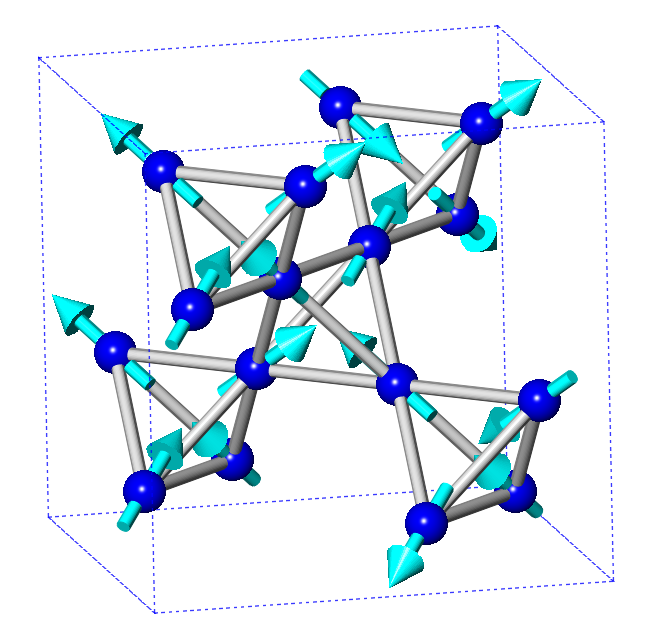
Magnetic materials might seem simple: line up spins and you get a magnet; scramble them and you get something nonmagnetic. But in certain crystals with “frustrated” geometries – where spins cannot all satisfy their preferred interactions at once – the magnetic landscape becomes bizarre. Spin-ice materials, for example, have spins arranged on a lattice reminiscent of water ice. Under low temperatures and in specific field conditions, their collective spin configurations behave as if they host emergent magnetic monopoles.
These are not true fundamental monopoles, but effective quasiparticles: defects in the pattern of spins that move through the material carrying a net magnetic charge. In everyday conditions, the same compound looks like an obscure ceramic. Only when cooled down to a few degrees above absolute zero and placed in controlled fields does this emergent “monopole gas” behavior become apparent, observable in subtle measurements of heat capacity, neutron scattering, and magnetic noise.
The tools to see and manipulate this are fairly new: powerful neutron sources, low-temperature techniques, and high-sensitivity magnetometers. It is a reminder that even in apparently simple oxide crystals, there can be rich layers of behavior hidden just a few experimental advances away. What looks like a dull brick at room temperature can host a game of magnetic chess where the pieces are quasi-monopoles sliding through a sea of frustrated spins.
#11: Ferrofluids and Active Colloids – Liquids That Sprout Spikes and Self-Organize
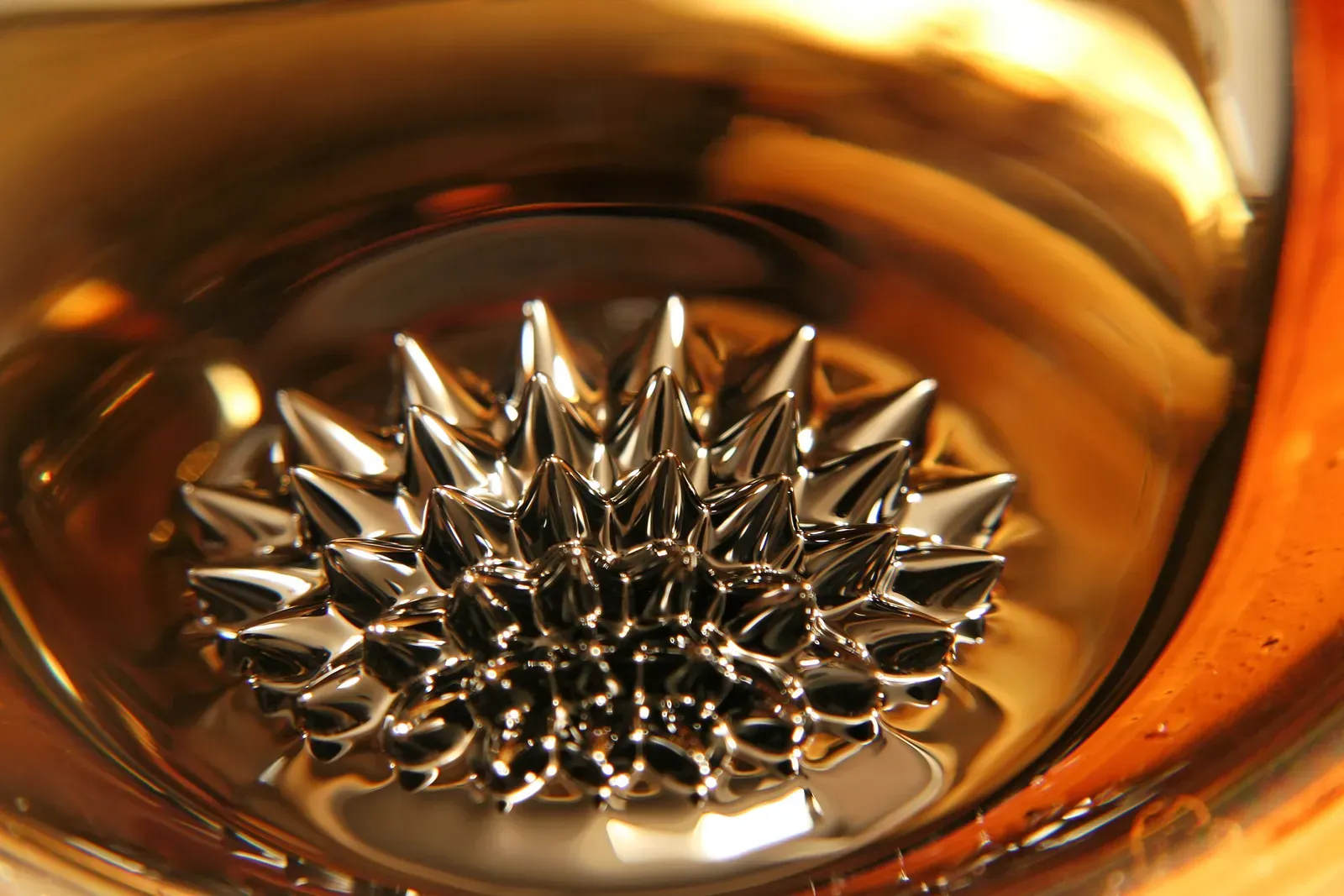
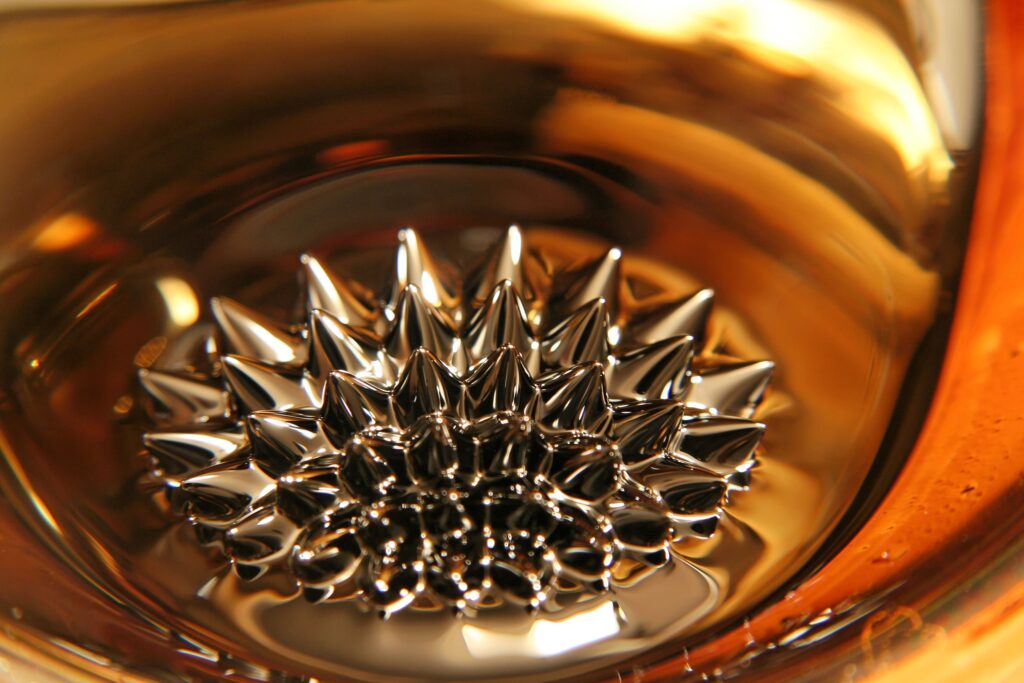
Ferrofluids are one of those materials that look like a visual effect until you see them up close: a black, oily liquid that suddenly sprouts sharp spikes and ridges when you bring a magnet near. At rest, it is just a stable suspension of tiny magnetic nanoparticles in a carrier fluid. Under a strong magnetic field, those particles align and interact in ways that make the liquid surface unstable, leading to those iconic spiky patterns that seem to defy intuition.
Active colloids take the strangeness one step further. These are particles suspended in a fluid that can move on their own when you shine light, apply electric fields, or change chemical conditions. Alone, a single particle is just a microscopic swimmer. In large numbers, and under carefully tuned driving, they organize into swirls, clusters, or even structures that look like living tissues. The same liquid that looked utterly boring under a normal microscope becomes a churning, coordinated swarm when you dial in the right external stimulus.
These behaviors only fully reveal themselves thanks to modern high-speed imaging, microfluidics, and the ability to make nanoparticles with precise sizes and coatings. It is not a stretch to say we are learning to treat matter a bit like programmable crowds: apply the right “social rules” via fields and chemistry, and new, emergent patterns appear in systems that would have been dismissed as simple fluids a few decades ago.
- Ferrofluids: magnetic nanoparticles that form dramatic patterns in fields.
- Active colloids: driven particles that self-organize into dynamic structures.
- Behavior depends critically on field strength, frequency, and particle design.
#12: Warm Dense Matter – Stuff Between Solid and Plasma, Recreated on Earth

There is a whole regime of matter that is neither a regular solid nor a fully ionized plasma, often called warm dense matter. It exists naturally inside giant planets, brown dwarfs, and during the first instants of nuclear explosions. In this state, electrons are partially free, atoms are squished together, and traditional theories for solids or plasmas both start to fail. For decades, it was the domain of astrophysical speculation and classified weapons research, not tabletop experiments.
That changed as ultra-intense lasers and pulsed power machines came online. Now, by firing a massive laser pulse at a thin foil or compressing a target with rapid magnetic fields, researchers can briefly create warm dense matter in the lab. Diagnostics like X-ray scattering and ultrafast imaging allow them to probe how electrons and ions behave at these extreme conditions. The same aluminum that forms a soda can at ambient conditions becomes a ferociously compressed, partially ionized soup, with properties that defy simple intuition.
This is not just curiosity-driven. Understanding warm dense matter helps in designing better models for planetary interiors and in pursuing controlled fusion, where similar states appear for microseconds at a time. Yet the material only reveals this side of itself when we slam it with pressures and temperatures far beyond what conventional furnaces or presses can manage. It is a good example of how new machines open new worlds: build a more powerful laser, and suddenly even common elements show you faces they have never shown humanity before.
Conclusion: When We Push Matter, It Pushes Back With Surprises

Looking across these twelve examples, a pattern emerges: most of the really strange behavior is not hiding in exotic, alien substances. It is hiding in the same elements and compounds we thought we understood, waiting for us to twist, cool, squeeze, or drive them into regimes they never naturally experience on Earth’s surface. Carbon turns superconducting when twisted just so, hydrogen becomes metallic under crushing pressure, and simple oxides host phantom magnetic monopoles when cooled to the edge of absolute zero.
My personal opinion is that we are still at the beginning of this story. As our ability to control temperature, pressure, fields, and time improves, we will keep stumbling on phases of matter that make today’s “weird” look tame. That is exciting, but it also demands humility: predictions based on everyday experience are a poor guide in these extreme corners of physics. We are learning that matter has a deeper playbook than we ever suspected, and we have barely peeked at the first few pages.
If there is one takeaway, it is this: the universe is not obligated to behave intuitively once you leave the comfort zone of ordinary conditions. The more precisely we can create and explore those extremes, the more likely it is that a “boring” material on your desk is secretly capable of sci-fi behavior under the right circumstances. When you think about the metals, glasses, and fluids around you, does it make you wonder what other personalities they are hiding, just out of reach for now?