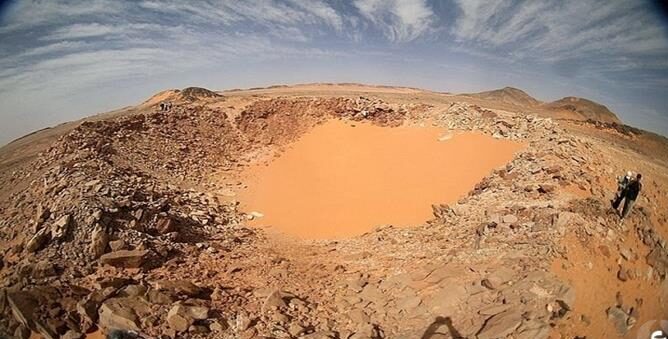
You stand on a rocky plateau in the deep Sahara, and at your feet the ground suddenly drops away into a near-perfect bowl, ringed with jagged walls and streaked with pale rays that shoot far into the desert. It looks almost artificial, like someone fired a giant bullet straight into the planet and paused the scene a moment after impact. That is essentially what happened at Kamil Crater in southwestern Egypt, a site only about forty-five meters – roughly one hundred and thirty feet – across, yet now considered one of the most exquisitely preserved meteorite impact craters on Earth. ([en.wikipedia.org](https://en.wikipedia.org/wiki/Kamil_Crater?utm_source=openai)) You might expect a crater this striking to have been famous for generations, but Kamil lay unnoticed until the late 2000s, when it was spotted on satellite images and then confirmed by expeditions trudging across one of the most remote corners of the Sahara. Since then, this small, sharp-edged scar has turned into a kind of natural laboratory for impact science. It gives you a rare, three‑dimensional freeze‑frame of what happens when a compact chunk of cosmic iron slams into solid rock at hypersonic speed – and what that might mean for the risks you live with today. ([esa.int](https://www.esa.int/Enabling_Support/Operations/Egyptian_desert_expedition_confirms_spectacular_meteorite_impact?utm_source=openai))
A Tiny Crater With Outsized Scientific Importance
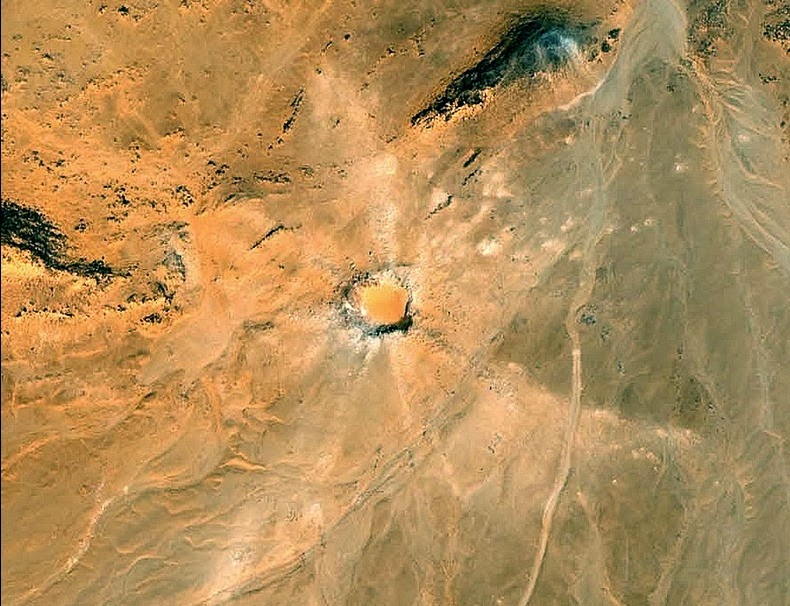
When you first hear the numbers, Kamil Crater sounds almost underwhelming: about forty‑five meters wide and originally close to sixteen meters deep, carved into sandstone bedrock in Egypt’s East Uweinat Desert near the border with Sudan. That size puts it firmly in the “small impact crater” category, nothing like the grand, tourist‑friendly bowls you see in Arizona or the multi‑kilometer basins buried under rock elsewhere. But that modest scale is exactly what makes it so important, because craters this small almost never survive intact on Earth. Erosion, vegetation, and human activity erase most of them long before anyone can study them. ([en.wikipedia.org](https://en.wikipedia.org/wiki/Kamil_Crater?utm_source=openai)) At Kamil, you get something different: a structure whose basic form is still razor‑sharp. The rim is steep and continuous, the floor retains its original concave shape, and the ejecta – the material blasted out of the hole – still radiates away in striking rays that look more like a lunar photograph than an earthly landscape. You rarely get that kind of textbook clarity outside the Moon or Mars, which is why researchers quickly started calling Kamil a “type structure” for small impacts: if you want to understand how a meter‑scale iron meteorite reshapes rock, this is where you come to check your models against reality. ([onlinelibrary.wiley.com](https://onlinelibrary.wiley.com/doi/full/10.1111/maps.12023?utm_source=openai))
How You Can Read the Impact Like a Crime Scene
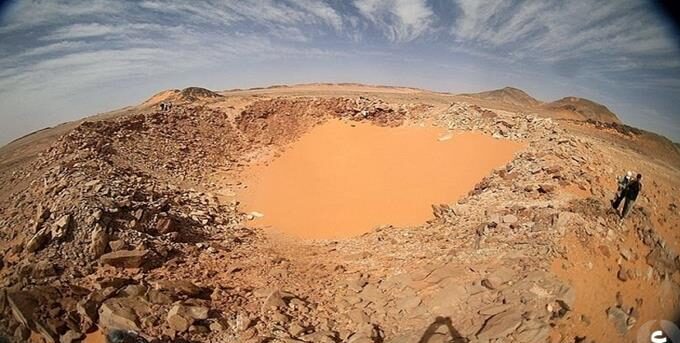
If you treat Kamil like a crime scene, every feature tells you something about the “weapon” and the angle of attack. The crater’s nearly circular outline and high depth‑to‑diameter ratio point to a high‑speed object that struck almost intact, rather than a loose cluster of fragments that simply splashed into the surface. Even the way the floor is slightly off‑center and the rim is a bit lower in the downrange direction hints that the meteorite came in at a shallow angle from the southwest, plowing into the sandstone like a bullet that ricocheted through stone rather than metal. ([onlinelibrary.wiley.com](https://onlinelibrary.wiley.com/doi/full/10.1111/maps.12023?utm_source=openai)) You also see the trail of destruction beyond the rim. Rays of ejected material stretch out for hundreds of meters, with overturned blocks of sandstone pointing back toward the point of impact, almost like frozen waves on a stone ocean. Around and within the crater, thousands of iron fragments are scattered in a pattern that concentrates downrange, mirroring the trajectory of the original meteorite. When you put those clues together, the scene becomes surprisingly vivid: a compact iron mass diving into the desert at several kilometers per second, exploding in a fraction of a second, and throwing both rock and metal out in a focused cone. ([earth-prints.org](https://www.earth-prints.org/handle/2122/7013?utm_source=openai))
The Iron Bullet From Space: Gebel Kamil Meteorite
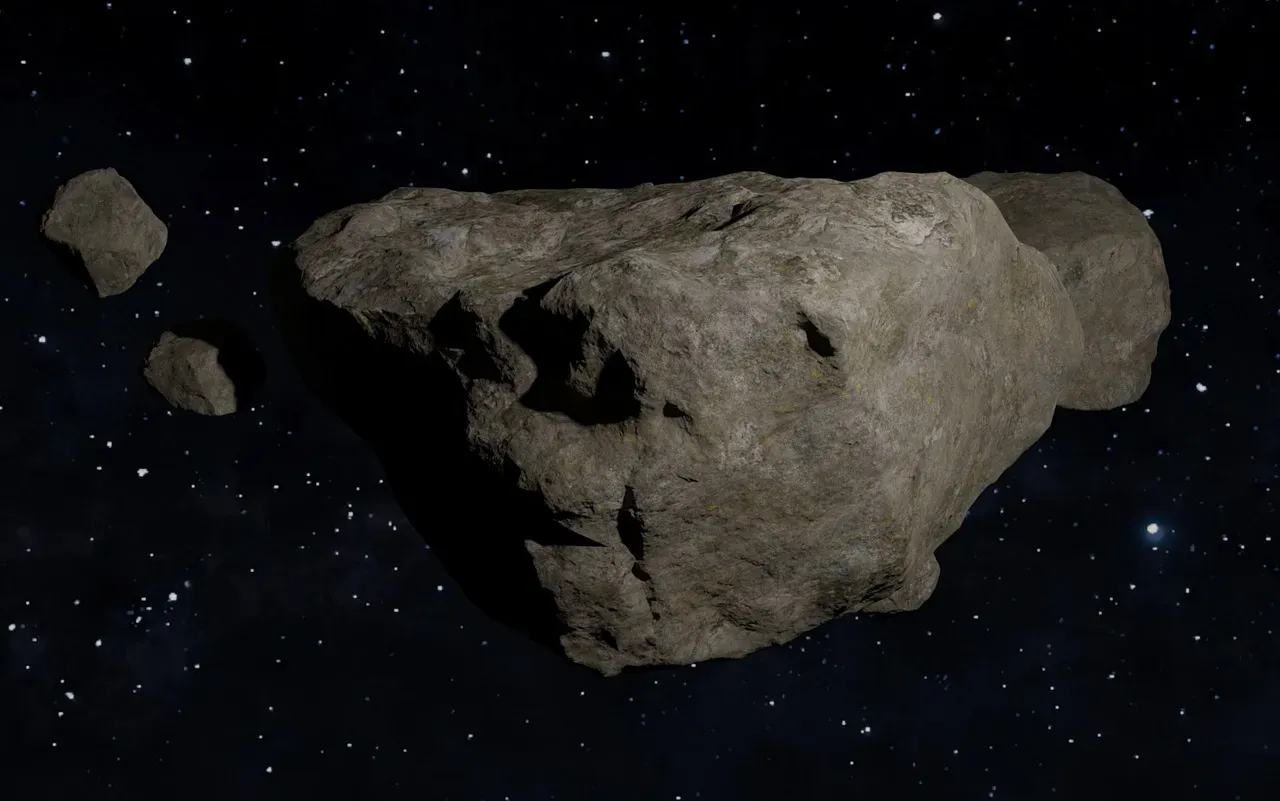
The object that made this crater has a name you might not expect to see attached to a rock: Gebel Kamil. It was an iron meteorite, unusually rich in nickel and chemically distinct enough to be classed as “ungrouped,” meaning it does not fit neatly into the established iron meteorite families. By reconstructing the total mass from the scattered shrapnel, researchers estimate that the original body weighed several thousand kilograms and measured around a meter in diameter before it hit. In more familiar terms, you are looking at an iron boulder about the size of a small car, dense enough to plow through the atmosphere largely intact. ([onlinelibrary.wiley.com](https://onlinelibrary.wiley.com/doi/full/10.1111/j.1945-5100.2011.01222.x?utm_source=openai)) What really stands out to you is how thoroughly that car‑sized rock was shredded at the moment of impact. Instead of a few big chunks, the team that excavated Kamil recovered roughly one and a half tons of iron in thousands of pieces, most of it small, twisted shrapnel scattered within a few tens of meters of the crater. Only one fragment over eighty kilograms has been found, and there is no big remnant buried beneath the floor. That distribution tells you that the asteroid survived the atmosphere but essentially exploded underground, vaporizing and fragmenting in a tight zone that left a neat crater but no single lump to dig up. ([onlinelibrary.wiley.com](https://onlinelibrary.wiley.com/doi/full/10.1111/j.1945-5100.2011.01222.x?utm_source=openai))
Why This Crater Is So Shockingly Well Preserved
You might wonder why this particular crater looks so fresh when most impact scars of similar size vanish from Earth’s surface within a geologic blink. The answer is partly about where it landed and partly about when. Kamil lies in a hyper‑arid part of the Sahara with almost no rainfall, no rivers, and minimal biological activity to erode or cover it. The surrounding sandstone does weather, but far more slowly than soils in wetter climates. Add in the isolation – it sits far from roads, towns, or mines – and you get a natural museum piece that human feet barely touched until scientific teams arrived. ([esa.int](https://www.esa.int/Enabling_Support/Operations/Egyptian_desert_expedition_confirms_spectacular_meteorite_impact?utm_source=openai)) Timing matters too. Dating studies and the pristine state of the ejecta rays suggest the impact happened within the last few thousand years, likely after around 3000 BCE. That is recent enough that wind has not yet planed down the rim or stripped away the radial pattern of debris, but long enough that loose sand has already begun to creep into part of the crater from the north, giving you a glimpse of how fast desert processes can blur sharp features. Standing at the rim, you are essentially looking at a snapshot from late prehistory that has been left almost untouched for you to read. ([earth-prints.org](https://www.earth-prints.org/handle/2122/7013?utm_source=openai))
A Natural Laboratory for Extreme Pressures and Melting Rock
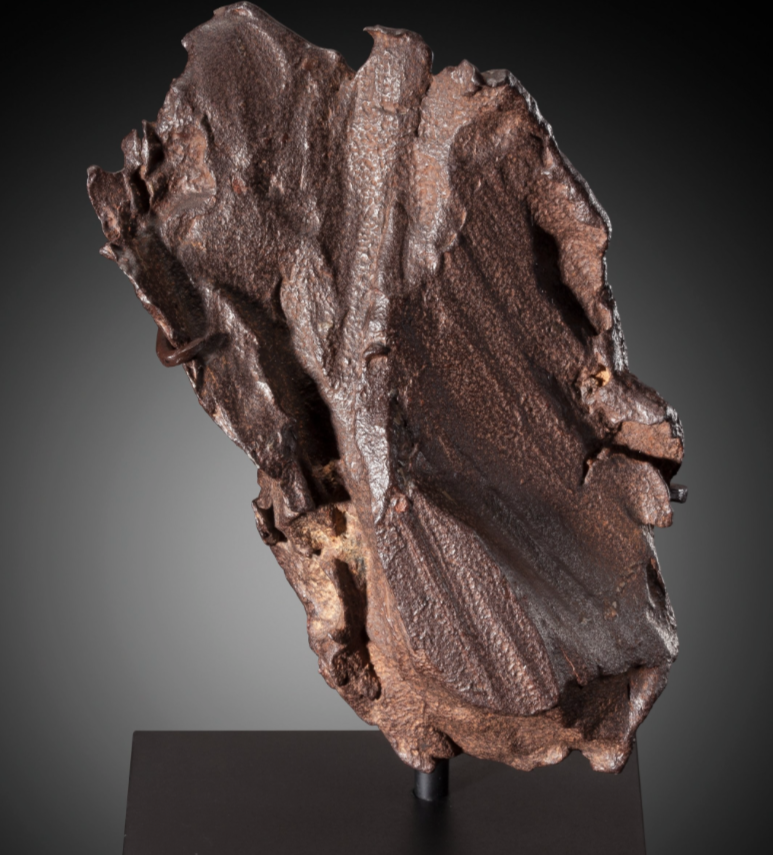
Kamil Crater lets you do something you very rarely get to do on Earth: walk through a full spectrum of shock effects frozen in place at a small, accessible site. When you pick up sandstone from different spots, you can trace how the rock responded as pressure surged and then dropped. Some grains show microscopic fractures and distinctive planar features that only form when rock is slammed by a shock wave traveling faster than sound. In other places you see glassy veins and tiny pockets of melted material, evidence that parts of the sandstone briefly liquefied before cooling back into solid form. ([onlinelibrary.wiley.com](https://onlinelibrary.wiley.com/doi/full/10.1111/maps.12385?utm_source=openai)) Those details give you hard numbers. By comparing what you see under the microscope with experiments and models, researchers can back‑calculate the pressures and temperatures that the rocks experienced, and from there estimate how fast the meteorite was traveling and how the shock wave moved through the ground. Kamil shows you that even a relatively small iron body can generate extreme conditions in a very localized volume, transforming ordinary desert sandstone into a mosaic of crushed, shocked, and melted zones. If you care about how planets record their impact histories, that kind of “ground truth” is priceless, because it anchors the stories you tell about much older, more eroded craters. ([onlinelibrary.wiley.com](https://onlinelibrary.wiley.com/doi/full/10.1111/maps.12385?utm_source=openai))
From Google Earth Curiosity to Scientific Icon
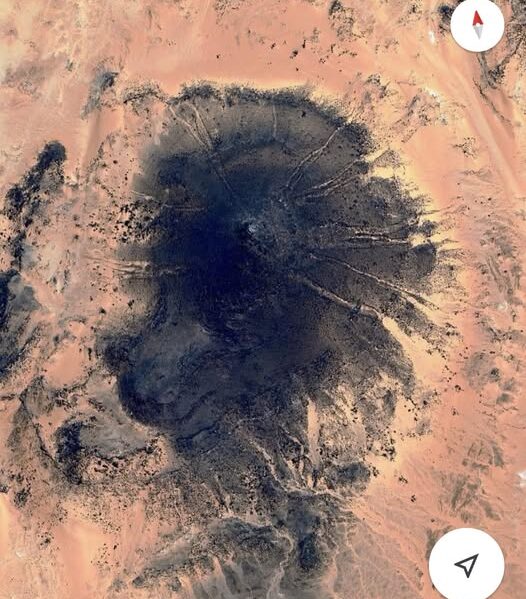
One of the strangest parts of Kamil’s story is how late you discovered it. Astronomers and geologists spent centuries cataloging meteorites and impact sites, yet this perfect little crater remained unknown until someone scrolling through satellite images noticed a suspiciously round feature in a remote patch of Egypt around 2008. That casual digital observation set off a chain of field expeditions, where teams battled heat and logistics to reach the site, map it in detail, and collect thousands of meteorite fragments. In a way, you watched a classic nineteenth‑century style discovery unfold in the twenty‑first century, driven not by camel caravans but by pixels. ([esa.int](https://www.esa.int/Enabling_Support/Operations/Egyptian_desert_expedition_confirms_spectacular_meteorite_impact?utm_source=openai)) Since then, Kamil has become a kind of benchmark you see referenced in scientific papers about small impacts, shock metamorphism, and crater morphology. When researchers model how oblique impacts should look, or how ejecta patterns should behave, they test their simulations against the real‑world data from that tiny bowl in the Sahara. For you, that means this is not just a curiosity lost in the dunes; it is now woven into the way scientists think about hazards, planetary surfaces, and even how to interpret craters on Mars and the Moon. Every time you see a crisp little crater in a rover image, there is a good chance that lessons from Kamil are lurking in the background. ([onlinelibrary.wiley.com](https://onlinelibrary.wiley.com/doi/full/10.1111/maps.12023?utm_source=openai))
Conclusion: A Small Hole That Opens Up a Bigger Universe
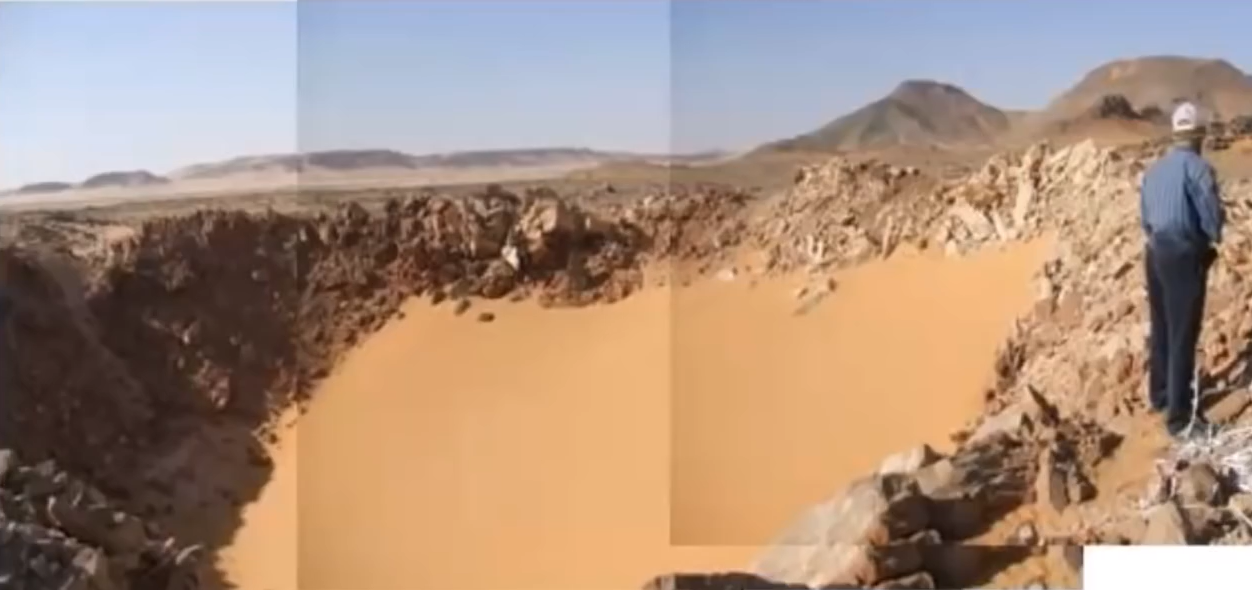
If you ever find yourself standing at the rim of Kamil Crater, you are not just looking into a hole in the ground; you are looking into an instant in time when space and Earth collided with enough force to melt rock, shred iron, and permanently rewrite a patch of desert. In a world where you often focus on giant disasters and planet‑wide events, this little, one‑hundred‑and‑thirty‑foot‑wide scar quietly reminds you that even modest pieces of cosmic debris can leave deep, lasting marks. It bridges scales for you: from microscopic shock features in sandstone, to the risk to modern cities, to the craters dotting the Moon that you can see with your naked eye on a clear night. Maybe that is the real power of Kamil Crater for you. It makes an abstract idea – meteorite impacts – personal and tangible, something you can walk around, measure, and even hold in your hand as a twisted piece of iron pulled from the sand. Next time you glance up at the night sky and see a meteor streak by, you might catch yourself wondering: somewhere, right now or centuries from now, will another small crater like this quietly appear on Earth, waiting for someone like you to notice it?