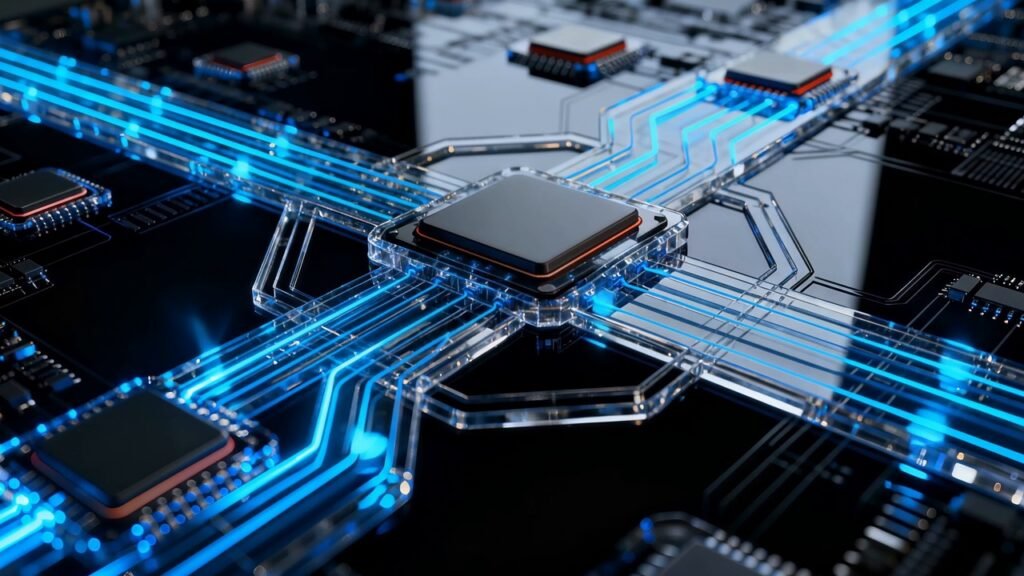
In a landmark leap for quantum technology, researchers have engineered what is being called the most accurate quantum computing chip ever built—thanks to a revolutionary silicon-based architecture that dramatically boosts performance and error resilience. This cutting-edge chip, developed by physicists at Silicon Quantum Computing (SQC) in Sydney, Australia, achieves unprecedented levels of fidelity by precisely embedding phosphorus atoms into silicon substrates, creating an atomic-scale quantum processor with error rates approaching fault-tolerant thresholds.
The breakthrough is being heralded as a pivotal step toward scalable, high-precision quantum machines that can eventually outperform classical supercomputers for complex tasks in cryptography, optimization, and simulation. Unlike many quantum systems that rely on exotic materials or difficult fabrication, this silicon approach taps into familiar semiconductor technology—potentially smoothing the transition from lab prototypes to large-scale quantum processors.
A New Silicon Architecture for Quantum Excellence
At the heart of this advance is the innovative “14/15” silicon architecture, named for the periodic table elements involved: silicon (atomic number 14) and phosphorus (atomic number 15). In this design, engineers embed phosphorus atoms with atomic-level precision (≈0.13 nanometers) into a silicon wafer to form qubits—the fundamental units of quantum information.
This meticulous placement yields remarkably high fidelity, with the chip demonstrating fidelity rates between 99.5% and 99.99% across clusters of nine nuclear and two atomic qubits—far surpassing typical error rates seen in many current quantum platforms and pushing closer to the levels needed for fault-tolerant quantum logic.
Why Accuracy Matters in Quantum Computing
Quantum bits (qubits) are notoriously fragile, easily disturbed by environmental noise that leads to computational errors. Traditional error-correction demands huge overhead, often requiring thousands of physical qubits to make a single logical qubit reliable. The SQC chip’s high raw fidelity significantly reduces this burden, enhancing practical performance and scalability.
In benchmark testing, the chip achieved a record-high 98.87% fidelity on Grover’s algorithm—a key quantum search algorithm—without additional error correction, showcasing the architecture’s inherent resilience and potential for real-world quantum tasks.
Silicon’s Advantage Over Other Technologies
Many leading quantum efforts, such as superconducting qubits (e.g., Google’s Sycamore) and trapped-ion systems, have focused on other physical platforms that face trade-offs between qubit fidelity, size, and cooling complexity. Silicon offers a stable and well-understood host for qubits, benefiting from decades of semiconductor industry refinement and infrastructure.
SQC’s approach leverages silicon’s stable spin environment to keep qubits coherent longer and reduce certain error types, especially bit-flip errors, while concentrating correction resources on the more manageable phase-error category—an efficient strategy toward fault tolerance.
Scalability: From Eleven Qubits to Millions
While the current prototype integrates only eleven qubits, researchers emphasize that the architecture’s strength lies in its scalability potential. Because the silicon-based design fits within traditional semiconductor fabrication, experts predict the technology could eventually support millions of qubits—an essential milestone for practical, large-scale quantum computing.
Reduced error-correction overhead and compatibility with established manufacturing methods could position silicon quantum processors ahead of others that require more exotic conditions or bespoke fabrication lines, potentially accelerating the commercialization of quantum hardware.
Implications for the Future of Quantum Tech
This breakthrough arrives amid a rapid acceleration in quantum research, including large qubit arrays, refined error correction techniques, and hybrid classical-quantum systems under development worldwide. Silicon-based quantum chips may become a cornerstone of this emerging ecosystem.
If the fidelity gains demonstrated by this new chip can be maintained—or even improved—as systems grow, the technology could unlock powerful quantum applications in fields from drug discovery and materials science to secure communications and optimization problems that elude classical machines.
The development of the most accurate quantum computing chip yet isn’t just a technical milestone—it’s a strategic pivot toward practical quantum computing grounded in silicon, the bedrock of classical computing. By marrying atomic-precision engineering with established semiconductor processes, researchers have charted a path that could bridge the gap between experimental prototypes and scalable, commercially viable quantum machines. While challenges remain—especially in error correction and qubit interconnects—the fusion of fidelity, scalability, and silicon’s manufacturing maturity suggests this approach could define the next generation of quantum hardware. In a field often constrained by abstract physics, this breakthrough brings us one step closer to real-world quantum advantage—and the transformative applications that come with it.