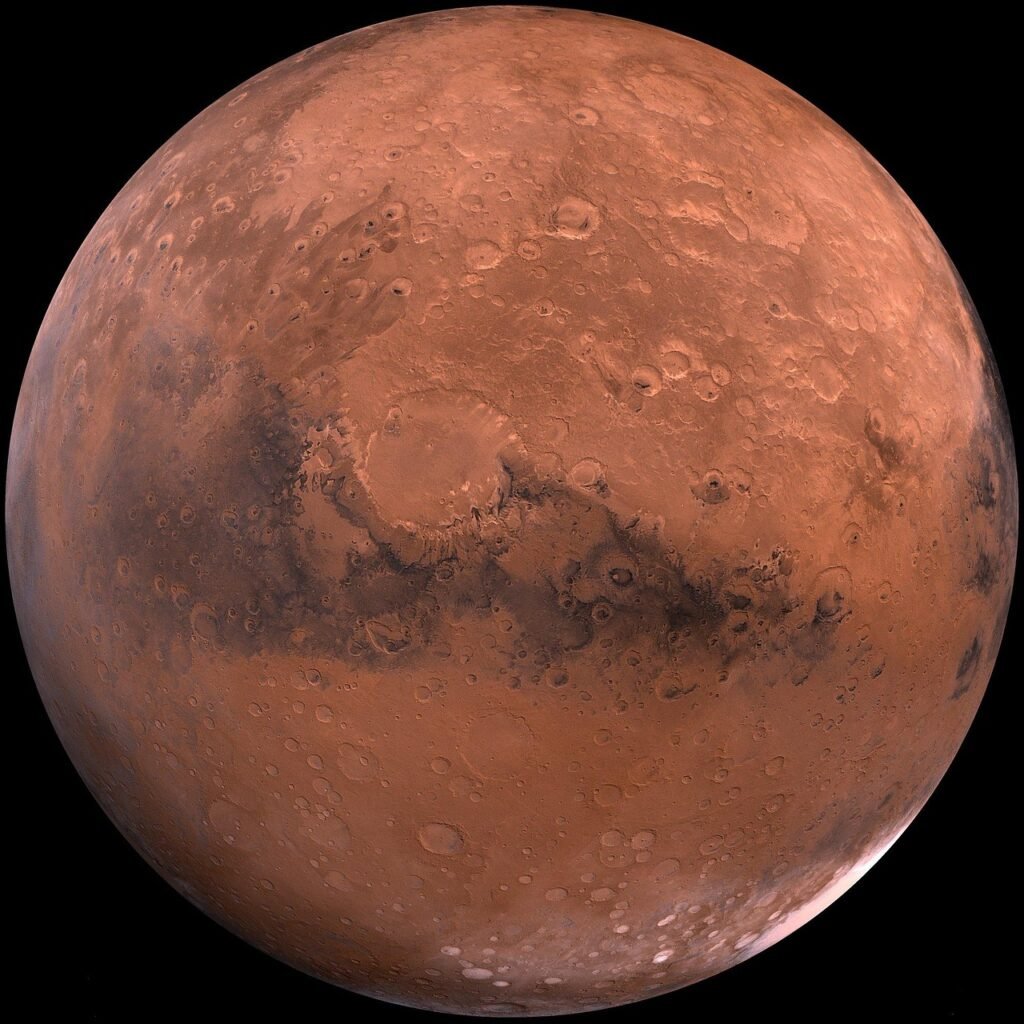
A mysterious dark “shadow” has been slowly spreading across the surface of Mars for nearly 50 years—and scientists still don’t fully understand why. First spotted in images taken by NASA’s Viking orbiters in 1976, the phenomenon has grown dramatically in size, raising new questions about how active—and unpredictable—the Red Planet really is.
What makes this discovery especially intriguing is not just the scale of the change, but the speed. On a planet where geological transformations usually take millions of years, something is shifting in just decades.
A Dark Patch That Wasn’t Always There
The strange feature lies in a vast Martian plain known as Utopia Planitia, one of the largest and flattest regions on the planet. Early images from 1976 showed only a limited dark area, but recent high-resolution images reveal that the patch has expanded significantly over time.
The contrast is striking—light, rust-colored Martian dust sits side by side with a darker material that appears almost like a creeping shadow. Scientists now believe this dark region is made up of volcanic ash or mineral-rich material buried beneath the surface.
Evidence From Decades of Space Observation
The transformation became clear only after comparing images taken decades apart. Data from NASA’s Viking missions in the 1970s were placed alongside modern images captured by the European Space Agency’s Mars Express orbiter, revealing just how far the dark material has spread.
Such visible change over a 50-year period is unusual for Mars. Scientists typically expect surface changes to unfold over geological timescales, making this relatively rapid shift both surprising and scientifically valuable.
Two Competing Theories, No Clear Answer
Researchers currently have two main explanations—but neither fully solves the mystery. One possibility is that Martian winds are gradually spreading the dark volcanic ash across the surface, redistributing it over time.
The other theory suggests the opposite: instead of the dark material moving, lighter dust may be blowing away, exposing what was always underneath. Despite these ideas, scientists admit there is still no definitive explanation for what’s driving the change.
What This Reveals About Mars Today
The discovery challenges the long-held view of Mars as a mostly static and unchanging world. While the planet is cold and dry today, its surface is still shaped by active processes like wind, dust movement, and possibly buried ice interactions.
It also hints that Mars may be far more dynamic than previously believed. Features like this could help scientists better understand the planet’s climate history—and even guide future exploration missions.
A Planet Still Full of Surprises
Mars continues to defy expectations. Every new image reveals something unexpected, from hidden ice deposits to shifting surface patterns. This growing “shadow” is just the latest reminder that the Red Planet is not frozen in time—but evolving in ways we are only beginning to understand.
Conclusion: A Mystery That Refuses to Fade
There’s something quietly fascinating about a shadow that isn’t really a shadow—one that has been moving, growing, and reshaping a distant world for half a century. It forces us to rethink Mars not as a dead planet, but as one that is still alive with subtle change.
And perhaps that’s the real takeaway: even after decades of exploration, Mars is still holding back its secrets. The question isn’t just what this dark patch is—it’s what else we’ve yet to notice.