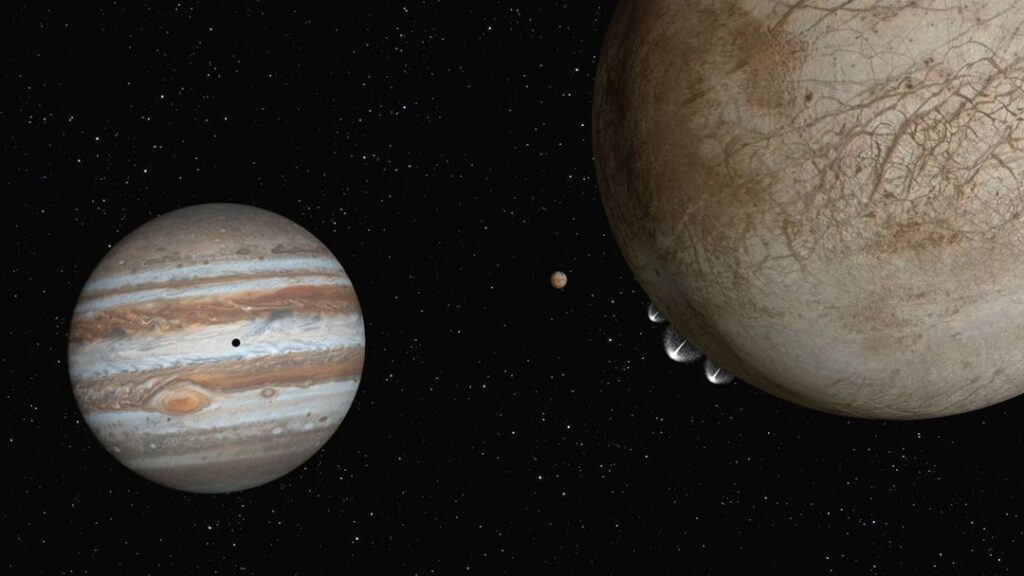
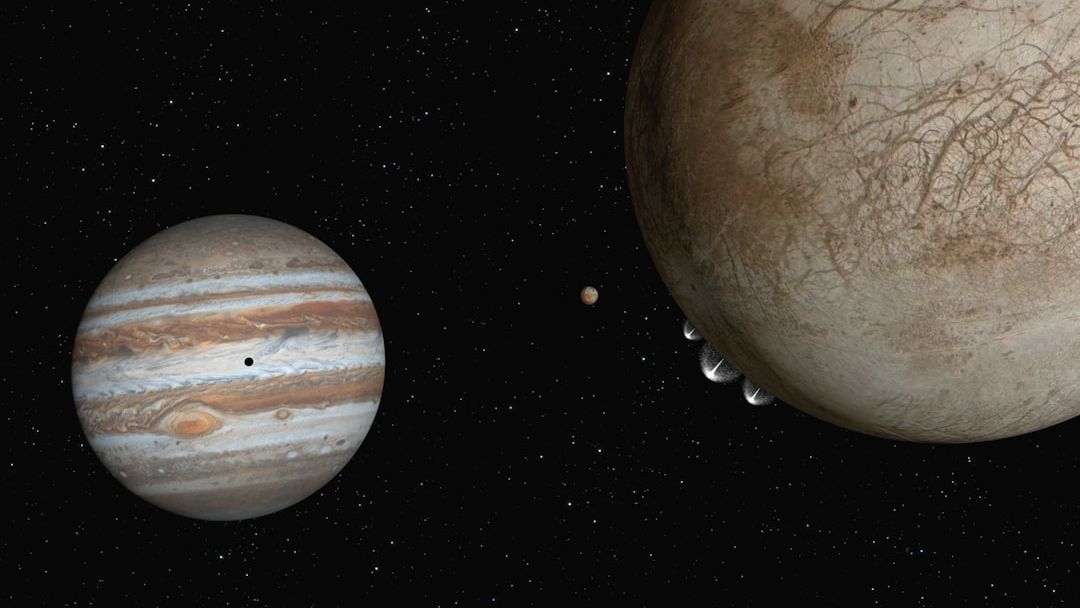
Scientists thought Jupiter’s moon Europa was ejecting water. Now they’re not so sure – Image for illustrative purposes only (Image credits: Unsplash)
Hubble Space Telescope observations from more than a decade ago once pointed to faint water vapor rising from Jupiter’s icy moon Europa. Those signals were interpreted as evidence of intermittent plumes linked to a subsurface ocean. A fresh examination of the complete dataset has now lowered the in those findings.
Early Hints of Activity on an Icy World
Europa has long intrigued scientists because of strong evidence for a global ocean beneath its frozen crust. In 2014 researchers reported ultraviolet emissions that appeared consistent with water vapor escaping into space. The detection relied on specific patterns in Lyman-alpha light and oxygen emissions captured during targeted Hubble sessions.
At the time the results carried high statistical weight and aligned with models of cryovolcanic activity. They also raised hopes that material from the hidden ocean might reach the surface or even enter the spacecraft-accessible environment. Follow-up observations with other telescopes added occasional supporting signals, though none matched the original strength.
Full Dataset Tells a Different Story
Planetary scientists recently completed a comprehensive reanalysis covering 14 years of Hubble Space Telescope Imaging Spectrograph data. The team focused on periods when Europa was fully illuminated and not passing in front of Jupiter, removing potential contamination from the planet’s glow. Instead of clear plume signatures, the expanded record showed patterns more consistent with statistical fluctuations or a steady, diffuse hydrogen exosphere.
Lead author Lorenz Roth noted that the original 99.9 percent confidence level dropped below 90 percent after the broader review. “That’s simply not enough evidence to support the certainty of claims we made at the time,” he said. Co-author Kurt Retherford added that the description of the phenomena no longer holds up in the same way. The current measurements do not rule out occasional plumes entirely, yet they no longer supply concrete proof of their existence.
This shift highlights how additional data can refine or overturn early interpretations in planetary science. What once looked like localized outbursts now blends into background noise when viewed across many more orbits and viewing geometries. The work appears in the journal Astronomy & Astrophysics and underscores the value of long-term archival studies.
Why the Distinction Matters
Confirmed plumes would offer a rare window into Europa’s interior chemistry without drilling through kilometers of ice. Material ejected from below could carry salts, organics, or other tracers of habitability. Even without active venting, the moon remains a prime target for understanding ocean worlds and the conditions that might support life elsewhere in the solar system.
Upcoming missions such as NASA’s Europa Clipper and ESA’s JUICE will fly past the moon repeatedly and carry instruments capable of detecting trace gases or surface changes. Those spacecraft can test the plume question directly through in-situ measurements or high-resolution imaging of potential vent sites. Until then, ground- and space-based telescopes continue to monitor for any new activity.
Looking Ahead with Measured Expectations
The revised assessment leaves open the possibility that Europa occasionally releases water vapor, but it removes the earlier sense of near-certainty. Researchers emphasize that absence of strong evidence is not evidence of absence, especially for transient phenomena. Continued observations and improved modeling will be needed to settle the question.
In the meantime the findings serve as a reminder that scientific conclusions evolve with better data. Europa’s subsurface ocean still stands as one of the most compelling places to search for extraterrestrial life, whether or not visible plumes are part of the picture.