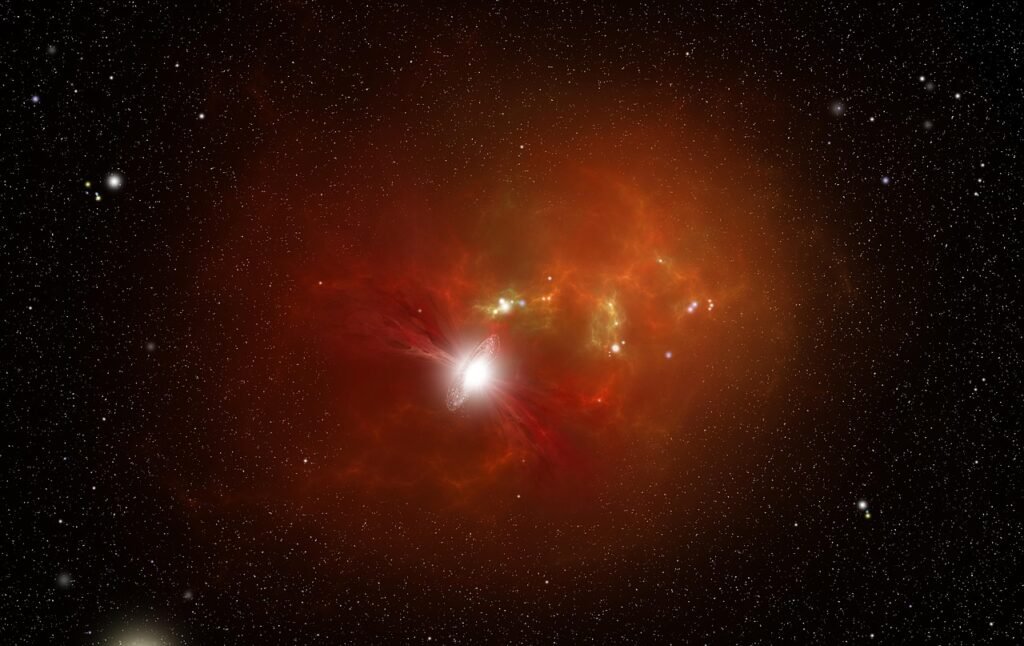

A Historic First in Stellar Demise Studies (Image Credits: Pixabay)
Astronomers detected radio waves from a rare exploding star, providing the first direct evidence of massive material ejections in the years prior to its detonation.
A Historic First in Stellar Demise Studies
Researchers achieved a breakthrough when they intercepted radio emissions from a supernova progenitor, marking the initial capture of such signals from this type of cosmic event.
These faint radio waves carried crucial information about the star’s turbulent endgame. The detection highlighted processes that unfolded over several years before the explosion. Previously, scientists relied on indirect clues from light or X-rays. This new observation opened a window into hidden dynamics near stellar death.
Unpacking the Pre-Explosion Chaos
The star underwent extreme mass loss just before its outburst, ejecting vast quantities of material into surrounding space at high speeds.
Radio observations showed that this shedding created a dense shell of gas and dust. When the supernova shockwave later collided with this shell, it produced the detectable radio glow. Such violent pre-explosion activity suggested interactions beyond the star’s solitary evolution. The material loss likely reshaped the environment around the blast site.
The Companion Star’s Pivotal Influence
Evidence pointed to a nearby companion star as the trigger for the dramatic material ejection.
This binary system dynamic intensified in the star’s final phases, stripping away outer layers through gravitational tug-of-war or stellar winds. Astronomers noted that the interaction accelerated mass transfer, leading to instability. Without this partner, the star might have ended more quietly. The finding underscored how binary pairs drive some of the universe’s most spectacular explosions.
Transforming Supernova Science
This discovery equipped scientists with a powerful method to reconstruct the timelines of stellar explosions.
Radio signals now serve as a forensic tool, tracing back events years earlier than optical data allows. Researchers anticipate applying this technique to future supernovae for broader patterns.
- Identifies material shells invisible in other wavelengths.
- Reveals binary interactions in real time.
- Refines models of massive star lifecycles.
- Enhances predictions for nearby supernova risks.
- Links pre-explosion phases to remnant properties.
Future telescopes will hunt for similar signals, expanding the catalog of observed events.
Key Takeaways
- Radio waves offer the first glimpse of mass ejections years before a supernova.
- Companion stars play a key role in triggering explosive finales.
- This tool rewinds the clock on stellar deaths, reshaping supernova research.
These revelations challenge earlier views of supernovae as isolated culminations, revealing layers of interstellar drama. As observations multiply, the cosmos’ explosive narratives grow richer. What insights might the next detection bring? Share your thoughts in the comments.