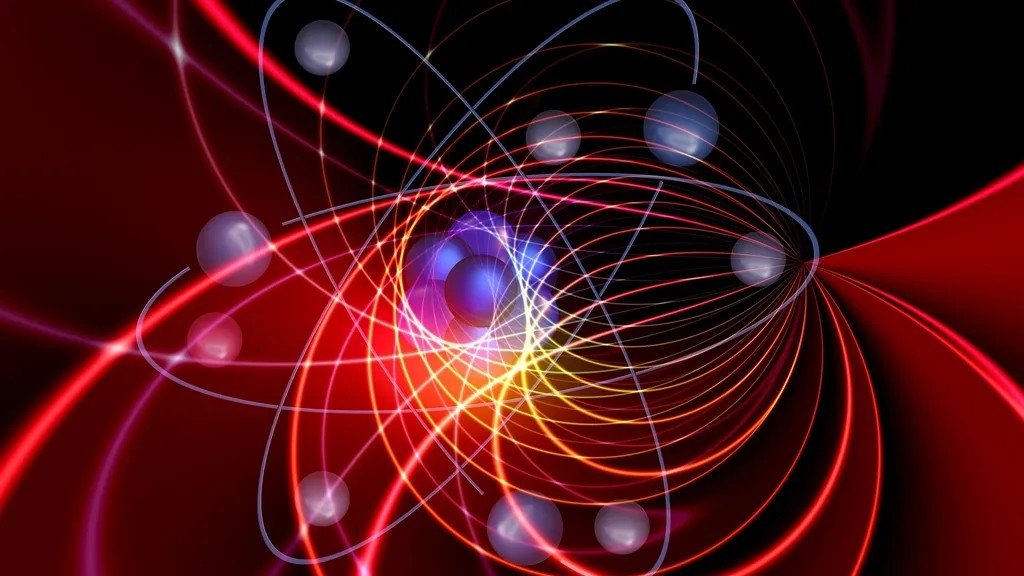

Look around you: the screen in front of you, the chair under you, the floor beneath your feet. It all feels solid, steady, and obvious. But when you zoom in far enough, down to the smallest building blocks of matter, that comforting solidity starts to fall apart in the strangest ways. Quantum physics doesn’t just tweak our picture of reality; it pretty much flips it inside out.
Over the last century, experiments have revealed a world where particles behave like waves, objects can be in multiple states at once, and just looking at something can change what it is. That sounds like science fiction, but it’s behind modern technologies like lasers, MRI scanners, and the chips in your phone. The unsettling part is this: the more accurately we test quantum theory, the more it seems to say the same thing – reality is not what our senses are telling us.
Particles That Act Like Waves (And Vice Versa)
Here’s a wild starting point: the basic “stuff” of the universe can behave like both a solid particle and a spread-out wave. In famous experiments with electrons and light, scientists fired single particles at a barrier with two slits and found an interference pattern, something you’d expect from waves rippling on a pond, not from tiny bullets. Yet, when they tried to check which slit each particle went through, the wave pattern disappeared, and they behaved like particles again.
This so-called wave–particle duality is one of the earliest clues that reality is not as straightforward as we’d like. At the quantum level, an electron isn’t just “here” or “there” in a clear way; it spreads out like a cloud of possibilities. Only when we measure it does it “pick” a location. In everyday life, objects are so huge compared to these scales that all this weirdness averages out, giving us the comforting illusion that things are always in one place and acting in predictable ways.
Superposition: When One Thing Is Many Things
Quantum superposition might be the most unsettling idea of all: a single system can exist in multiple states at the same time. A particle can spin up and down simultaneously, or take several paths at once, until a measurement is made. It’s not that it’s secretly in one definite state and we just don’t know which; the math and experiments say it truly behaves as if all the options are real at once.
People often use the example of a coin spinning in the air, being both heads and tails while it spins. But superposition is stranger than that, because it isn’t just about not knowing yet – it’s about reality genuinely being spread over several possibilities. Quantum computers rely on this: their basic units, qubits, can be in a mix of zero and one at the same time, allowing them to process many potential outcomes in parallel. So this isn’t just philosophical hand-waving; it’s a feature engineers now use to build devices that outperform classical machines on specific tasks.
Entanglement: Spooky Connections Across Space
Entanglement takes the weirdness and stretches it across space. When two particles become entangled, their properties link together so strongly that what happens to one instantly relates to the other, no matter how far apart they are. Change the measurement on one particle in the lab, and the other, maybe on the other side of the planet, shows a corresponding result that fits perfectly with it.
This doesn’t mean you can send messages faster than light, but it does mean our usual idea of objects as independent, separate things breaks down. Experiments over the last few decades, including tests closing more and more loopholes, keep confirming that the world does not obey “local realism”: the idea that objects have definite properties before we look, and that nothing influences anything else faster than light. Instead, reality looks deeply interconnected in a way that our everyday instincts never prepared us for.
The Measurement Problem: Does Observation Create Reality?
If quantum systems can be in superpositions, why do we never see a table that is both in the kitchen and the living room at the same time? This is where the measurement problem kicks in: quantum theory says a system evolves smoothly as a spread-out wave of possibilities, but when we measure it, we only get one definite outcome. The big puzzle is: what exactly counts as a “measurement,” and why does that process seem to snap the possibilities into a single reality?
Some interpretations suggest that the wave function – the mathematical description of all those possibilities – simply encodes our knowledge, and measurement is just updating that knowledge. Others treat the wave function as something real that somehow “collapses” when it interacts with a measuring device. There are also ideas like decoherence, where the environment effectively hides the quantum weirdness, making things look classical. None of these answers fully resolves the mystery, and that gap is where a lot of the “does consciousness create reality?” debates sneak in, sometimes going beyond what the science actually supports.
Does Consciousness Really Affect Reality?
The idea that human consciousness literally shapes physical reality is seductive and shows up everywhere from pop spirituality to social media quotes. Some people point to experiments like the double-slit or the measurement problem and jump to the conclusion that the universe needs a mind to become real. The truth is more nuanced and, honestly, less flattering to our egos. Quantum experiments require detectors, not human eyeballs, to trigger outcomes, and those detectors are made of regular matter following physical laws.
Most working physicists treat measurement as an interaction between a quantum system and something larger and more classical, like a device or the environment, not as a mystical act of awareness. That said, the fact that our best theory of nature still has this fuzzy line between “possibility” and “actual outcome” is a real, unsolved problem. It leaves space for philosophical speculation about what counts as an observer and whether information and physical reality are more tightly connected than we currently understand. But so far, there’s no solid evidence that your thoughts alone can bend the laws of physics.
Is Reality Digital, Holographic, or Something Else Entirely?
Once you accept that matter is mostly empty space, that particles can be waves of possibility, and that distant things can be deeply linked, it starts to feel like the universe might be less like a solid machine and more like a strange information process. Some researchers explore the idea that the universe is fundamentally made of information, with physical objects emerging as patterns in that information. Others study holographic principles, where the physics of a region of space can be described by information on a lower-dimensional boundary, a bit like a 3D movie projected from a 2D screen.
These ideas are still active areas of research rather than settled facts, and they can be easy to oversell. But they do suggest a common theme: what we experience as solid, continuous reality might be a kind of large-scale illusion, a stable appearance emerging from much more abstract and non-intuitive rules underneath. It’s like thinking of a video game character walking on a stone road; to the character, the road is solid and obvious, but under the hood it’s all code, numbers, and logic. We may be living in something equally structured but far more complex, with quantum physics as our first serious glimpse under the surface.
Why This Strange Quantum World Still Matters to Everyday Life
It’s tempting to treat quantum physics as a distant curiosity that only matters for labs and sci-fi plots, but it’s quietly threaded into modern life. Technologies like GPS, medical imaging, lasers, and the microchips powering your phone rely on quantum principles, even if they hide all the weirdness behind neat user interfaces. As quantum computing, quantum communication, and quantum sensing continue to grow, the gap between “quantum” and “normal” life is only going to shrink.
On a more personal level, there’s something humbling and oddly liberating about knowing that the solid, obvious world is built on such unfamiliar rules. Our everyday experience isn’t wrong; it’s just incomplete, like one layer of a much deeper story. Quantum physics reminds us that certainty can be an illusion and that reality is often stranger and more subtle than our first impressions. The universe doesn’t owe us comfort or simplicity; it offers mystery, and we’re just beginning to learn how to listen.