

Picture this: it is 2 a.m., the room is dark and quiet, and your dog has somehow taken up three quarters of the bed. You might be clinging to the edge of the mattress wondering who invited this furry roommate, but your body could be quietly thanking you. A growing body of research in human–animal interaction suggests that close physical contact with a familiar dog can help regulate stress biology, including levels of cortisol, the main stress hormone.
Now, the claim that dogs who sleep in their owner’s bed show measurably lower cortisol levels throughout the night fits neatly into what we already know about attachment, safety cues, and co-regulation between bonded beings. At the same time, the science is still catching up to the folklore. There are hints, not hard law. In this article, we will walk right up to the edge of what the evidence can actually support, connect it to psychological theory, and talk honestly about when bed-sharing might help, when it might not, and why the emotional story behind it matters just as much as the numbers.
The Science Of Cortisol: What “Lower At Night” Really Means

Cortisol is often called the stress hormone, but that nickname is only half the story. It does spike during stress, yes, but it also follows a natural rhythm tied to the day–night cycle: highest in the early morning to help you wake up, gradually falling across the day, and typically lowest in the late evening and during sleep. When people talk about lower cortisol at night being good, what they really mean is that the hormone is following that smooth downward curve instead of staying stubbornly elevated.
In both humans and dogs, chronically high cortisol or a flattened daily rhythm has been linked with anxiety, poor sleep, slower healing, and even behavior changes. So the idea that some dogs may show lower, more regulated cortisol levels when they sleep in bed with a trusted human is not wild speculation; it is an extension of what we already know about safety, rest, and biology. Still, it is important to remember that research so far tends to focus on general effects of human–dog contact, not just bed-sharing, so any specific claim about night-time numbers has to be treated as an informed hypothesis rather than a settled fact.
Attachment And Safety: Why Being Close Changes A Dog’s Stress Biology

From a psychological point of view, the bed is not just a soft rectangle; it is the center of the “safe base” in many homes. Attachment theory, originally developed to explain why human infants calm down in a caregiver’s arms, has been adapted to dogs as well. Many dogs treat their primary human much like a secure base, using their presence as a cue that the environment is safe and threats are unlikely. For a social species, perceived safety is not an abstract feeling; it is a concrete biological signal that it is okay to downshift stress systems and allow cortisol to drop.
When a dog curls up next to or on top of their person, they are bathing in a rich sensory soup of familiar smells, sounds, and warmth. Those cues can dampen vigilance: fewer startle responses, less scanning the room, less reacting to every minor noise outside. Over the course of a night, that lower level of alertness can translate into quieter stress physiology. The dog may fall back to sleep faster after disturbances and spend more time in deeper stages of sleep, during which cortisol secretion tends to be low and stable. That does not mean every dog must sleep in a human bed to feel safe, but for many, that closeness functions like a biological security blanket.
Human–Dog Co‑Regulation: Two Nervous Systems Calming Each Other

One of the most fascinating ideas in modern psychology is co-regulation: the process by which two bonded beings literally help regulate each other’s nervous systems. We see this clearly with parents and babies, but something similar appears to happen between people and their dogs. When a person relaxes, breathes more slowly, and feels emotionally at ease, their dog often mirrors that shift through posture, heart rate, and behavior. Likewise, a dog’s calm, rhythmic breathing, steady warmth, and predictable presence can feed back into the owner’s sense of safety and comfort.
If both partners in this relationship are more relaxed at night, cortisol levels on both sides are more likely to stay low and smooth instead of spiking. Some studies have found that gentle contact with a familiar dog, such as stroking or sitting close, can lower cortisol and heart rate in humans and is associated with calmer behavioral responses in dogs. It is a small step from there to imagine that sleeping together, where contact and proximity are prolonged and automatic, could act like an overnight stress-dampening loop. The owner feels safer, the dog senses that safety, both relax further, and the cycle deepens with each night of shared rest.
What Current Research Actually Shows (And What It Does Not)

Right now, scientific research directly measuring canine cortisol specifically during human bed-sharing nights versus separate-sleep nights is limited. What we do have are several related threads: studies showing that secure dog–owner attachment is linked with more stable stress responses, findings that separation from a bonded human can raise stress markers in some dogs, and evidence that calm, predictable human–dog contact can reduce cortisol after acute stress. Put together, these patterns make the headline idea plausible, even if the data are not yet exhaustive.
At the same time, psychologists and veterinarians are careful not to overpromise. Dogs are individuals, and cortisol is only one piece of a complex stress puzzle that includes behavior, heart rate, immune function, and sleep quality. A quieter, more content dog may well show lower night-time cortisol when snuggled into the curve of a familiar body, but another dog might sleep just as peacefully in a crate nearby if that is what they are used to and prefer. The responsible stance is to treat bed-sharing as one potential pathway to lower stress in dogs, not a magic switch that guarantees perfect hormone numbers.
Behavioral Clues: How A Low‑Stress Bed‑Sharing Dog Actually Looks

If dogs who sleep in the bed tend to show lower cortisol through the night, we would expect to see that calm written on their bodies and behavior. Typically, a low-stress sleeper has loose muscles, a relaxed jaw, slow and steady breathing, and only brief, gentle shifts in position. They may sigh, stretch, twitch during dreams, and then immediately sink back into stillness. They are not jumping up at every sound or constantly scanning the room, which would hint at a more vigilant, higher-stress state.
Owners often report that bed-sharing dogs seem to “melt” into them, pressing close without being clingy, sleeping for long stretches, and waking up mildly instead of bolt upright and on high alert. Over time, a dog that regularly gets deep, restorative sleep usually shows that during the day as well: more patience, smoother reactions, and less edgy reactivity. While none of this behavior proves a specific cortisol number, it definitely aligns with a picture of a dog whose stress systems are not constantly revved up, especially in the place they should feel safest – the bedroom.
When Sharing The Bed Helps The Dog More Than The Human (And Vice Versa)

The cozy image of a dog snoozing peacefully in the crook of your knees sounds like a win–win, but real life can get messier. Some people sleep better with their dog in the bed; others sleep worse. For dogs, the equation can be just as nuanced. An anxious dog that panics when left alone might feel dramatically safer sleeping pressed against their person, potentially smoothing out their night-time cortisol profile. However, a hyper-vigilant dog that barks at every noise may keep everyone awake, undermining the human’s sleep quality even if the dog feels more secure.
Psychologically, you can think of it as a trade-off between emotional closeness and logistical practicality. If your dog’s presence in the bed makes you toss and turn, you might see your own stress climb over time, even if their biology is calmer. On the other hand, if you sleep like a rock while your dog is nearby and they appear well rested and relaxed, then you have stumbled onto a co-regulation sweet spot. The key is to watch both sides: how well each of you sleeps, how you both behave during the day, and whether the arrangement feels genuinely comforting instead of secretly draining.
Individual Differences: Not Every Dog Wants Or Needs Your Pillow

Just as some people crave a weighted blanket and others feel trapped by it, dogs have different sleep style personalities. Breed tendencies, early experiences, and temperament all shape where a dog feels most at ease. A confident, laid-back dog might happily spill across the bed and snore without a care, while a more independent or heat-sensitive dog might prefer a cool spot on the floor or their own elevated cot. For those dogs, forcing bed-sharing in the name of stress reduction could actually create the opposite effect, bumping up night-time arousal instead of letting cortisol drift down.
There are also medical and behavioral conditions that complicate the picture. Dogs with pain, mobility issues, or certain sleep disorders may struggle to get on and off a bed safely or rest comfortably on a soft, shifting surface. Others with resource guarding or territorial tendencies might become more possessive when allowed to share the bed, which can increase behavioral tension even if their hormone profile looks fine. A psychologically informed approach respects the individual dog’s signals: choose sleeping arrangements that lead to the most relaxed, consistent rest pattern, not the one that seems most heartwarming on social media.
Training, Boundaries, And The Psychology Of Choice

One underrated factor in the stress equation is choice. From a behavioral and welfare perspective, animals that have some control over where they rest and how close they are to others often show healthier stress responses. That means the magic of bed-sharing, if it exists, may depend partly on the dog being free to hop on and off rather than being physically or emotionally forced to stay. A dog that can choose between a bed, a nearby crate, and a dog mattress in the same room has room to self-regulate, finding the distance that makes them feel safest.
Clear, consistent training can make this flexibility possible. Teaching cues such as “on,” “off,” and “go to your place” allows you to invite the dog up without making the bed a confusing, contested resource. From a psychological angle, predictable rules reduce uncertainty, and less uncertainty often means lower baseline stress. Over nights and months, a dog that understands they are welcome but not required on the bed may naturally gravitate toward whatever sleeping spot best supports their own calm biology – and that is exactly the kind of context where night-time cortisol is most likely to look healthy.
Health, Hygiene, And The Risks Of Chasing A Single Metric
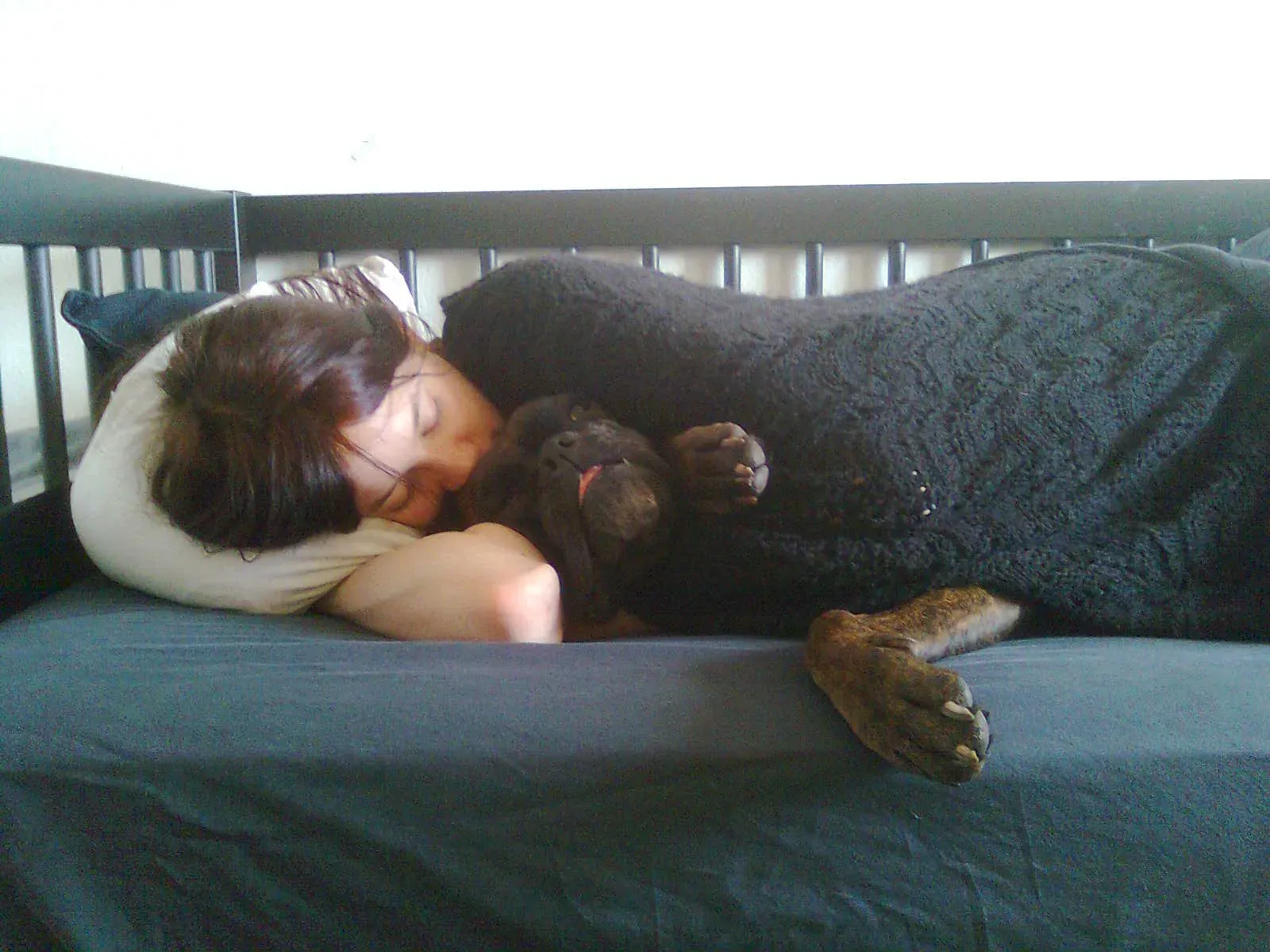
Even if we accept that many bed-sharing dogs may enjoy lower night-time cortisol, it would be a mistake to treat that one hormone as the only thing that matters. Overall health, hygiene, and safety still count. For some humans, allergies, asthma, or immune issues make dogs-in-the-bed a genuine medical problem. For some dogs, the risk of falling, being accidentally rolled on, or overheating is non-trivial. A psychologically wise decision weighs cortisol against all the other pieces of well-being instead of sacrificing common sense in pursuit of more relaxed lab readings.
Focusing too narrowly on cortisol can also obscure more practical signs of stress or comfort. If your dog is restless, panting, growling when moved, or snapping when disturbed, that tells you more than any hormone test. In contrast, a dog that sleeps deeply on a nearby cushion, wakes cheerfully, eats well, and has stable behavior is clearly doing fine, bed or no bed. Rather than chasing the supposedly perfect arrangement, it makes more sense to ask: does this setup help both of us sleep better, feel safer, and live more easily? If the answer is yes, then you are already serving the deeper psychological goal, whether or not anyone is measuring cortisol at 3 a.m.
Opinionated Conclusion: The Real Win Is Shared Calm, Not Just Lower Cortisol

Here is my take: the idea that dogs who sleep in their owner’s bed show lower night-time cortisol fits the broader story that safety, attachment, and closeness soothe a social brain. It is likely true for many dogs in a loose, practical sense, even if we do not have shelves of perfect, bed-specific hormone data yet. But obsessing over the exact size of the cortisol drop misses the more human truth hiding in plain sight: these shared nights shape how both of you feel about each other, about your home, and about rest itself. A bed that holds a trusting, gently snoring dog is, quite simply, a different psychological space than one that does not.
So if you love having your dog in the bed, you both sleep soundly, and your daily life is calmer for it, you do not need a lab report to justify that choice; your nervous systems are already voting with every relaxed breath. If, on the other hand, bed-sharing leaves either of you cranky, over-tired, or on edge, you should feel zero guilt about creating a new routine that protects everyone’s sleep – even if that means slightly different cortisol curves. In the end, the real measure of a good night is not a hormone level; it is waking up in a body and a relationship that feel steady, safe, and ready for the day. When you look at your dog in the morning, do you see that kind of quiet confidence looking back?