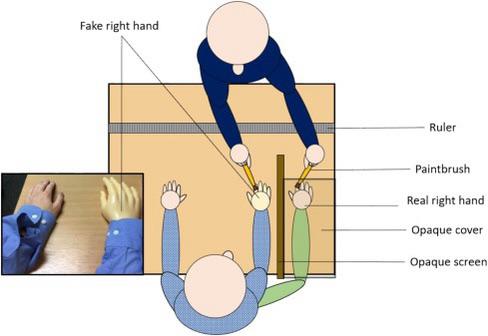
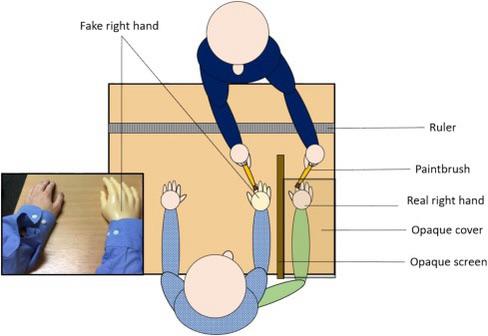
Sit at a table, hide one hand behind a screen, and watch a rubber hand get stroked with a paintbrush while someone strokes your real, hidden hand in exactly the same rhythm. Within a couple of minutes, something strange happens. Most people start to feel like the rubber hand is theirs, and some flinch when it’s threatened, as if their own skin were on the line.
This isn’t a party trick or internet myth. It’s one of the most replicated findings in cognitive neuroscience, and it has quietly reshaped how researchers think about the boundary between self and object. What follows is a closer look at how the illusion works, what’s happening inside the skull while it does, and why a simple brush and a fake hand keep turning up in labs studying everything from prosthetics to anxiety.
The 1998 experiment that started it all
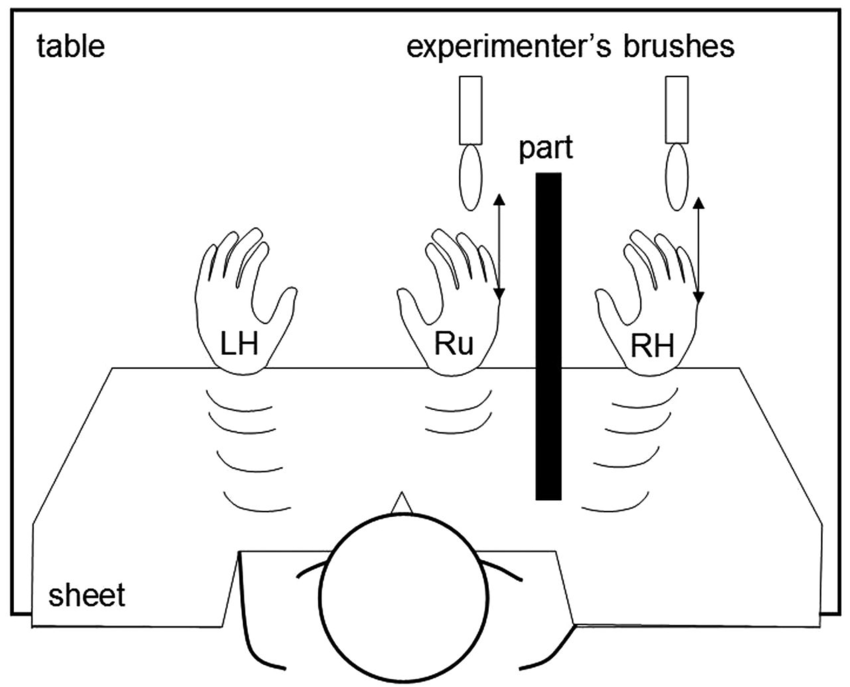
The rubber hand illusion was formally described by Matthew Botvinick and Jonathan Cohen in a short 1998 paper in Nature, and it has been a staple of body perception research ever since. Botvinick and Cohen’s original paper, titled “Rubber hands ‘feel’ touch that eyes see,” appeared in Nature in 1998. The setup was almost embarrassingly simple: a participant’s real hand hidden from view, a visible rubber hand positioned where the real one would normally be, and synchronized brushing on both.
What made the finding remarkable wasn’t the setup but the consistency of the result. Participants watch an artificial rubber hand being stroked in synchrony with strokes on their own occluded hand, and this synchronous visuo-tactile stimulation alters bodily experience as it induces the illusion that the rubber hand is one’s own hand. Nearly three decades later, the experiment still gets run in undergraduate psychology labs almost exactly as it was first published, because it works reliably and the effect is easy to observe firsthand.
How the illusion actually works
At its core, the rubber hand illusion is a conflict between three streams of information: what you see, what you feel, and what your body’s internal sense of position tells you. This perception of one’s own body cannot be reduced to unisensory somatosensory processing, such as touch or proprioception, but instead arises from the integration of sensory information across multiple modalities to form a coherent perception of one’s body in space. When vision and touch line up but proprioception says otherwise, the brain has to settle the disagreement somehow.
It turns out the brain often sides with what it sees. If you see a hand in a location and orientation such that the hand could be yours, and then see this hand contingently touched while feeling the touches, there is a very strong likelihood that this is your hand based on past experience. The brain essentially runs a probability calculation, decides the rubber hand and the felt touch share a common cause, and updates its model of the body accordingly, all without you consciously choosing anything.
Proprioceptive drift: the body quietly moves the goalposts
One of the most measurable signs that the illusion has taken hold isn’t a subjective feeling at all. It’s a physical shift in where people think their real hand actually is. The illusion induces an illusory sense of ownership over the rubber hand in addition to a mislocalization of the real hand, known as proprioceptive drift, where the participant’s perceived hand position shifts towards the rubber hand.
Researchers typically measure this by asking blindfolded participants to point to where they think their hidden hand is before and after the illusion, and the pointing reliably drifts toward the fake hand. Interestingly, this drift and the subjective feeling of ownership don’t always move in lockstep. The subjective embodiment scores and the extent of proprioceptive drift do not always go parallel, which is why researchers continue to treat them as related but distinct measures of the same underlying phenomenon.
Inside the brain during the illusion
Brain imaging studies have tried to pin down exactly where this recalibration happens, and the picture that’s emerged points to a small network rather than a single region. The experience of illusory hand ownership has been linked to activity in frontal brain regions such as the premotor cortex, occipito-temporal regions such as the extrastriate body area, intraparietal areas, the anterior insula, and the temporoparietal junction. That’s a fairly wide net, which fits with the idea that body ownership isn’t handled by one dedicated “self” module but assembled from several sensory and integrative systems working together.
More recent work using electrodes placed directly on the brain’s surface has sharpened this picture further. Increased high-gamma activity in premotor and intraparietal cortices reflected the feeling of ownership, and in both areas this activity was tightly coupled with the subjective onset of the illusion, sustained both during and between touches. That kind of precise timing is hard to fake with a placebo effect, which is part of why the illusion is taken so seriously as a genuine window into how the brain builds bodily self-awareness.
The brain defends what it believes is its own
Perhaps the most striking evidence that the rubber hand genuinely gets folded into the body’s self-model comes from threat experiments. Researchers bring a needle or a bent finger toward the fake hand during the illusion, and the body reacts almost as if it were real. Threat to the rubber hand can induce a similar level of activity in the brain areas associated with anxiety and interoceptive awareness, namely the insula and anterior cingulate cortex, as when the person’s real hand is threatened.
This isn’t just brain activity with no outward sign, either. Forceful bending of the finger of the rubber hand elicits enhanced sweating of the skin, as measured by skin conductance response, during the illusion of ownership. And the effect scales with belief: the stronger the feeling of ownership of the artificial hand, the stronger the threat-evoked neuronal responses in the areas reflecting anxiety. In other words, the more convinced your brain is that the rubber hand belongs to you, the more it panics on its behalf.
Not everyone falls for it the same way
Like most psychological phenomena, the rubber hand illusion doesn’t land with identical force on every person. Some individuals report an almost immediate, vivid sense of ownership, while others feel little more than mild confusion, and researchers have spent considerable effort figuring out why. These two components of the illusion, the feeling of ownership and the proprioceptive drift, seem to be influenced by specific personality traits, with higher sensory suggestibility scores associated with a stronger illusory feeling of ownership.
Structural brain differences may play a role too, not just momentary psychological state. One study found that individual variation in how strongly people experience the illusion tracked with differences in cortical thickness in regions already linked to ownership processing. Previous functional neuroimaging studies have revealed that the feeling of body ownership is linked to activity in the premotor cortex, the intraparietal areas, the occipitotemporal cortex, and the insula, and a study investigated whether individual differences in the sensation of body ownership over a rubber hand are associated with structural brain differences in cortical thickness. It’s a reminder that even a shared illusion can be a genuinely personal experience, shaped by both temporary suggestibility and more fixed features of brain anatomy.
From lab curiosity to real-world tool
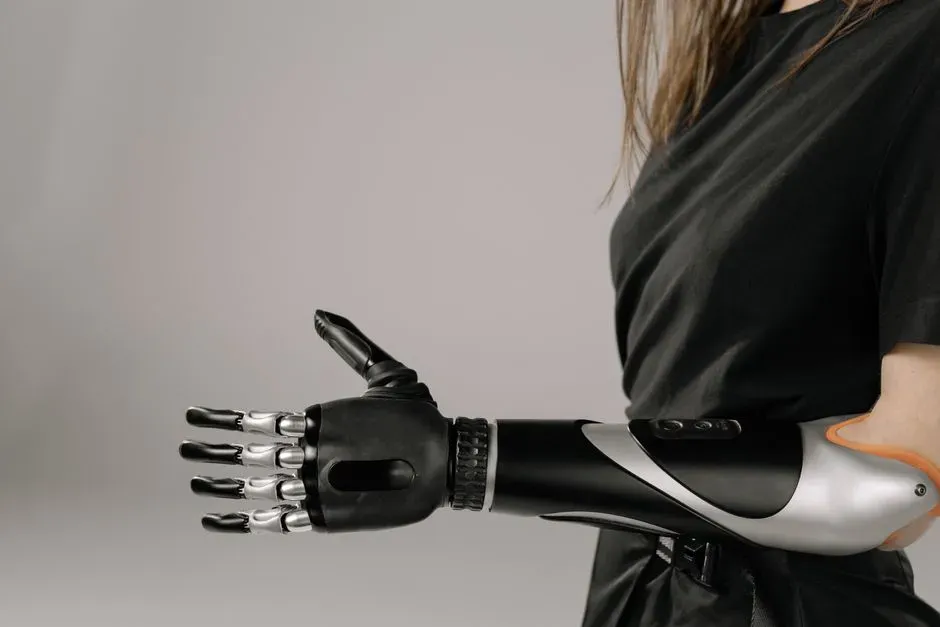
What began as a tidy demonstration of multisensory integration has since found practical footing well outside the psychology lab. Clinicians and engineers have borrowed the same visuo-tactile logic to help people who have lost a limb, or who struggle to accept a prosthetic one. The illusion has been used to study conditions such as phantom limb pain and body dysmorphia, since individuals with these conditions exhibit altered body perception and ownership that can be examined using the same paradigm.
Virtual reality has become a particularly active frontier for this research, letting scientists swap a rubber hand for a photorealistic digital one without changing the underlying mechanism. The investigation of prosthetic embodiment has become a topic of interest in the research community focused on enhancing the perception of artificial limbs as part of users’ own bodies, with surface electromyography interfaces emerging as a promising technology for improving upper-limb prosthetic control. Full-body versions of the illusion have gone even further, with researchers using immersive headsets to make people feel they’ve swapped into an entirely different body. A first person perspective of a life-sized virtual human body substituting for a subject’s own body was found sufficient to generate a body transfer illusion.
Final thoughts
What strikes me most about the rubber hand illusion isn’t that it works, but how little resistance the brain puts up. Give it a plausible visual cue and matching touch, and it will happily reassign ownership of a limb to a piece of latex within minutes, no debate required. That should probably unsettle us a little more than it does.
It suggests that our sense of “this is mine” is far less fixed than it feels from the inside, more of a running best guess than a hard boundary. That’s not a flaw in the system. It’s arguably what makes prosthetic limbs, virtual avatars, and even certain pain therapies possible in the first place. The self, at least the bodily version of it, seems to be something the brain builds fresh from sensory evidence every waking moment, and a paintbrush stroked at just the right rhythm is apparently all it takes to convince it otherwise.