Quantum computing has long been heralded as the next frontier in technology, promising solutions to problems that classical computers cannot tackle. Recent advancements by MIT researchers have introduced a groundbreaking method for quantum processors (QPUs) to communicate directly, paving the way for scalable quantum supercomputers. This innovation addresses key challenges in quantum computing, including error reduction and efficient data transfer.
The New Interconnect: Revolutionizing Quantum Communication
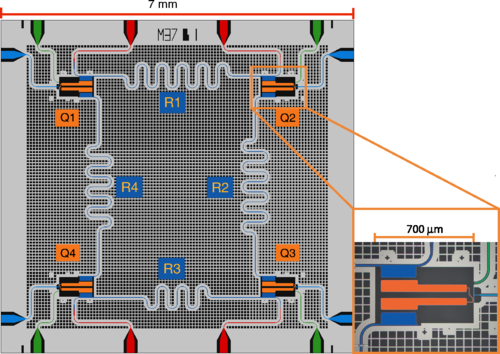
MITS’s invention introduces an “all-to-all” communication system, enabling quantum processors to exchange information directly without relying on point-to-point connections. This system uses a superconducting waveguide to shuttle photons—particles of light—between processors. Unlike traditional methods, which require multiple transfers across nodes, this approach minimizes noise and errors, ensuring more reliable quantum data transmission.
Remote Entanglement: A Key Step Forward
The researchers demonstrated remote entanglement, a phenomenon where quantum processors share correlated states despite being physically separated. This capability is important for building distributed networks of quantum processors. By using microwave pulses to emit photons in user-defined directions, the system achieves flexibility and scalability, making it suitable for large-scale quantum computing applications.
Qudits: Expanding Quantum Computing Horizons
In addition to the interconnect innovation, researchers are exploring the use of qudits—multi-dimensional units of quantum information. Unlike qubits, which operate in binary states (0 and 1), qudits can encode three or more states simultaneously. This advancement enhances computational efficiency and reduces errors, offering new possibilities for simulating complex quantum phenomena.
Implications for Scalable Quantum Supercomputers
These breakthroughs mark significant progress toward quantum supercomputers. The ability to connect multiple processors directly and utilize qudits opens doors to solving high-energy physics problems, optimizing chemical reactions, and advancing artificial intelligence. As quantum computing evolves, these innovations will play a pivotal role in shaping the future of technology.
Conclusion:
MIT’s advancements in quantum communication and the exploration of qudits represent a leap forward in the quest for scalable quantum supercomputers. By addressing fundamental challenges in data transfer and computational efficiency, these innovations bring us closer to realizing the full potential of quantum computing.
Source: