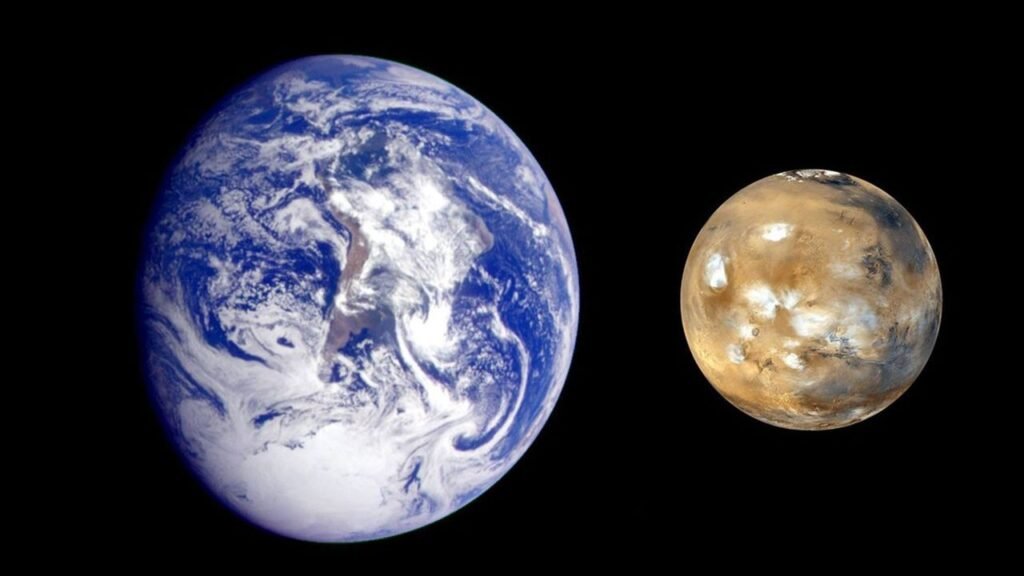

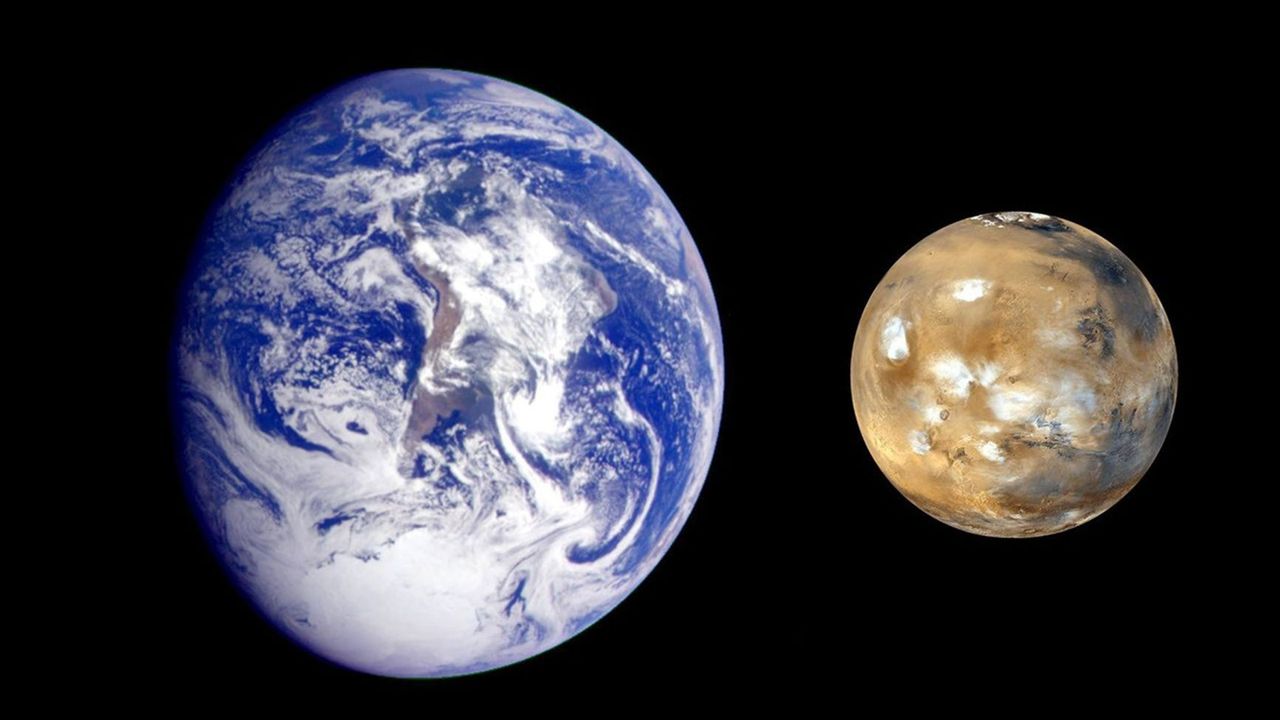
The Subtle Forces Behind Climate Swings (Image Credits: Cdn.mos.cms.futurecdn.net)
Earth’s climate has long danced to the subtle rhythms of its orbit around the Sun, but recent research uncovers an unexpected partner in this cosmic ballet: the distant Red Planet.
The Subtle Forces Behind Climate Swings
Astronomers have identified how gravitational interactions among planets drive the Milankovitch cycles, which dictate the timing of ice ages and warmer interglacial periods on Earth. These cycles arise from variations in our planet’s orbit and axial tilt, influenced by the pulls of neighboring worlds. For decades, scientists focused primarily on the roles of massive Jupiter and closer Venus, assuming smaller Mars contributed little due to its size and distance. Yet a comprehensive study published in late 2025 challenged this view, demonstrating Mars’ outsized effect on these long-term patterns.
The research, led by planetary astrophysicist Stephen Kane from the University of California, Riverside, analyzed how Mars perturbs Earth’s path. Kane’s team modeled orbital dynamics over millions of years, revealing that the Red Planet amplifies key cycles. Without Mars, Earth’s climate history would lack the familiar 100,000-year oscillations tied to glacial advances and retreats. This finding reframes our picture of solar system stability, showing even modest bodies can leave lasting marks.
Mars Punches Above Its Planetary Weight
Mars, with only about one-tenth of Earth’s mass and a diameter half that of our planet, seems an unlikely heavyweight in climate matters. Positioned roughly 140 million miles away on average, its gravitational influence might appear negligible compared to Jupiter’s dominant pull. However, simulations from the study illustrated Mars’ precision timing in orbital perturbations, creating resonances that build over geological timescales. These interactions gradually alter Earth’s eccentricity – the shape of its elliptical orbit – and its axial precession, the wobble of its rotational axis.
One striking revelation came from removing Mars entirely from the models. The 100,000-year cycle, which aligns with major ice age shifts over the past million years, vanished in the absence of the Red Planet. A longer 2.3-million-year cycle, evident in deep-sea sediment records, also depended heavily on Mars’ presence. Kane noted in the publication that these results highlight the interconnected nature of planetary systems, where no body operates in isolation.
Tracing Cycles Through Earth’s History
Milankovitch cycles operate on scales from 19,000 to 2.4 million years, modulating the amount of solar radiation reaching Earth’s surface. The eccentricity cycle, varying from nearly circular to more elongated orbits, spans about 100,000 years and directly correlates with ice volume changes recorded in polar ice cores. Mars’ contribution emerges in how it fine-tunes these variations, preventing chaotic drifts that could destabilize the system.
Evidence from geological archives supports this model. Sediment layers from ocean floors and cave deposits show rhythmic patterns matching the simulated cycles, including those amplified by Mars. For instance, the mid-Pleistocene transition around 1 million years ago, when ice ages lengthened, aligns with enhanced Martian influences in the models. This connection extends back tens of millions of years, suggesting Mars has quietly shaped habitability conditions throughout Earth’s history.
Key Cycles Influenced by Mars
To illustrate the scope of Mars’ role, consider the primary Milankovitch components affected:
- Eccentricity Cycle (100,000 years): Determines seasonal intensity; Mars stabilizes its amplitude, linking directly to glacial-interglacial shifts.
- Axial Tilt Cycle (41,000 years): Affects high-latitude sunlight; Martian pulls modulate its extremes, influencing polar ice melt.
- Precession Cycle (19,000–23,000 years): Shifts seasonal timing; Mars contributes to resonance, syncing with longer-term climate beats.
- Grand Cycle (2.3 million years): Encompasses multiple interactions; without Mars, this overarching rhythm disrupts entirely.
These elements combine to create the predictable climate pulses observed in paleoclimate data, underscoring Mars’ integral part in the solar system’s gravitational symphony.
Implications for Future Climate Research
This discovery prompts a reevaluation of how we model Earth’s climate future amid human-induced warming. While Milankovitch cycles operate slowly, understanding their drivers improves predictions of natural variability. For example, current orbital configurations place Earth in a cooling phase, but anthropogenic greenhouse gases override this trend. The study emphasizes the need for holistic solar system simulations in climate science.
Looking ahead, researchers plan to extend these models to other exoplanetary systems, testing if similar dynamics foster habitable zones elsewhere. Kane’s work, detailed in the Space.com report, invites broader collaboration between astronomers and climatologists.
Key Takeaways
- Mars significantly shapes Earth’s 100,000-year and 2.3-million-year climate cycles through gravitational perturbations.
- Simulations confirm that removing Mars eliminates these critical ice age rhythms.
- This interplay highlights the delicate balance sustaining Earth’s long-term habitability.
As we uncover these cosmic connections, one truth stands clear: Earth’s climate story is woven into the fabric of the entire solar system. What role do you see for such planetary influences in addressing today’s environmental challenges? Share your thoughts in the comments.