
The Galactic Center’s Enduring Riddle (Image Credits: Upload.wikimedia.org)
At the turbulent core of the Milky Way, compact clumps of ionized gas have long traced erratic paths toward Sagittarius A*, the galaxy’s supermassive black hole. These enigmatic clouds, too dense for ordinary gas yet too diffuse for stars, offered clues to how matter feeds such extreme objects. Recent observations now point to a nearby binary star system as their origin, revealing a dynamic process that links stellar winds to black hole activity. This finding, detailed in Astronomy & Astrophysics, clarifies a key piece of the galactic center’s complex machinery.
The Galactic Center’s Enduring Riddle
Astronomers have scrutinized the region around Sagittarius A* for decades, drawn to its density of stars, swirling gas, and relentless gravity. This area serves as a unique testing ground for black hole dynamics. Among its standout features were small, bright gas clouds on highly elliptical orbits, inching closer to the black hole over time.
These structures puzzled researchers from the start. Infrared telescopes first spotted them, highlighting their compact nature and rapid motion. Tidal forces from the black hole appeared to stretch them, turning them into vital indicators of inward material flow. Yet their source remained elusive, hindering explanations for the black hole’s steady, low-level accretion.
Unraveling the G-Cloud Network
The plot thickened in 2012 with the detection of G2, a cloud roughly equivalent in mass to a few Earths. Soon after, G1 emerged as a precursor on a parallel trajectory, followed by G2t, a trailing fragment. Further scrutiny revealed these as segments of a broader streamer, dubbed the G1–2–3 system, all sharing nearly identical paths.
Such precise alignment defied chance. Independent clouds converging on matching orbits seemed statistically improbable. This prompted a hunt for a unified producer, capable of ejecting material in a steady sequence. Even modest delivery rates – one Earth mass every decade – could match the black hole’s observed quiescence, underscoring the clouds’ potential role in sustaining it.
Pinpointing the Stellar Engine: IRS 16SW
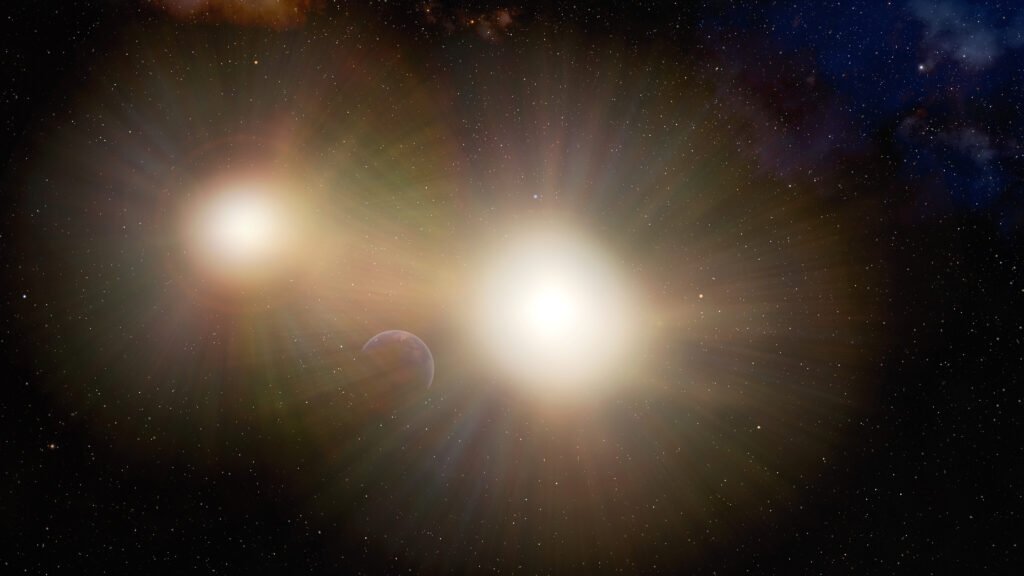
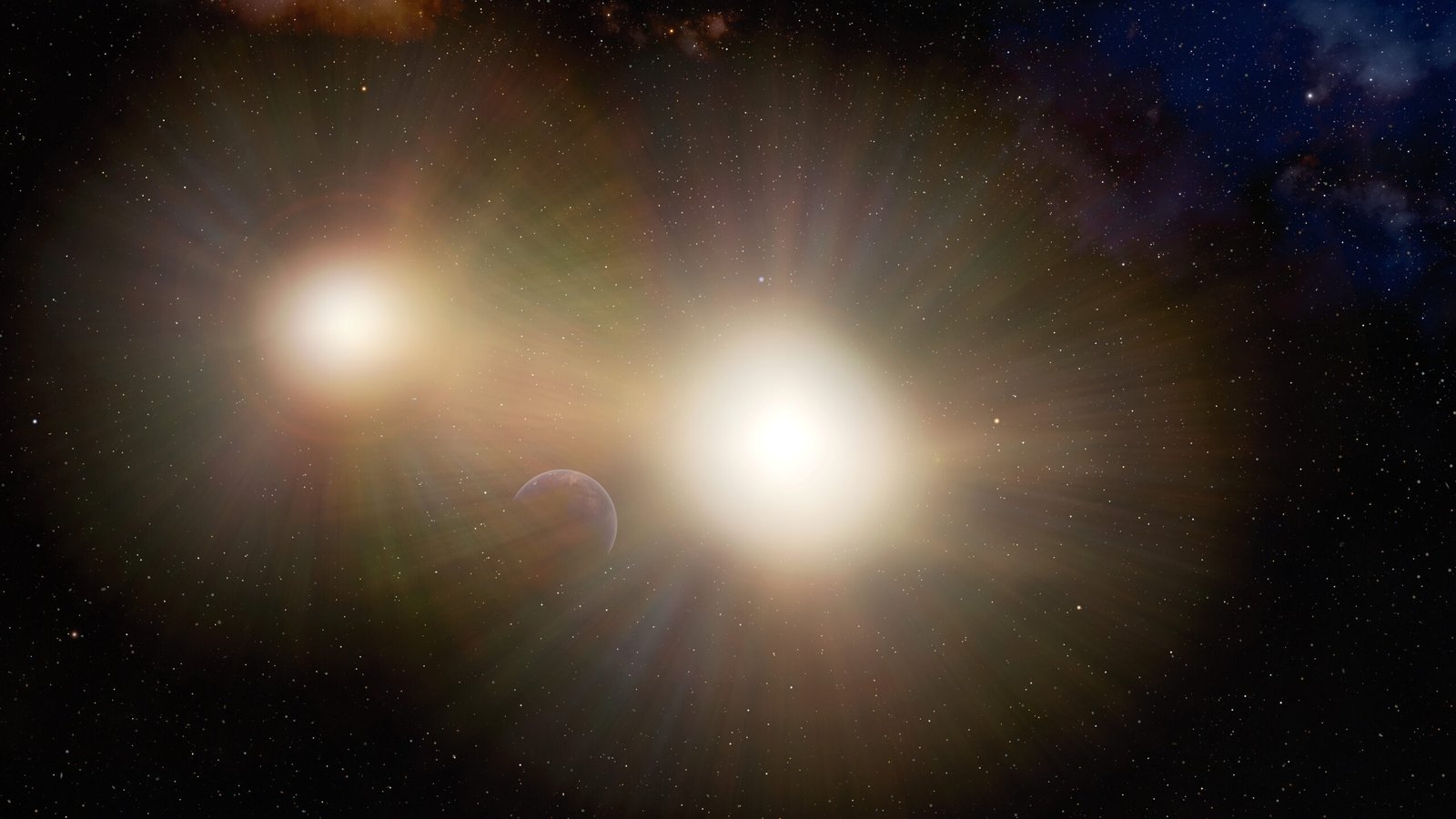
Advanced tracking finally cracked the case. Instruments like SINFONI and ERIS captured infrared emissions, especially the Brackett-γ line, allowing precise backward trajectory mapping. The paths converged on IRS 16SW, a contact binary of massive stars embedded in a young stellar disk around the galactic center.
In this system, the stars orbit so tightly that their fierce stellar winds smash together, forming shock zones ripe for gas compression. Hydrodynamic models confirmed the setup: colliding winds carve out dense pockets that break free and spiral inward, mimicking the observed G-clouds. Orbital wobbles in the binary accounted for slight path variations among G1, G2, and kin.
New data from June and July 2024 sharpened the picture. Position-velocity diagrams from ERIS showed G2t’s emission concentrated at specific offsets, trailed by a faint extension hinting at ongoing flow along the G1–2–3 route. Comparisons with older 2008 observations of G2 reinforced the continuity, painting a vivid sequence of gas ejection and infall.
This longer view integrates scattered clues into a cohesive narrative. What seemed like sporadic events now reflects rhythmic stellar output, modulated by the binary’s own motion within the crowded disk.
Bridging Stars, Gas, and Black Hole Evolution
The revelation extends beyond local clouds. IRS 16SW demonstrates how massive stars actively contribute to their black hole’s diet through wind interactions. These binaries transform stellar outflows into tractable parcels, bridging micro-scale ejections to macro-scale accretion.
Researchers anticipate similar processes elsewhere. In other galaxies, comparable stellar clusters could fuel central black holes via discrete clumps, refining models of growth and quiescence. The galactic center thus emerges not as isolated chaos, but as an interconnected web where stars propel the engine of cosmic power.
With this mechanism identified, attention shifts to refining inflow rates and testing against future observations. The G-clouds, once outliers, now illuminate a fundamental cycle sustaining Sagittarius A* amid the Milky Way’s heart.