
You are glowing right now, whether you feel like it or not. Tiny packets of electromagnetic energy are streaming off your skin, your clothes, your coffee mug, your phone, rushing outward at the cosmic speed limit. Most of that light will be absorbed and re-emitted nearby, but a small fraction will simply miss everything and keep going, crossing the Solar System, the Galaxy, and then the enormous darkness beyond.
If our best cosmological models are right, some of that light will still be traveling long after Earth has crumbled, the Sun has died, and every familiar thing has vanished. It will move through an ever-expanding universe that grows colder, thinner, and quieter, and there is nothing in known physics that reaches out and yanks those photons back. Once that light leaves you, it has its own future, and it is vastly longer than yours.
The Light Leaving You Right Now Really Does Go On (Almost) Forever
It sounds like poetic exaggeration, but the idea that light you emit today can outlive galaxies is a straightforward consequence of basic physics. Every warm object emits electromagnetic radiation; your body glows mainly in the infrared, while LEDs, screens, and lamps add visible and higher-energy photons to the mix. Once those photons escape your immediate surroundings without being absorbed, they are effectively on an endless one-way journey through space, unless they collide with something or fall into a black hole.
Because the universe is not just big but expanding, many of those photons will never find anything to hit. As space stretches, their wavelengths lengthen and their energy drops, but they do not slow down and they do not stop. They just become redder, then microwave-like, then unimaginably long radio waves spread across volumes of space you cannot picture. You can think of each photon as a tiny message that says you once existed, racing outward into a universe that increasingly has nothing left to read it.
Why Nothing in Physics Reaches Out and Erases Those Photons
When you imagine something moving forever, you might instinctively picture friction eventually bringing it to rest. In everyday life, that is how things work: air resistance, surfaces, and fields sap motion away. But at the deepest level, what you are used to calling friction is just interactions with other particles and fields. In the near-perfect vacuum between galaxies, those interactions become so rare that, statistically, most photons never meet anything dense enough to significantly change their path.
Relativity locks in the rule that nothing outruns or overtakes light in a vacuum, and no known law says that free-flying photons simply vanish after a certain time. You do not get a fade-to-black command written into Maxwell’s equations or Einstein’s field equations. Instead, what you get is dilution and redshifting: the light’s energy per photon drops as space expands, and its density falls as it spreads over larger and larger regions. From your perspective, the universe eventually forgets how to notice that light, but it is not because physics cancels it; it is because everything becomes too far apart and too low-energy to care.
Expansion Means Your Light Is Carried Into a Colder, Emptier Future
Cosmological observations point toward a universe whose expansion is not slowing down but accelerating, driven by something you call dark energy. That acceleration means distant galaxies already race away so fast that their light can never reach you, and in the far future your own Milky Way’s remnant will see less and less of the cosmos. Flip that picture around, and it means the light that leaves you and slips past local matter will be swept along into regions no future civilization here could ever reach or even observe.
As the expansion continues, the average temperature of the universe drops, and radiation everywhere is stretched to longer wavelengths. The cosmic microwave background already bathes you with ancient light chilled close to absolute zero, and your own escaping photons are fated to join that ghostly background of low-energy radiation. Over stunningly long timescales, the universe does not so much switch off your light as bury it under distance and expansion, turning sharp, vibrant energy into a faint sea of stretched-out waves.
Heat Death: The Universe Becomes a Place Where Nothing Much Happens
If the current picture holds, your universe is heading toward what cosmologists call heat death, despite the name sounding like everything gets hotter. In reality, it is the opposite: over time, energy sources like stars burn out, fuel is exhausted, and temperature differences smooth away until almost everything sits at nearly the same, very low temperature. The second law of thermodynamics drives systems toward higher entropy, and on cosmic scales that trend points to a state where there are no more big gradients to exploit, no more engines to run, and no more bright, structured phenomena like you.
In that future, nearly all matter is locked in dead stars, cold remnants, or black holes, which themselves very slowly leak energy away as radiation. Your photons are simply part of that far-future haze: stray quanta drifting through an immense, dark cosmos that has lost the conditions for chemistry, biology, or complex structures. When people tell you cosmology is the most humbling science, this is part of what they mean: everything you have ever seen is a brief, bright disturbance in a universe whose long-term plan is to flatten all drama into a thin, uniform fog.
The Silent Battle Between Gravity, Dark Energy, and Your Escaping Light
For a long time, physicists argued over whether gravity might eventually pull the universe back together in a Big Crunch or at least halt expansion. The discovery that expansion is accelerating tipped the balance strongly toward eternal expansion and scenarios like heat death or, under more extreme dark-energy behavior, a Big Rip. In those futures, gravity still matters locally, helping galaxies bind and stars form for a while, but on the grandest scales, the repulsive effect of dark energy wins, and everything becomes more isolated as time passes.
Your light is a spectator in that conflict. It does not change the overall dynamics in any meaningful way; its energy is far too tiny compared to the bulk contents of the cosmos. Instead, it follows the geometry that gravity and dark energy together sculpt. Photons trace out paths through curved, expanding spacetime, stretching and thinning as the cosmic stage grows. You can picture it as tossing a handful of glitter into an inflating balloon: as the balloon doubles, then doubles again, the glitter grains get farther and farther apart, until their presence becomes mathematically trivial even though none of them were ever deliberately removed.
Signals, Memory, and the Limit of What Your Light Can Ever Influence
There is another twist: as expansion accelerates, it creates a kind of cosmic horizon that limits what events today can ever affect. Beyond a certain distance, space expands so quickly that even light racing outward at its top speed can never catch up to regions moving away. That horizon carves the universe into zones of possible influence and zones that are, for all practical purposes, forever disconnected from you. Some of the light you emit is doomed from the start never to reach certain distant galaxies, no matter how long it flies.
Inside your local region, though, your photons can and do interact. They warm dust grains, bounce off atmospheres, hit detectors, and scatter from particles, embedding traces of you in the physical history around you. In principle, with absurdly powerful technology and enough patience, a far-future observer inside the same causal region might still extract tiny clues from those interactions, reading the universe the way you read tree rings or ice cores. In practice, noise and chaos drown such signals quickly. Your surviving light is like a whisper shouted into a stadium during a thunderstorm: technically there, but effectively lost in the roar.
Your Everyday Life Is Already Plugged Into the Cosmic Story

All this talk of heat death and horizons can feel impossibly remote, but it is tied to very ordinary things you already know. Every time you feel the warmth of sunlight on your skin, you are experiencing photons that left the Sun minutes ago, born in nuclear reactions that began their chain inside its core millions of years earlier. When you turn on a lamp, you trigger electric charges that jostle and emit photons, some of which, by sheer geometry, will never hit another atom closely enough to be absorbed.
Once you realize that, it becomes hard not to see yourself as part of a continuous chain of radiation and matter, with no clean boundary between the human-scale world and the cosmic one. Your body is made of atoms forged in ancient stars; your heat and light feed back into the environment and, on a tiny scale, into the larger universe. Compared to the energies involved in galaxies and quasars, your contribution is microscopic, but it is not categorically different. You are another temporary structure through which energy flows on its way from concentration to diffusion.
Meaning, Mortality, and the Strange Comfort of Endless Photons
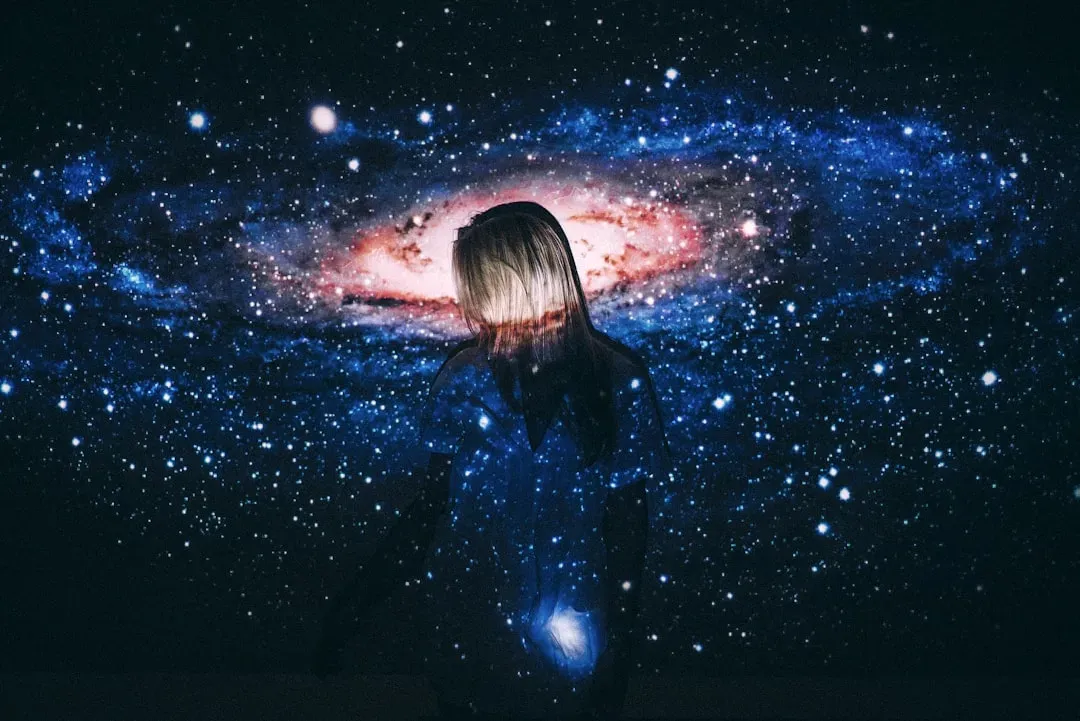
Knowing that the universe heads toward a bleak, low-energy future can feel crushing, and you might wonder what it does to ideas of meaning or significance. If everything you care about ultimately dissolves into a thin bath of long-wavelength radiation, it is tempting to say that nothing really matters. But you can flip that perspective: the very fact that the laws of physics allow for brief pockets of structure, warmth, and consciousness in an otherwise indifferent cosmos makes your small window of time more, not less, astonishing.
You can also take a quiet, almost poetic comfort in the idea that some of your light just keeps going. Long after your memories fade from human minds and your atoms are recycled into other forms, photons that once bounced off your face or radiated from your skin will still be crossing unimaginable distances. They will not tell a coherent story about you, and they will not carry your thoughts, but they will remain a physical trace that you existed, embedded in the same fabric of spacetime that holds the afterglow of the Big Bang. In a universe that forgets almost everything, that is as close to permanence as physics seems willing to offer.
Conclusion: You Shine Briefly, But Your Echo Travels On
When you step back, the picture that cosmology paints is both harsh and oddly beautiful. You live in a universe that began hot and dense, is now cooling and expanding, and very likely will spend almost all of its existence in a dim, dilute state where nothing much happens. Against that backdrop, your entire life, your planet, your species, even your galaxy are transient, local phenomena, like ripples on the surface of a vast, slowly settling ocean. Yet while almost everything familiar will someday cease to exist, the light that leaves you now simply follows the rules and travels on.
You cannot stop that light, and nothing in physics seems inclined to reach back and erase it. It will be stretched, cooled, and diluted beyond recognition, but it will keep going, part of the long twilight of the cosmos. If you let that thought sink in, it can change how you feel about your own brief spark: you are not just passing through the universe, you are also radiating into it, contributing your own tiny threads to its infinite tapestry. When you look up at the night sky, knowing that some of your photons are already on their way to join the darkness, what does that make you feel?