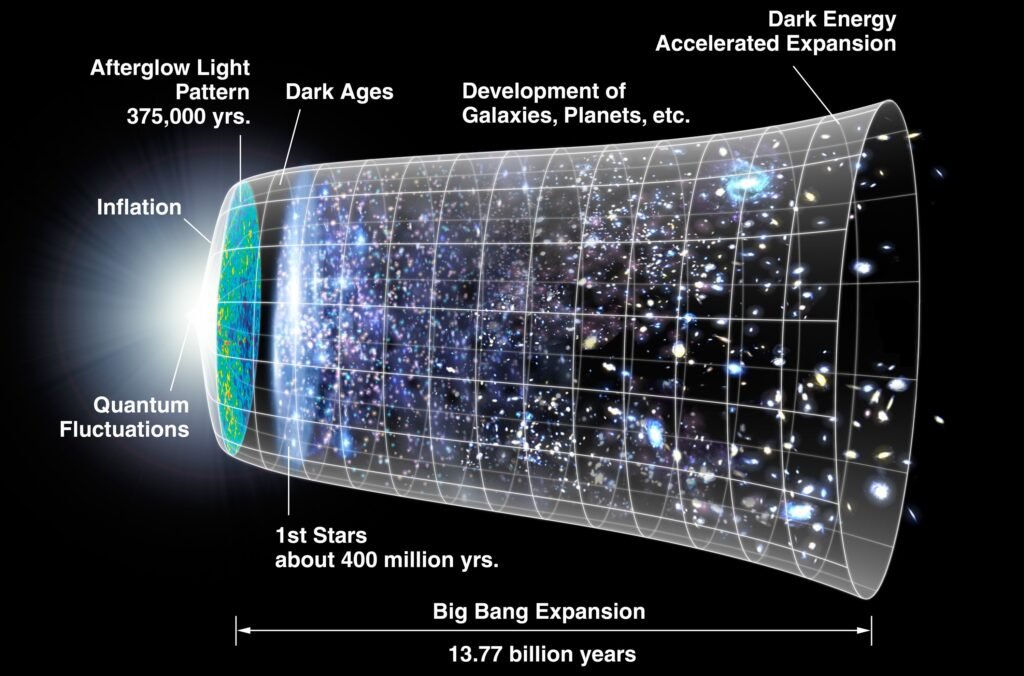


Gravitational Waves Step into the Hubble Debate (Image Credits: Upload.wikimedia.org)
Astronomers grappled with conflicting measurements of the universe’s expansion speed for years, but a fresh technique harnessing gravitational waves promises clearer answers.
Gravitational Waves Step into the Hubble Debate
Researchers unveiled a groundbreaking method last month that taps into the faint cosmic “hum” produced by countless black hole mergers.[1][2] This approach, dubbed the stochastic siren method, analyzes the collective signal from distant collisions too dim for individual detection by current observatories like LIGO-Virgo-KAGRA.[3]
The innovation builds on observations of detectable mergers to predict the background noise, offering an independent gauge of cosmic expansion. Illinois Physics Professor Nicolás Yunes described the development as significant, noting it provides a vital new measurement to address longstanding discrepancies.[1]
Unpacking the Persistent Hubble Tension
The Hubble tension arose when measurements from the early universe, such as those from the cosmic microwave background, clashed with late-universe observations like supernovae distances. Early-universe data suggested a slower expansion rate, while local probes indicated faster growth, prompting speculation about new physics like early dark energy or altered dark matter behavior.[1]
Traditional gravitational wave techniques relied on “standard sirens” – individual mergers with identifiable host galaxies – but suffered from limited precision due to sparse events. The new method circumvents these limits by incorporating the pervasive background hum, shifting estimates toward values that align with the tension zone when applied to existing data.
Deciphering the Cosmic Hum
Teams estimated black hole merger rates from detected events, then extrapolated to unseen collisions across the observable universe. A lower expansion rate would shrink the observable volume, concentrating mergers and amplifying the expected hum; current non-detections thus rule out slower rates.[1]
University of Illinois graduate student Bryce Cousins, the lead author, explained that observed collisions inform the prevalence of unobserved ones forming this background.[2]
- Observed mergers provide direct rate data.
- Background predictions tie rates to cosmic volume.
- Non-detection imposes upper limits on signal strength.
- Combined analysis refines Hubble constant bounds.
- Future detections will yield even tighter constraints.
Researchers Behind the Breakthrough
A collaboration between the University of Illinois Urbana-Champaign and the University of Chicago drove the effort. Key figures included Yunes, founding director of the Illinois Center for Advanced Studies of the Universe; University of Chicago Professor Daniel Holz; and graduate students Cousins and Kristen Schumacher, both NSF Graduate Research Fellows.[1]
Holz highlighted the rarity of such novel cosmological tools, emphasizing the hum’s potential to reveal the universe’s age and makeup.[3] Their work appeared in Physical Review Letters, with a preprint on arXiv.
Looking Ahead to Cosmic Clarity
Gravitational wave detectors will gain sensitivity in coming years, potentially detecting the background within six, sharpening measurements further.[2] Even absent detection, tightening upper limits will narrow Hubble constant possibilities, aiding resolution of the tension.
Key Takeaways:
- Stochastic siren method uses merger rates to probe expansion.
- Independent of light-based techniques for unbiased results.
- Poised for precision leaps with upgraded observatories.
This gravitational wave strategy stands as a beacon for cosmology, potentially unveiling whether the tension signals flawed assumptions or undiscovered forces. What do you think will settle the debate? Tell us in the comments.