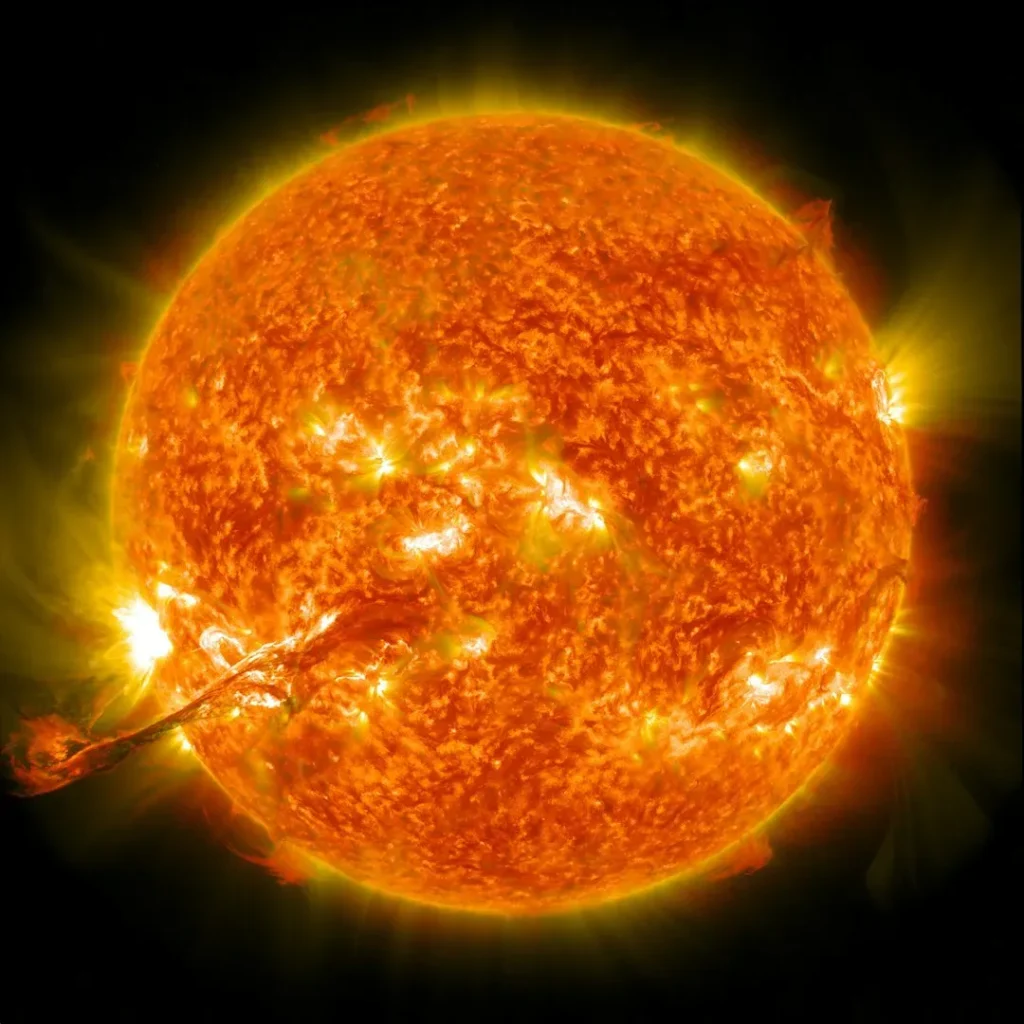

Most of us grow up with the Sun as this solid, background guarantee: it rises, it sets, life goes on. But astrophysics quietly adds a disturbing footnote to that comforting picture. Our star is not a permanent fixture; it is a nuclear engine halfway through its usable fuel, already evolving in ways that are subtle now but brutal in the long run. Once you really walk through the timeline of what happens from “right now” to “five billion years from now,” the calm blue sky starts to feel more like a ticking clock.
There is something strangely intimate about realizing the Sun is middle‑aged. It has moods, it has a life story, and we happen to exist right in its most stable, golden chapter. We are not at the beginning, and we are definitely not around for the end. That combination is comforting and uncomfortable at the same time: our near future is safe on human timescales, yet the script of our distant doom is already written in the physics of hydrogen and helium. Once you see that arc, it is hard to look at a sunny day in quite the same way.
We Live in the Sun’s Calm Middle Age
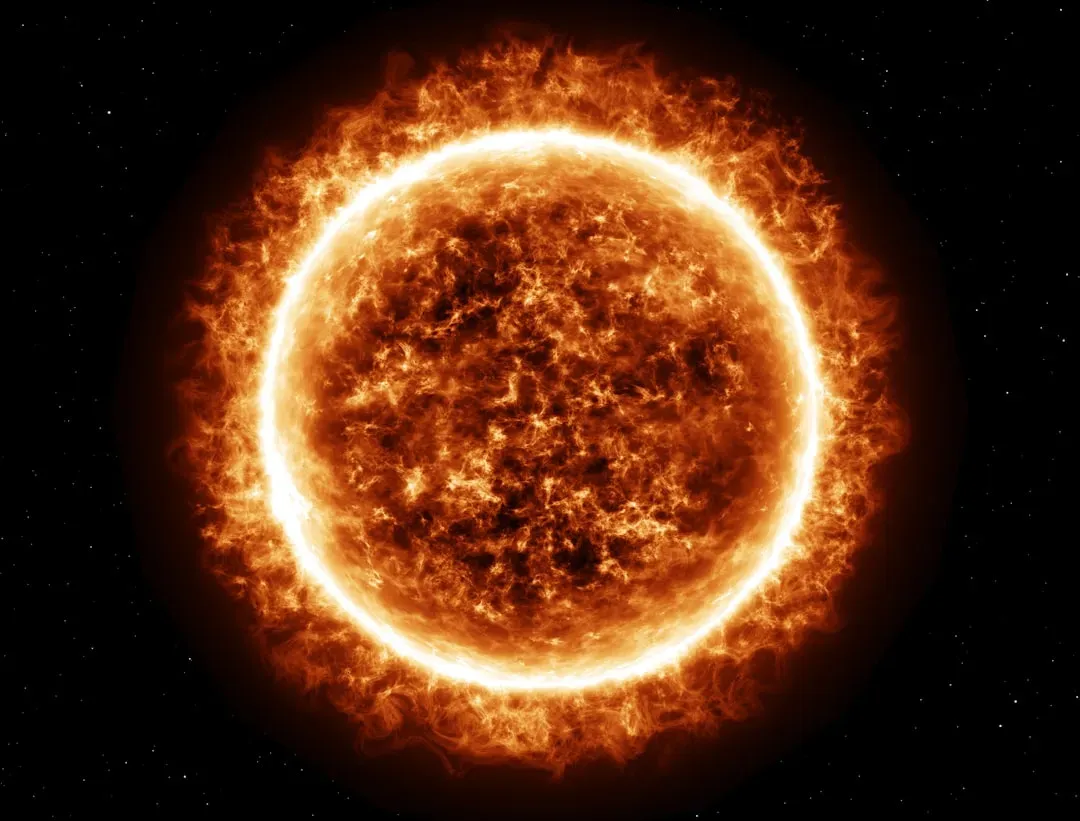
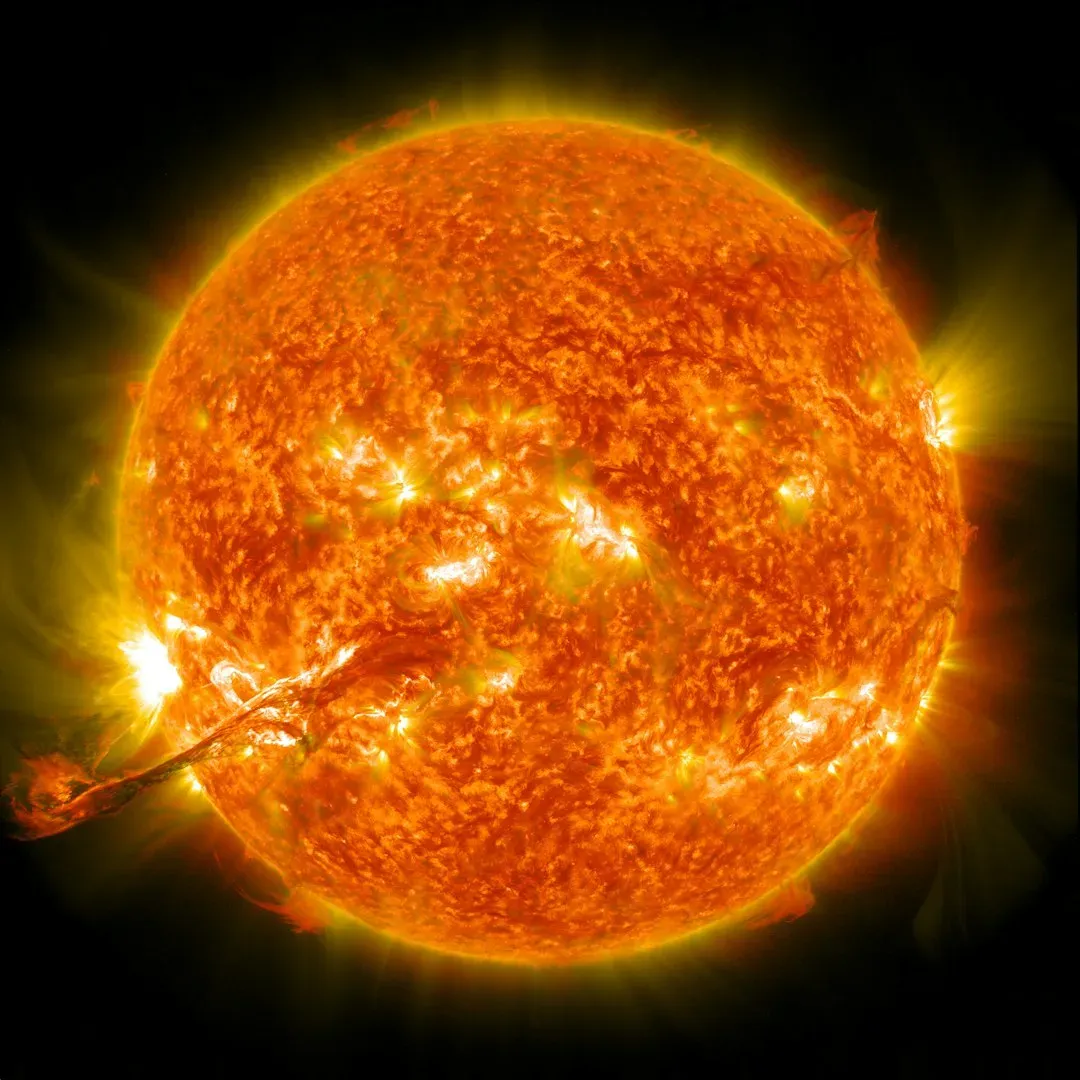
The Sun is about four and a half billion years old, and standard stellar models say a star like ours spends roughly about ten billion years in its current “main sequence” phase. That means the Sun has already burned through nearly half of the hydrogen in its core, the stuff that powers the nuclear fusion keeping it shining. Right now, it is a G‑type main sequence star: stable, steady, pretty boring by cosmic drama standards – and that is exactly why life thrives here. We are cosmic tenants who lucked into the quiet middle years of the landlord.
Even in this calm era, though, the Sun is not static. Over its main sequence lifetime, it slowly brightens as helium “ash” builds up in the core, forcing fusion to occur in a slightly denser, hotter environment. Compared with its early youth, the Sun today is already noticeably more luminous, and that gradual brightening will continue. On human timescales it looks constant, but over hundreds of millions of years, the energy output ticks upward like a very slow‑motion dimmer switch being turned the wrong way. We just happen to be watching during the flattest part of the curve.
The Subtle Brightening That Quietly Rewrites Earth’s Future
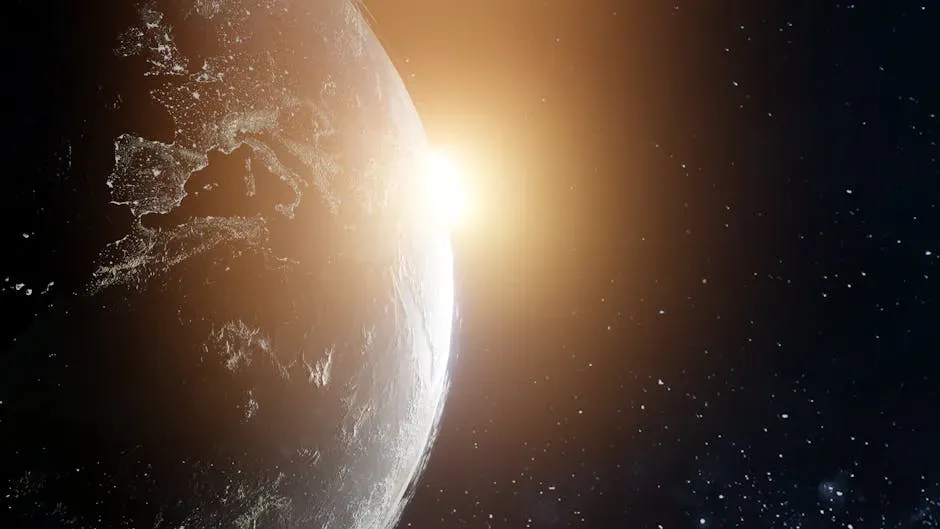
Here is the first uncomfortable twist: the Sun will make Earth uninhabitable long before it dies in any dramatic way. As the Sun’s energy output creeps higher over the next few hundred million to a couple of billion years, the extra heat will push Earth’s climate into regimes we do not see today. Models suggest that at some point in the next one to two billion years, the increased solar flux will trigger a runaway greenhouse‑like scenario. Oceans will gradually evaporate, water vapor – a powerful greenhouse gas – will trap more heat, and the planet’s surface will eventually become far too hot for complex life.
This is not the sudden fireball apocalypse people imagine when they hear “the Sun will die.” It is more like a slow suffocation, with the habitable zone sliding outward while Earth stays put. The atmosphere changes, clouds behave differently, and chemical weathering on rocks speeds up in bizarre ways as temperatures climb. Long before the Sun becomes a red giant, our blue planet’s surface will likely be a desiccated, scorched world. Life, if it survives at all, may retreat into niches underground or beneath the surface, clinging on in microbial pockets while the surface becomes hostile desert.
Core Hydrogen Runs Out: The End of the Main Sequence
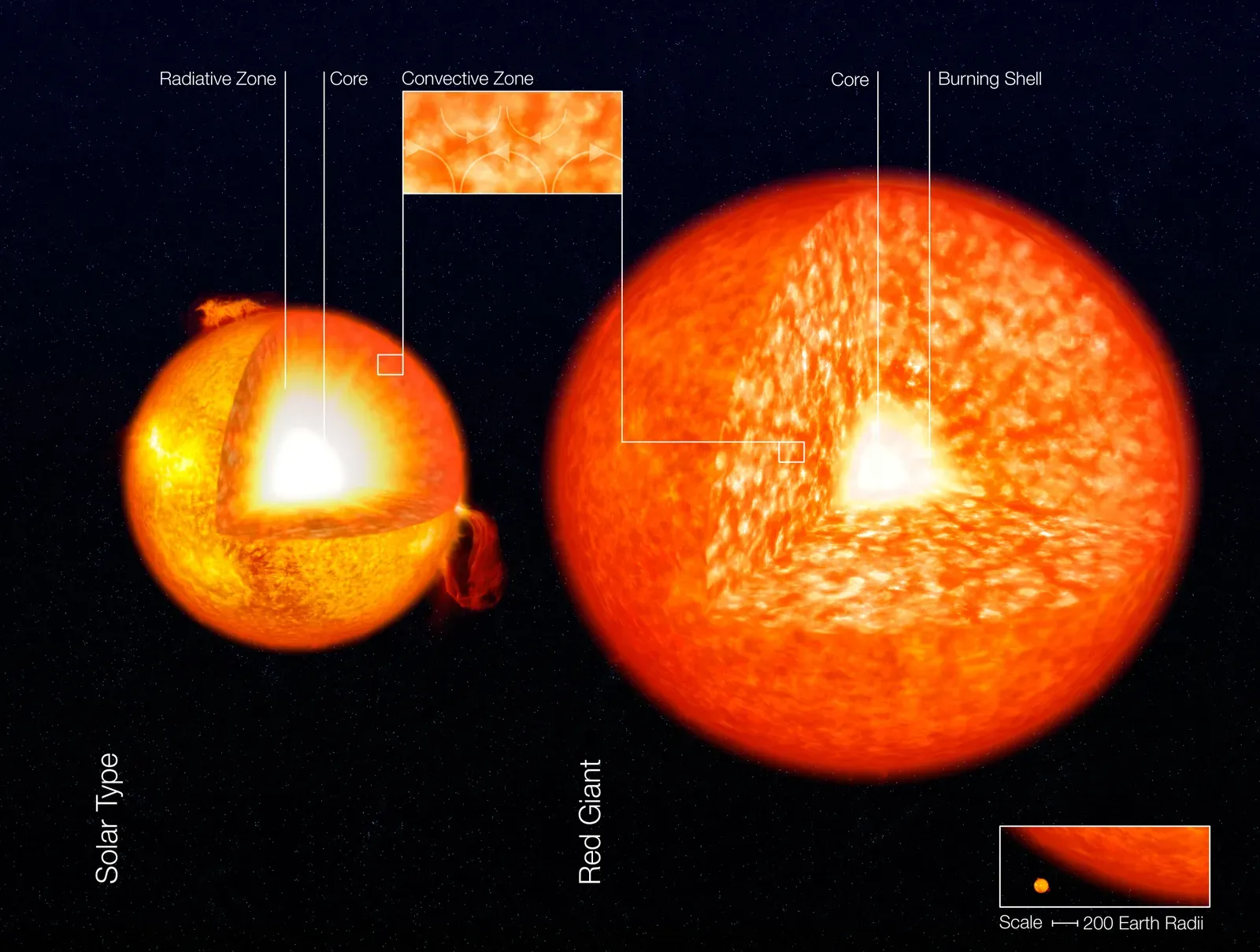
All of this soft‑focus climate horror builds toward a clear physical milestone: the moment the Sun exhausts the hydrogen fuel in its core. Fusion will still occur in a shell around the core, but the once‑actively‑burning central region turns into an inert ball of helium. Without the outward pressure from core fusion to counter gravity, the core contracts and heats up, while the outer layers respond by expanding. It is like the engine in a car suddenly switching to a different, less efficient gear that destabilizes everything under the hood.
From the outside, this marks the Sun’s exit from the main sequence on the Hertzsprung–Russell diagram – the classic graph astronomers use to track a star’s life stages. The star’s luminosity climbs, its radius balloons, and its surface temperature drops, turning it redder even as it becomes intrinsically brighter. This transition is relatively fast by stellar standards, unfolding over tens of millions of years instead of billions. On the cosmic calendar, that is practically an outburst of midlife crisis energy: fast, disruptive, and irreversible.
The Red Giant Phase: When the Sun Swallows the Inner Solar System

This is the part of the story that feels like pure science fiction but is grounded in brutally straightforward physics. As hydrogen shell burning ramps up around the contracting helium core, the Sun will swell into a red giant, expanding to dozens or even more than a hundred times its current radius. Its outer atmosphere will become bloated and tenuous, so spread out that the boundary between “Sun” and “space” becomes fuzzy. From Earth’s current orbit, the sky would not be blue at all; it would be dominated by a swollen, red‑orange disk filling an alarming portion of the heavens – assuming Earth still exists in a meaningful way.
Will the Sun’s swollen envelope physically engulf Earth’s orbit? The honest answer is that models disagree. Some predict the red giant Sun will expand beyond Earth’s current distance, vaporizing the planet entirely. Others suggest that as the Sun loses mass through powerful stellar winds, Earth’s orbit will expand outward, potentially keeping it just outside the Sun’s atmosphere, though the surface will be long fried and stripped. Either way, the inner solar system will become a graveyard: Mercury and probably Venus are gone, Earth is either consumed or sterilized beyond recognition, and the once‑gentle Sun has turned into a bloated, unstable monster.
Helium Ignition and the Wild Swings Before the End
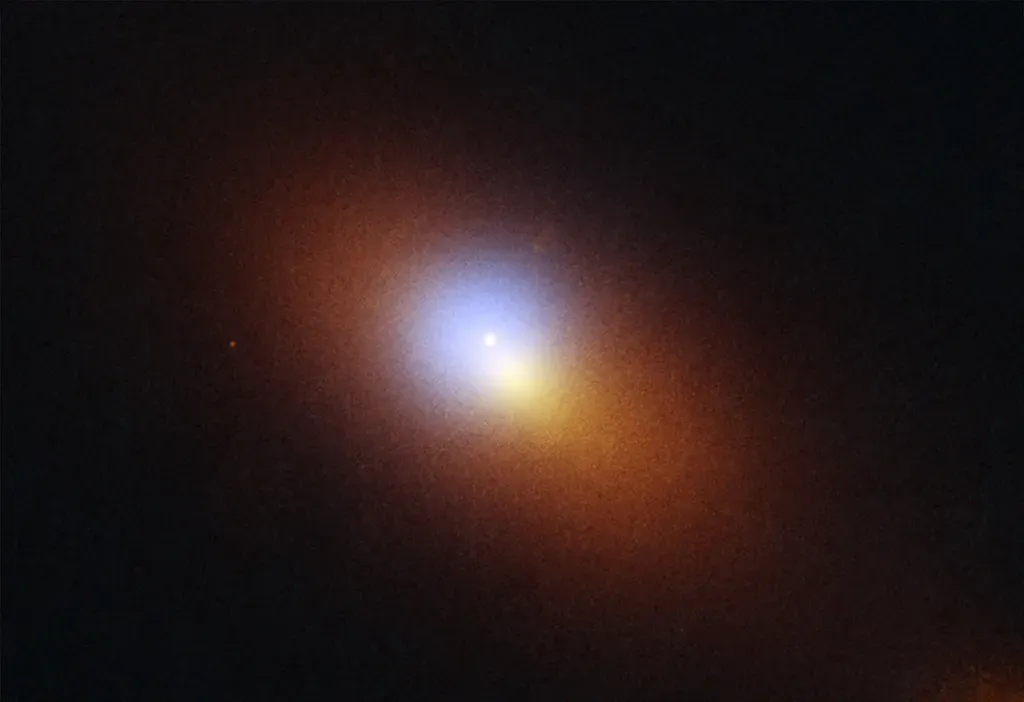
Deep inside that red giant, the contracting helium core keeps heating until it reaches the temperature needed to ignite helium fusion. For a star with the Sun’s mass, this ignition happens in a dramatic event often called a helium flash, where helium begins fusing into carbon and oxygen in a very rapid, intense burst in the core. From the outside, the flash is not a cinematic explosion, but it does dramatically rearrange the star’s internal structure and energy balance. After this transition, the Sun settles into a new, somewhat calmer phase burning helium in the core, though its appearance remains vastly different from the modest star we know now.
Once helium in the core is exhausted, the cycle repeats at a higher level of chaos: helium fusion moves into a shell around a growing carbon‑oxygen core, while hydrogen burning continues in an even larger shell farther out. During these late giant phases, the Sun’s outer layers experience pulses and instability. It sheds mass through strong stellar winds, creating complex flows of gas and dust around it. This is the phase where the Sun is essentially dismantling itself, peeling off its outer layers, one unstable episode at a time, in preparation for its final, stripped‑down state.
The Planetary Nebula and White Dwarf That Will Replace Our Sun
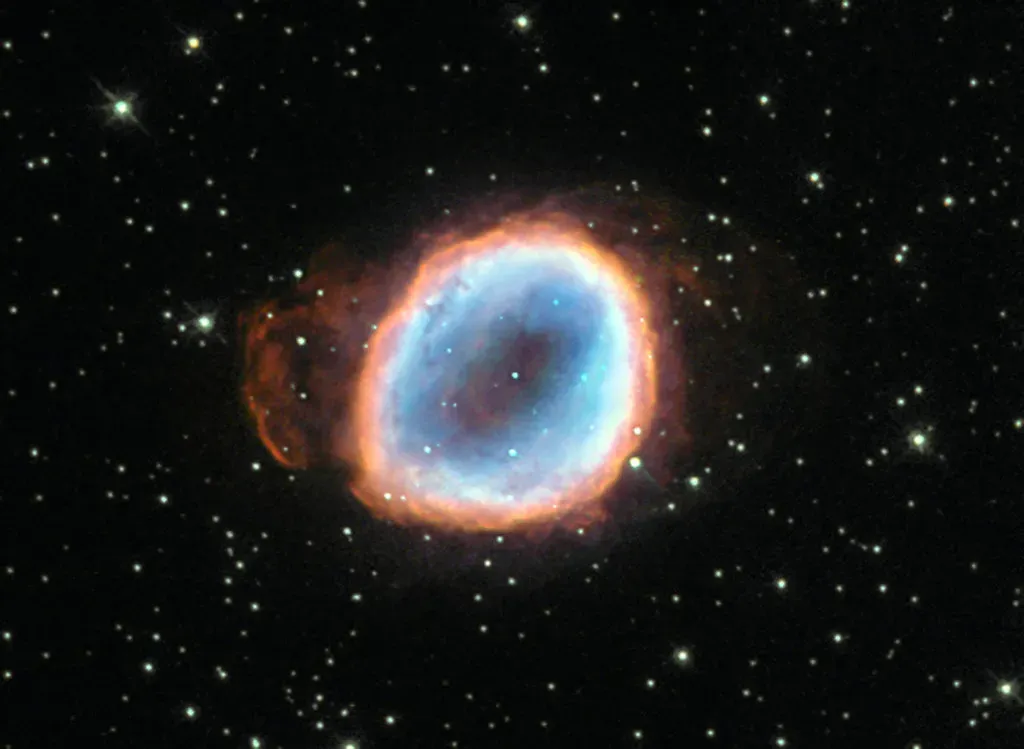
Eventually, the Sun will not have enough mass or pressure to ignite carbon fusion in its core, so it hits a hard physical limit. Instead of collapsing into a neutron star or black hole like massive stars do, it will release its outer layers into space in a series of ejections. Those layers, energized by the intense ultraviolet radiation from the hot, exposed core, will form a glowing shell of gas known as a planetary nebula. From far away, the Sun’s death shroud will look like the delicate, colorful bubbles we see in telescope images around other dying stars – beautiful, but also undeniably a sign of finality.
At the center of that nebula will sit the Sun’s remnant: a white dwarf, roughly about the size of Earth but with around half the Sun’s original mass packed into it. Supported not by fusion but by quantum mechanical pressure from tightly packed electrons, the white dwarf will be intensely hot at first and incredibly dense. Over trillions of years, it will slowly cool and fade, becoming darker and more inert. The solar system at that point will be a drastically different place, with cold, altered orbits, an ember where our star used to be, and any surviving planets or debris silently circling a cosmic corpse.
What This Timeline Really Says About Us
It is tempting to treat this whole five‑billion‑year script as abstract trivia: interesting, dramatic, but so far away that it feels emotionally irrelevant. I do not think that is the healthiest way to look at it. The fact that astrophysicists can chart our star’s long‑term fate with this level of confidence is a humbling reminder that we are not the main characters in the universe; we are local phenomena riding on the life cycle of a single, ordinary star. Our technology, our cultures, our crises – all of it fits inside a brief, thin slice of the Sun’s middle age. That perspective can feel unsettling, but it also cuts through a lot of human arrogance.
My own take is that this story should nudge us toward two apparently opposite attitudes at once: urgency and calm. Urgency, because the only timescales that really matter for us are the next few decades and centuries, where climate, ecosystems, and technology actually decide whether our civilization thrives or collapses. Calm, because on the scale of stellar evolution, our immediate panics shrink to their true size, and we see that the universe is going to do what it does with or without us. The Sun will swell, burn, and fade according to physics, not politics. The uncomfortable question is not whether the Sun will keep its schedule. It is whether we will use our brief window in its gentle light wisely enough to matter at all – and honestly, would you have guessed the universe gave us front‑row seats to such a slow, spectacular ending?