Astounding Orbital Dance Captured (Image Credits: Unsplash)
Astronomers detected a faint orbital perturbation in the gas giant HD 206893 B, located 133 light-years away, raising the possibility of a moon nearly half the mass of Jupiter.[1]
Astounding Orbital Dance Captured
Researchers observed HD 206893 B exhibiting a back-and-forth wobble superimposed on its path around its host star. This motion spans a distance comparable to the Earth-Moon separation and repeats every nine months.[1]
The signal points to an unseen companion exerting gravitational influence on the planet. Lead author Quentin Kral described it succinctly: “This kind of signal is exactly what you would expect if the object were being tugged by an unseen companion, such as a large moon.”[1]
Such precision measurements mark a breakthrough in detecting subtle dynamics in distant systems.
Unprecedented Scale of the Companion
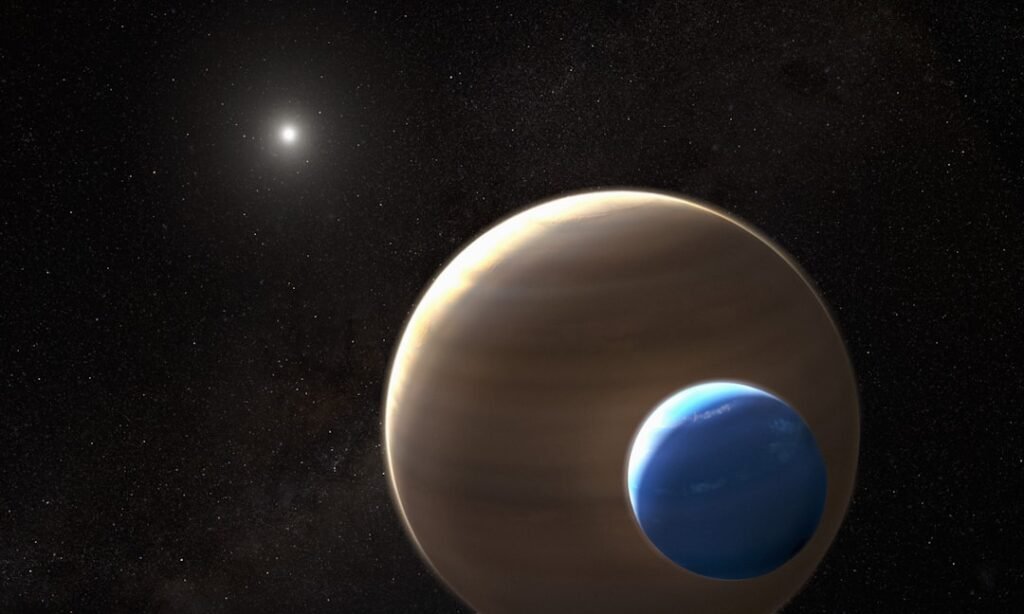
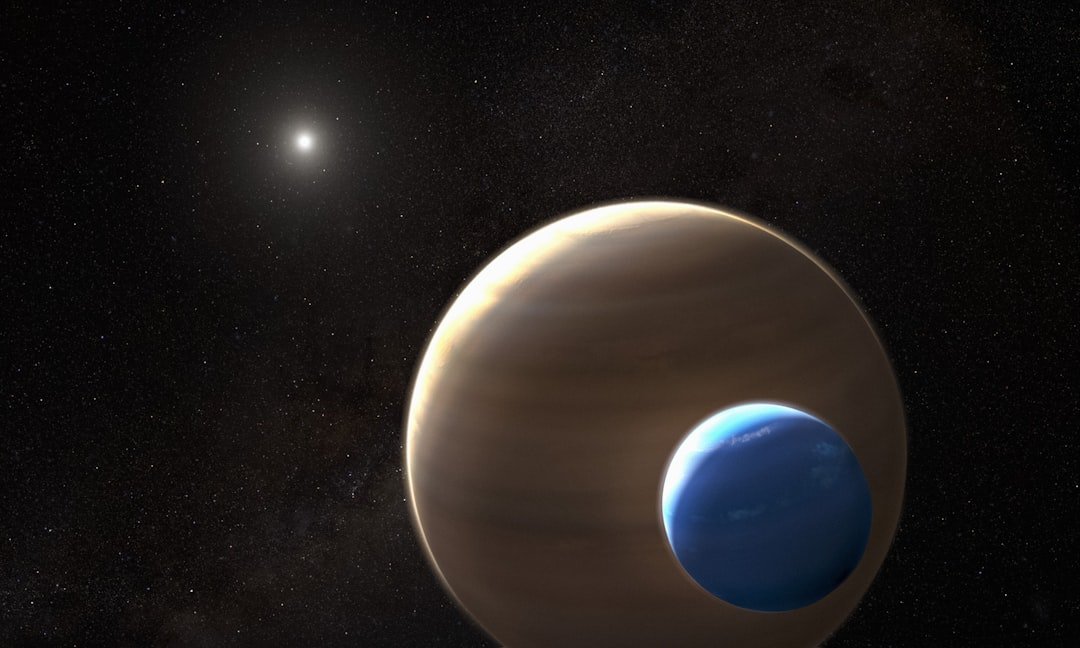
HD 206893 B itself weighs about 28 times Jupiter’s mass, classifying it as a formidable gas giant. The inferred moon candidate tips the scales at roughly 40 percent of Jupiter’s mass, equivalent to nine Neptunes.[1]
This dwarf’s Ganymede, Jupiter’s largest moon, which remains thousands of times lighter than Neptune. The candidate orbits at 0.22 astronomical units from its planet – about one-fifth the Earth-Sun distance – with a highly inclined path at around 60 degrees to the planet’s orbital plane.
- Planet mass: ~28 Jupiter masses
- Moon mass: ~0.4 Jupiter masses
- Orbital radius: 0.22 AU
- Orbital period: ~9 months
- Orbital inclination: ~60 degrees
Precision Tools Unlock the Secret
The Very Large Telescope’s GRAVITY instrument in Chile’s Atacama Desert enabled this feat through astrometry. This technique tracks minute positional shifts over short intervals, from days to months.[1]
Kral noted the advance: “In our study, we pushed this approach much further by monitoring the object over much shorter timescales.”[1] The team, including scientists from the University of Cambridge and Paris Observatory, analyzed data revealing the moon’s tug.
Astrometry proves ideal for wide-orbit moons, unlike transit methods suited to close-in worlds where large moons rarely endure.
Implications and Lingering Questions
No exomoon stands confirmed to date, rendering this a prime candidate amid prior suspects like those near WASP-49 b. Yet the sheer size prompts debate: Does such a behemoth qualify as a moon, or a low-mass binary partner?[1]
Kral highlighted the ambiguity: “At these masses, the distinction between a massive moon and a very low-mass companion becomes blurred.” The findings appeared in a preprint on arXiv and gained acceptance in Astronomy & Astrophysics.
Confirmation demands further observations to rule out alternatives and solidify the signal.
Key Takeaways
- First strong astrometric exomoon signal using VLT’s GRAVITY.
- Candidate vastly exceeds known moons, potentially reshaping definitions.
- Paves way for detecting stable, massive exomoons in outer orbits.
This discovery underscores how refining tools unveils extreme worlds, much like early “hot Jupiters” expanded exoplanet horizons. As techniques sharpen, more exomoons may emerge, refining our cosmic vocabulary. What implications do you see for planetary formation theories? Share your thoughts in the comments.