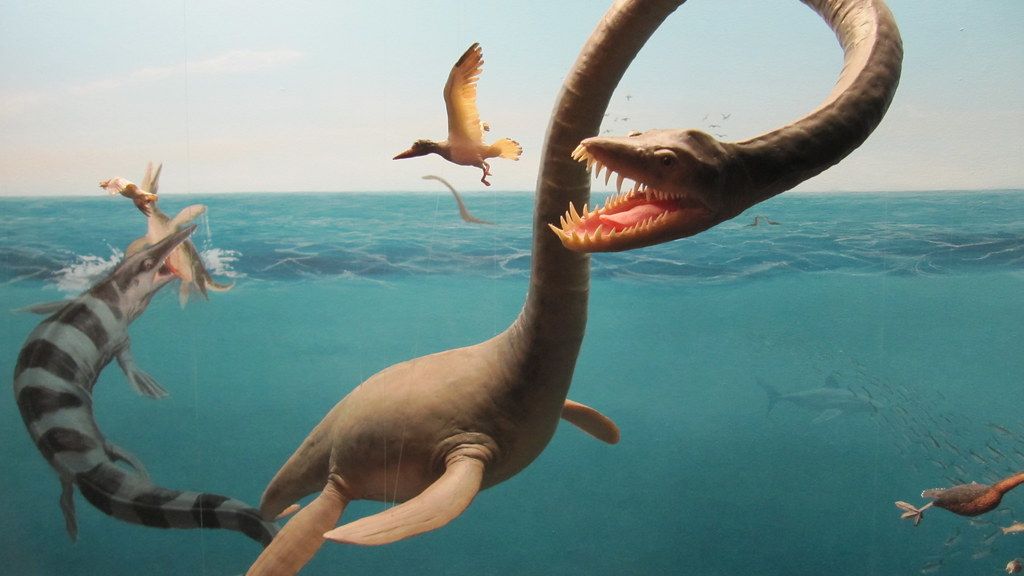
There’s a New T. Rex in Town – and It Swims – Image for illustrative purposes only (Image credits: Flickr)
Eighty million years ago, a vast inland sea divided North America and teemed with marine life. Among its top predators lurked a newly identified species of mosasaur now formally named Tylosaurus rex. Researchers uncovered the creature through careful reexamination of fossils long mislabeled in museum collections across Texas.
Discovery Corrects a Longstanding Mix-Up
Paleontologists at the American Museum of Natural History and the Perot Museum led the study. They compared multiple specimens against the standard example of a related species and spotted clear differences in skull shape and tooth structure. The work, published this week, reclassifies the animal as a distinct species.
The process revealed how easily similar fossils can be grouped together without detailed analysis. Several Texas specimens had sat in storage for years under the wrong name. Fresh scrutiny brought the true identity to light and added a dramatic new player to the record of Late Cretaceous seas.
Size and Features Set It Apart
At roughly 43 feet from snout to tail, Tylosaurus rex ranked among the largest mosasaurs known. Its body plan suited life in the shallow Western Interior Seaway, where it hunted fish, turtles, and other reptiles. The animal’s serrated teeth stand out from those of its relatives, suggesting a bite suited for tearing rather than grasping alone.
Researchers noted the species’ impressive scale with a nod to local pride. One scientist remarked that everything appears bigger in Texas, including these ancient marine lizards. The combination of length and dental weaponry positioned it as an apex hunter in its environment.
Evidence Points to a Violent Lifestyle
Beyond sheer size, the fossils carry signs of intense behavior. Study authors found marks and injuries on specimens that indicate frequent conflict within the species. Such traces exceed what appears in other Tylosaurus fossils examined to date.
Co-author Ron Tykoski described the animal as notably meaner than its close relatives. The pattern of damage suggests individuals may have fought over territory or prey. These details paint a picture of a predator that dominated its waters through both physical power and aggressive encounters.
Broader Context for Marine Reptile Evolution
The find adds to growing knowledge of how mosasaurs diversified during the final age of dinosaurs. Tylosaurus rex lived alongside sharks and giant crocodiles in a dynamic ecosystem that later vanished when the seaway retreated. Its traits help scientists trace adaptations that allowed these reptiles to thrive as top carnivores.
Reclassifying old specimens continues to reshape understanding of prehistoric oceans. Each correction refines the timeline of when certain features evolved and how different groups competed. The Texas discovery underscores the value of revisiting museum holdings with modern methods.
What matters now: The reclassification highlights how ongoing fossil study can rewrite chapters of ancient history. Future work may reveal more about the daily life and interactions of this formidable sea predator.