Human cultures have always borrowed from each other, but some patterns show up in places that seem to have no contact at all. Spirals carved into stone thousands of miles apart. Crosses scratched into pottery on different continents. Eye motifs watching from jewelry in both the Mediterranean and the Americas. It feels almost spooky, like the planet has a shared visual subconscious. Anthropologists usually explain this through shared human psychology and similar environmental challenges, not secret ancient airplanes or vanished super-civilizations. Still, when you line these symbols up, the parallels are hard to ignore and even harder not to feel fascinated by. Why does the same simple shape keep reappearing on tools, temples, toys and bodies? In this article, we’ll walk through twelve of the most intriguing symbols that show up on objects from seemingly unconnected places. We’ll look at what archaeologists actually know, what is still debated, and where people sometimes get carried away. Along the way, you’ll notice a pattern: even without contact, people facing birth, death, storms, hunger and love often reach for the same shapes to make sense of it all.
#1 The Spiral: From Neolithic Stones to Pacific Tattoos
The spiral might be the closest thing humanity has to a universal doodle. You see it scratched into megaliths in Neolithic Europe, carved into rocks across the American Southwest, traced in Bronze Age ceramics, and inked into Polynesian and Māori body art. These cultures were not part of a single global network, yet they kept circling back to the same form.
Part of the explanation is simple biology and physics. Spirals appear in nature everywhere: snail shells, galaxies, hurricanes, unfurling fern fronds, even the inner structure of the cochlea in our ears. When an artist in Ireland and a carver in Micronesia both look around for shapes that feel powerful and alive, the spiral is just sitting there, ready to be copied and mythologized.
In Europe’s Neolithic monuments such as passage tombs, spirals often cluster near entrances, thresholds, and key stones, leading many researchers to suspect they symbolized cycles: of life and death, of the sun, of seasons. In Polynesian tattoo traditions, spirals and spiral-like koru forms are commonly associated with new growth, ancestry and unfolding life. The specific meanings differ, but the underlying idea of motion and transformation keeps coming back.
Some quick ways people have interpreted spirals across cultures include:
- Cycles of birth, death and rebirth
- Solar or lunar paths across the sky
- Water and whirlpools, especially in seafaring cultures
- Inner journeys or spiritual unfolding
None of these interpretations is proven for every instance, and that’s the point: the same shape is flexible enough to carry many layers of meaning, which makes it an ideal candidate to reappear on objects across disconnected societies.
#2 The Sun Disk: Circles With Radiating Lines Everywhere
Draw a circle and add short lines around it and almost everyone on Earth will say you have drawn the sun. That simple formula turns up in ancient Egyptian art, prehistoric European carvings, rock art in the American Southwest, and Bronze Age decorations in Scandinavia and the Near East. The societies behind those objects were separated by geography and time, yet the basic motif is strikingly similar.
There is a very practical reason for this. The sun is one of the few celestial bodies that everyone experiences in basically the same way: it rises, it sets, it warms, and if you stare at it you get a radiating afterimage that looks exactly like a halo of spikes. Many cultures personified or deified the sun, so putting a circle with rays on tools, shields, boats, or jewelry was a way of inviting that power into everyday life.
Archaeologists often find sun disks etched or painted on:
- Ceramic vessels used in rituals or feasting
- Metalwork, especially on items connected to status or warfare
- Wooden objects such as sleds, boats or chariot-like vehicles
- Rock faces marking seasonal solar events
Because a circle-with-rays is such a basic graphic move, you do not need a trade route for the symbol to travel. All you need is people watching sunrises and trying to mark them in a way that sticks in memory.
#3 The Cross: Intersecting Lines From Temples to Textiles
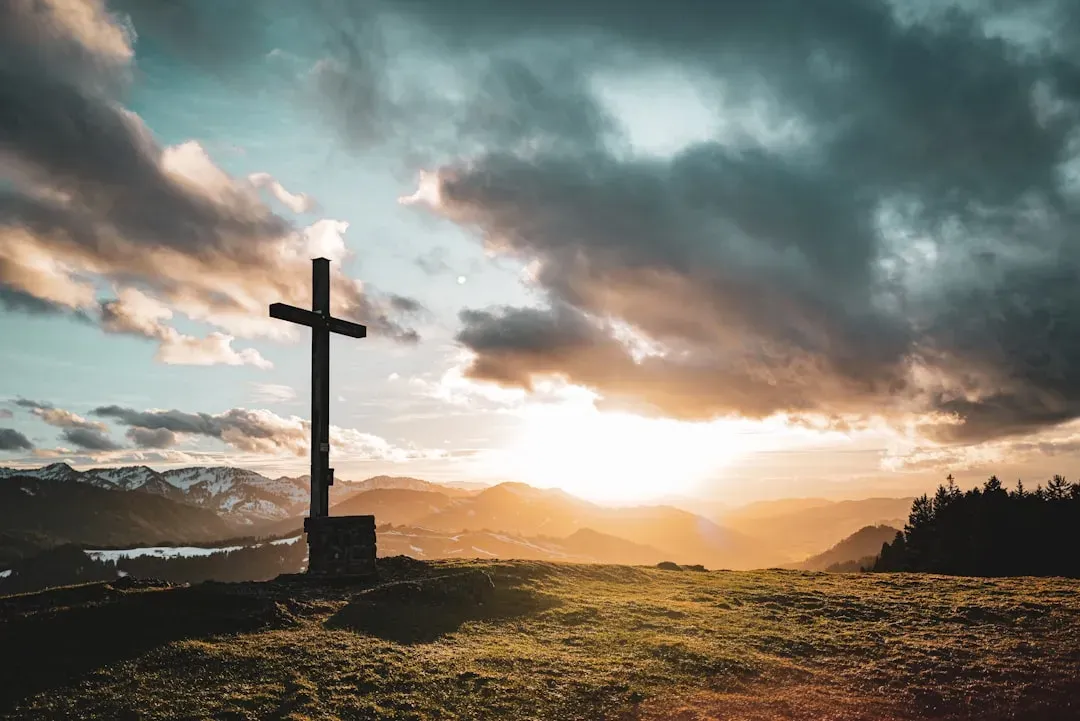
Long before it became strongly tied to Christianity, the simple cross – one vertical and one horizontal line intersecting – was already widespread. Variants of cross shapes show up on pottery in ancient Mesopotamia, carved stones in pre-Christian Europe, Central Asian textiles, Native American art, and African artifacts. Sometimes these are plain crosses, sometimes they are nested or rotated, but the basic idea is the same.
From a design point of view, a cross is almost unavoidable: two lines at right angles are one of the simplest ways to divide space. Many archaeologists interpret early crosses as representing the four directions, the intersection of heaven and earth, or the ordering of space into quadrants. That fits especially well for objects used in mapping fields, plotting buildings, or marking sacred centers.
Interestingly, cross-like layouts pop up in architecture too: settlements and sacred compounds divided into four quarters around a central axis, for instance in parts of Mesoamerica, South Asia and the Middle East. The same mental model – ordering chaos by drawing a north–south, east–west grid – can also spill into decorative motifs on clothing, tools and household items.
In some regions, the cross evolved into more elaborated forms like the equal-armed cross inside a circle (often called a solar or wheel cross). Items marked this way may have combined cosmic symbolism with very practical use, acting as orientation marks or ownership signs. When you spot the same basic pattern on weaving patterns in Peru and carved stones in Europe, you are not necessarily seeing shared religion; you might be seeing shared geometry.
#4 The Eye Motif: Watching Amulets From Many Worlds
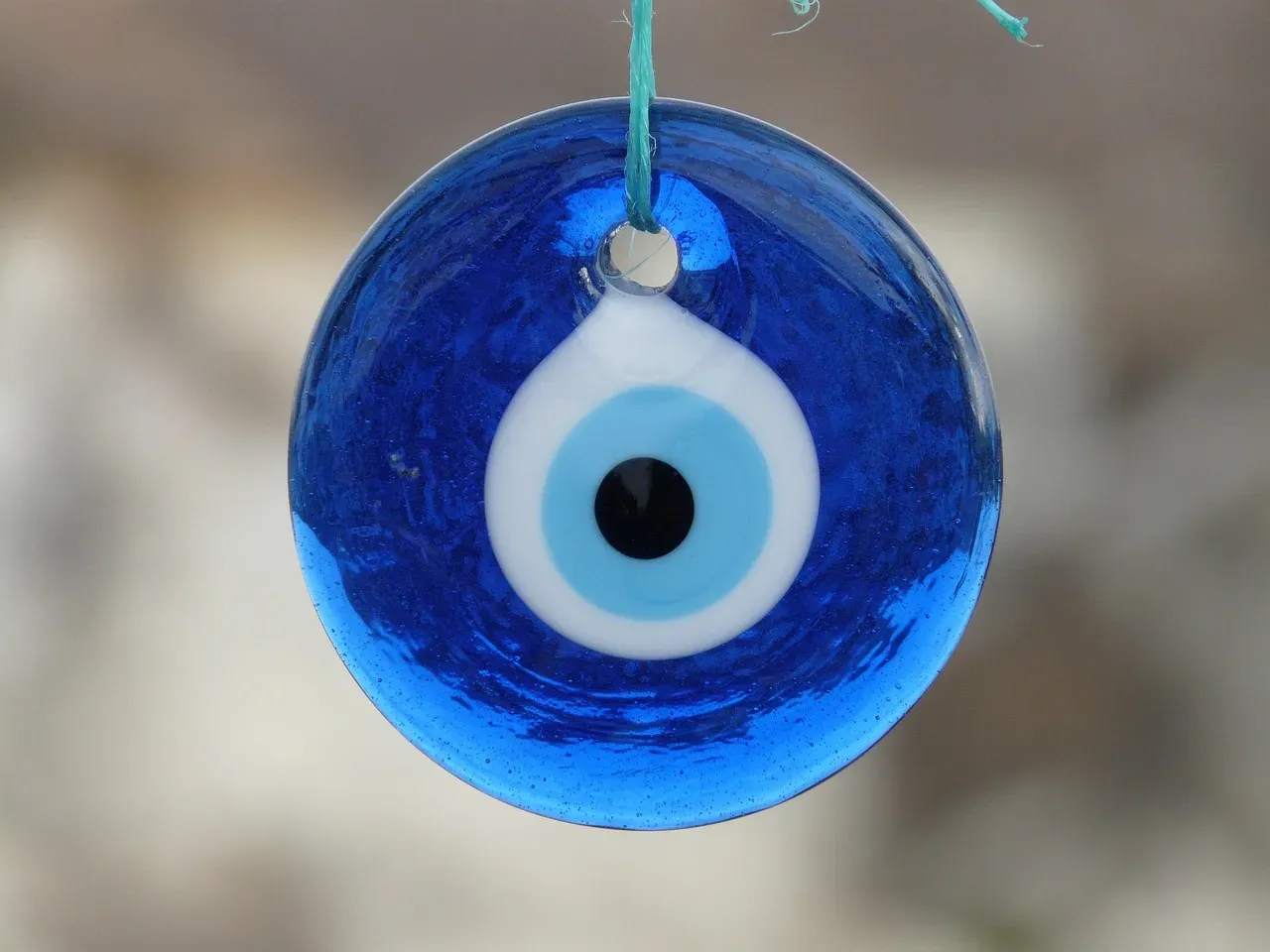
The feeling of being watched is such a basic human experience that people everywhere seem to have turned it into a protective symbol. Stylized eyes show up on ancient boats in the Mediterranean, in Middle Eastern and North African amulets, on jewelry in parts of Central Asia, and on pottery and figurines in Mesoamerica. The famous “evil eye” charms are one version of this wider habit of putting eyes on objects.
Psychologists have found that humans are extremely sensitive to eye-like patterns. Even three dots can feel like a face. That makes the eye an incredibly efficient symbol: a boat with painted eyes seems alert, a house with an eye plaque “sees” intruders, a pendant with an eye “watches” over the wearer. You do not need shared myths for people to come up with this idea; you only need brains wired for social perception.
Across very different places, eye motifs often cluster on:
- Personal objects such as rings, pendants and beads
- Doorways, lintels and house facades
- Boats, chariots and vehicles
- Small cult objects or figurines linked to healing or protection
The meanings are not identical everywhere, but a common thread is defense against harm – whether that harm is framed as envy, spirits, storms or illness. When you put an eye on an object, you are turning it into an ally who looks out for you, and that idea seems to arise again and again in unconnected societies.
#5 The Handprint: Marks From Caves to Modern Banners
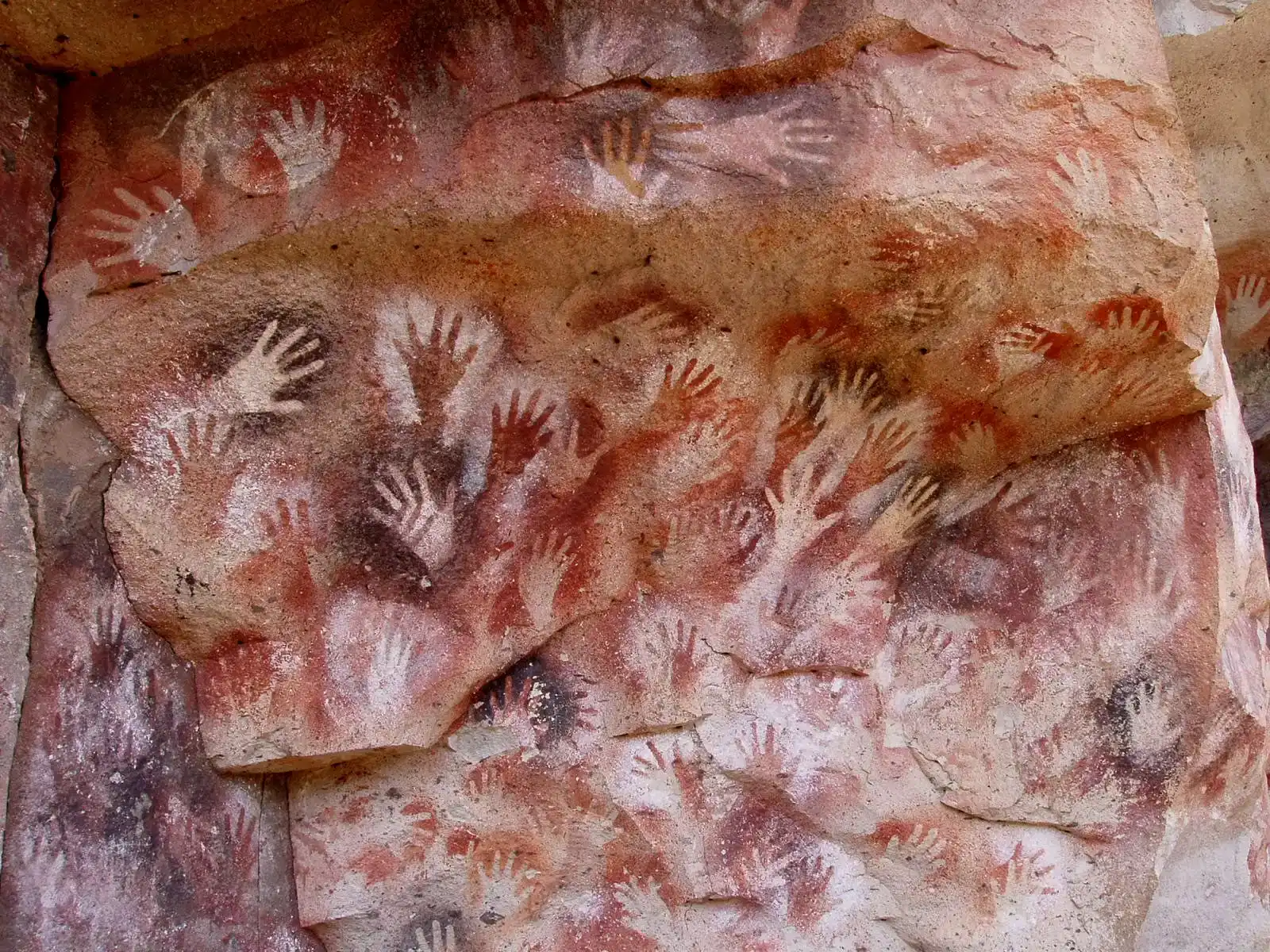
Open hands, often with outspread fingers, appear on ancient cave walls in Europe, Asia, the Americas and Oceania. Many of these are negative prints – people blowing pigment around a hand pressed against rock – but painted or carved hands also show up on pottery, textiles and ritual items in different parts of the world. The basic shape is unmistakable: five-fingered, human, personal.
At its simplest, a handprint can be exactly what it looks like: someone saying “I was here.” That alone explains a lot of wall hands in deep caves and remote rock shelters. But when hands appear regularly on tools, weapons, or ceremonial objects, researchers suspect they carried meaning beyond simple presence, perhaps marking status, pledges, or protective gestures.
Hands are convenient symbols because they are both unique and universal. Everyone has them, but each person’s hand is slightly different. In some cultures, hand motifs on shields or clothing seem to emphasize bravery or agency; in others, especially where the open palm is a ritual gesture, they may invoke blessing or ward off danger.
Consider how modern movements still use stylized hands in logos and banners to suggest solidarity, protection or resistance. That modern instinct is likely not far removed from the urge of a prehistoric artist to stencil their hand onto stone or paint a hand on a ritual object; the symbol ties bodies, identity and intention into a single, immediately legible sign.
#6 Zigzags and Lightning Lines: From Pottery to Petroglyphs
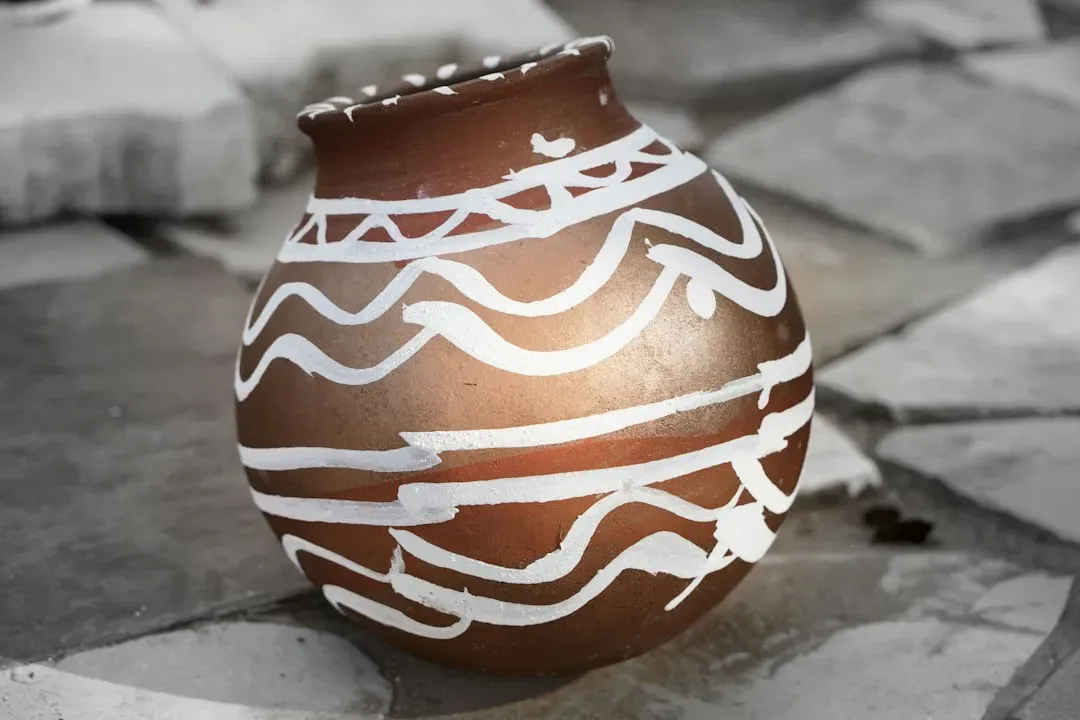
Zigzag lines are everywhere in the global archaeological record: etched into ceramics in Neolithic Europe and the Near East, painted on pottery in ancient China, cut into rock in the Americas and Australia, woven into African and Andean textiles, and carved into weapons and tools from multiple continents. At first glance, they look purely decorative, but their repeated placement hints at something more.
The most obvious natural model for the zigzag is lightning, which is terrifying, spectacular and life-altering when it strikes forests or fields. Many cultures associate zigzags with storms, thunder gods or the raw power of the sky. In arid areas, zigzags can also stand for flowing water, waves or rivers – a nice example of how the same shape can mean two almost opposite things: fire from above or water on the ground.
Across unconnected societies, zigzags appear on:
- Vessels used to store or pour liquids, suggesting water symbolism
- Weaponry, shields and armor, hinting at danger and power
- Architectural friezes, adding rhythm to otherwise plain walls
- Textiles, especially borders and edges, where they act as “visual fences”
Even when no explicit myths survive, the positioning of the pattern gives clues. A zigzag along the rim of a pot might evoke the edge of a river or waves. Bands of lightning-like lines around a warrior’s gear turn them, visually at least, into a storm on legs.
#7 The Swastika and Rotating Arms: Ancient Motifs, Modern Baggage
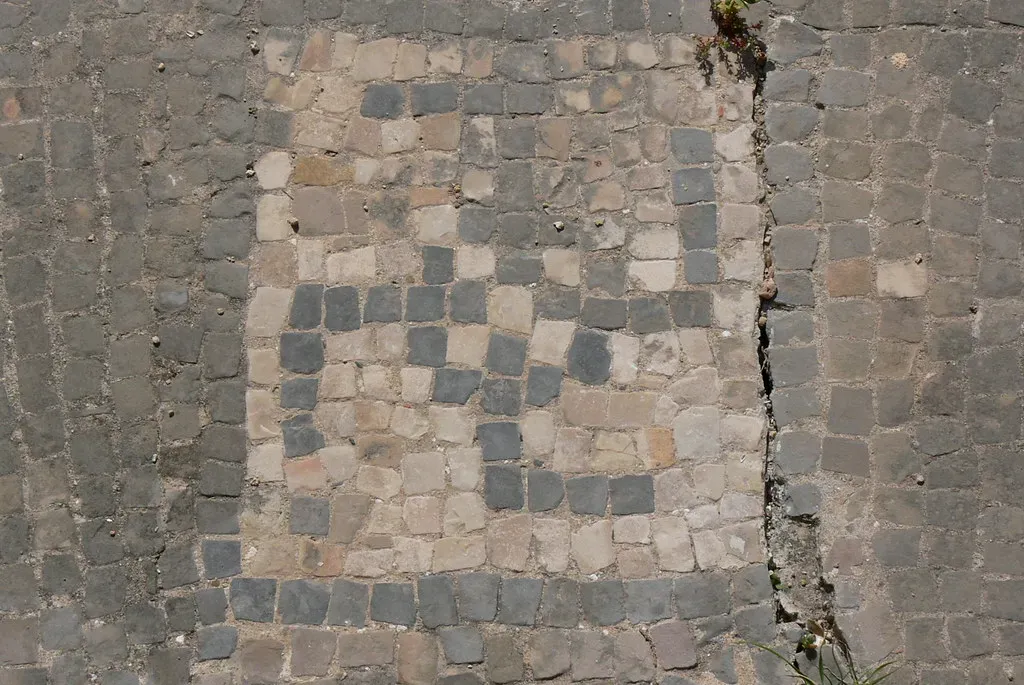
Few symbols show the gap between ancient use and modern reputation as starkly as the swastika and related rotating-armed motifs. Long before the twentieth century twisted it into a sign of hatred, this hooked cross appeared on objects from Iron Age Europe, ancient India, Central Asia, parts of China, and even on some pre-Columbian American artifacts. The basic form – a cross with bent arms forming a swirling pattern – is simple but visually dynamic.
Archaeologists generally interpret ancient swastikas and similar shapes as solar, cosmic or auspicious signs. The rotating feel of the motif fits ideas of turning seasons, spinning stars, or the wheel of life. On objects, the symbol often decorates jewelry, spinning tools, weapons, coins and architectural elements – items that either move literally or are connected to good fortune and protection.
It is important to stress that most of these occurrences arose independently. You do not need a single origin point for a pattern like this to appear. Start with a cross, add movement by bending the arms in the same direction, and you quickly reach a family of shapes that are easy to carve or weave. In many cultures, they likely felt like energetic cousins of the simpler sun disk or wheel cross.
Today, the symbol is understandably painful in much of the world because of its twentieth-century use, and any discussion demands care. Yet when we look at older objects – pottery shards, temple railings, spindle whorls – it is clear that our ancestors saw something very different in those rotating arms: blessing, order, and cosmic motion, not the modern politics forced onto it later.
#8 The Serpent: Coiled, Twined and Everywhere
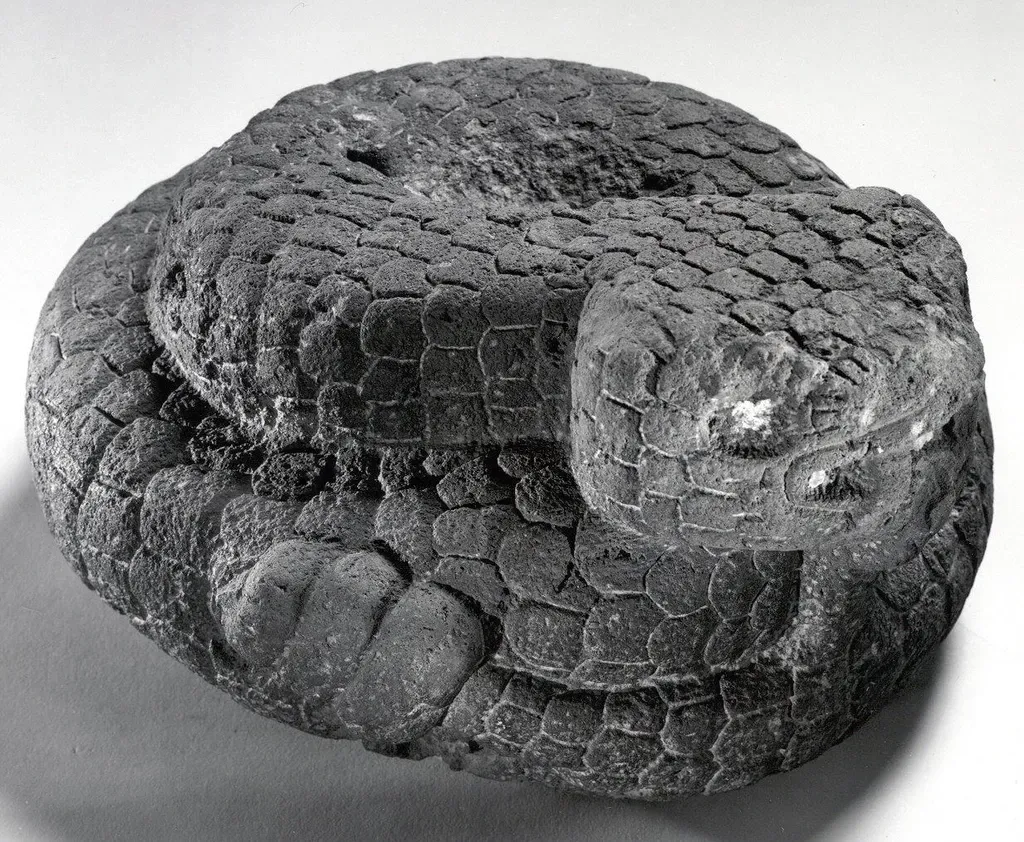
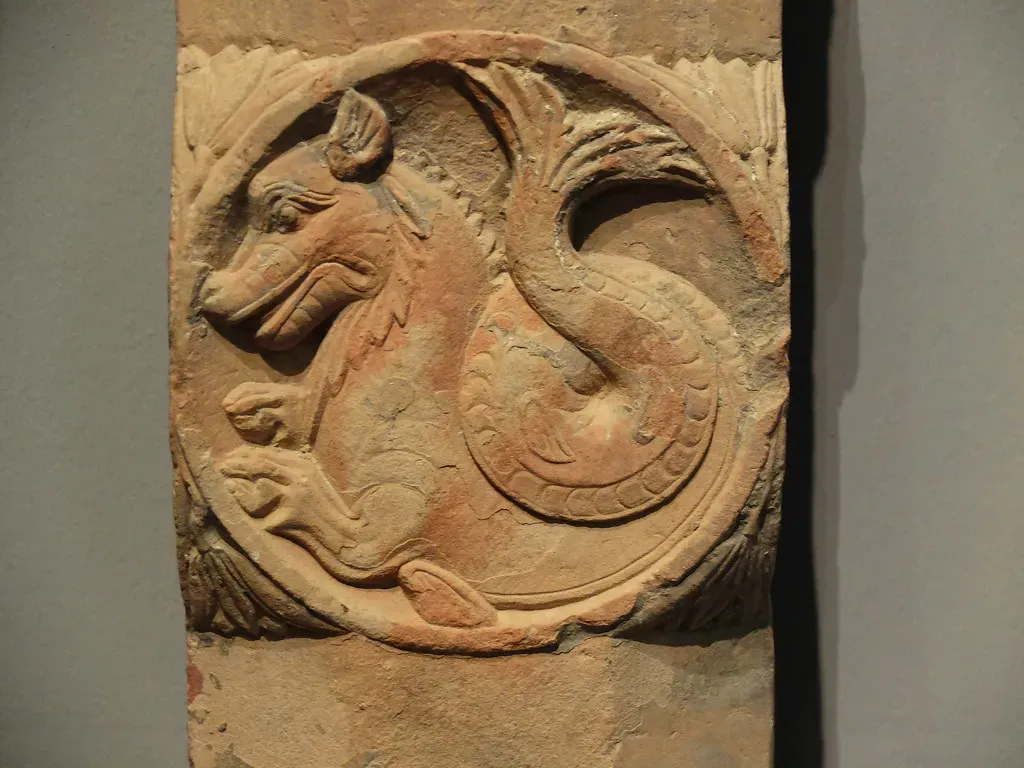
Snakes have a way of slithering into human imagination wherever people live in even vaguely snake-friendly environments. Carved serpents wrap around ritual stones in ancient Europe, appear in ornaments in West Africa, twist through Mesoamerican reliefs, and decorate pottery and jewelry in South and East Asia. Often they show up on objects directly tied to ritual, healing or status.
Biologically, snakes are a powerful stimulus. They move strangely, can be venomous, and shed their skins in what looks like a magical rebirth. That makes them natural candidates for symbolic duty. Across many unconnected societies, serpents end up linked either to danger and chaos or to fertility and renewal – sometimes both at once. A coiled snake on a ritual vessel or staff can encapsulate that entire tangle of fear and respect.
On objects, serpent motifs frequently:
- Wrap around handles, blades or staffs, using their natural coil
- Form borders on vessels, visually containing or empowering the contents
- Serve as central figures on amulets or pendants
- Intertwine with other symbols such as trees, suns or human figures
What makes this particularly striking is how similar the design solutions are. A sculptor in ancient Britain and a carver in pre-Columbian Mesoamerica both realized that a snake’s body is the perfect natural line to wrap around a staff or climb the side of a bowl.
#9 The Tree of Life and Sacred Trees: Vertical Bridges
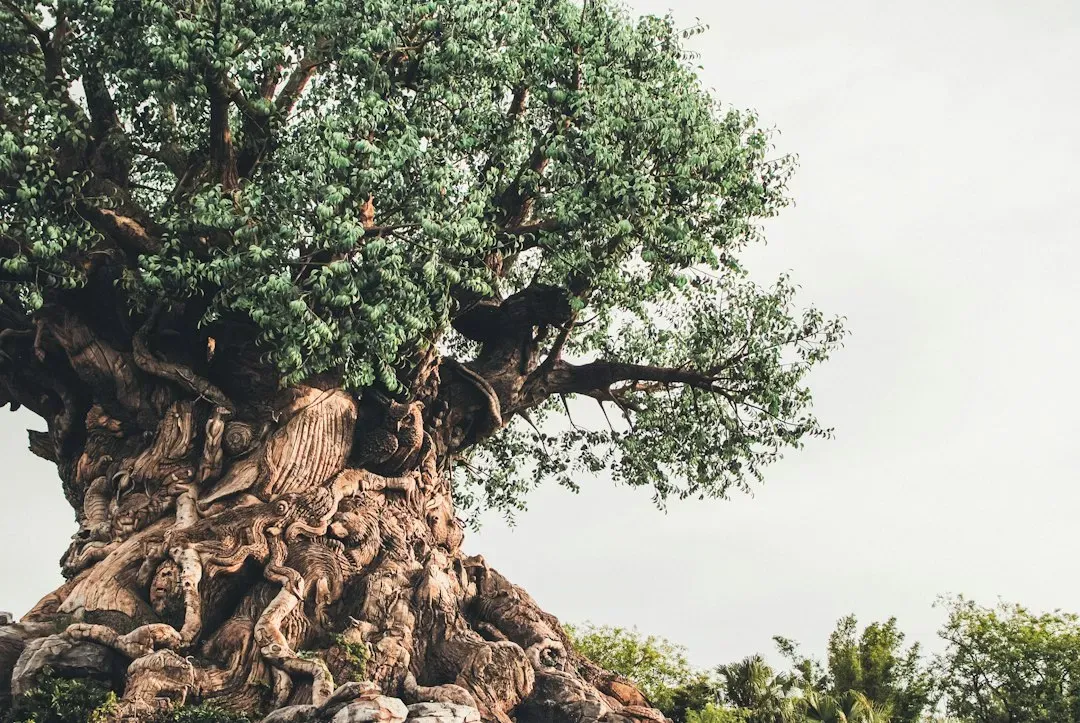
Tree-like symbols – trunks with branching tops, sometimes with roots or animals incorporated – are carved, painted and woven across vast parts of the Old World. Variants also pop up in Mesoamerican art, Norse carvings, and different parts of Africa and Oceania. Not every “tree” is the same concept, but a recurring idea is a vertical connector between realms: underground, surface world and sky.
From a practical view, trees are obvious candidates for symbolism: they are long-lived, rooted in one place, and link darkness underground with light above. When people draw them on objects, those objects often gain a sense of centrality and connection. You see tree-like motifs on ceremonial furniture, textiles used for special occasions, temple walls, and items associated with rulers or priests.
In many places, tree symbols are paired with birds, snakes, or human figures. A bird at the top and a serpent at the bottom, for example, sketch a whole cosmology in a single compact image. Even when we do not have the matching myths, the vertical layout on the object tells us this is more than simple landscape art; it is a diagram of how the world is stacked.
What is fascinating is that physical sacred trees – actual living trees treated as holy – also emerge in many unconnected cultures. Once that practice exists, representing these special trees on portable objects becomes an obvious move. Someone carving a symbolic “world tree” on a comb in one region and someone weaving a similar motif into cloth in another may not share a tradition, but they share the experience of looking at big trees and seeing a living axis.
#10 The Labyrinth and Meandering Maze Patterns
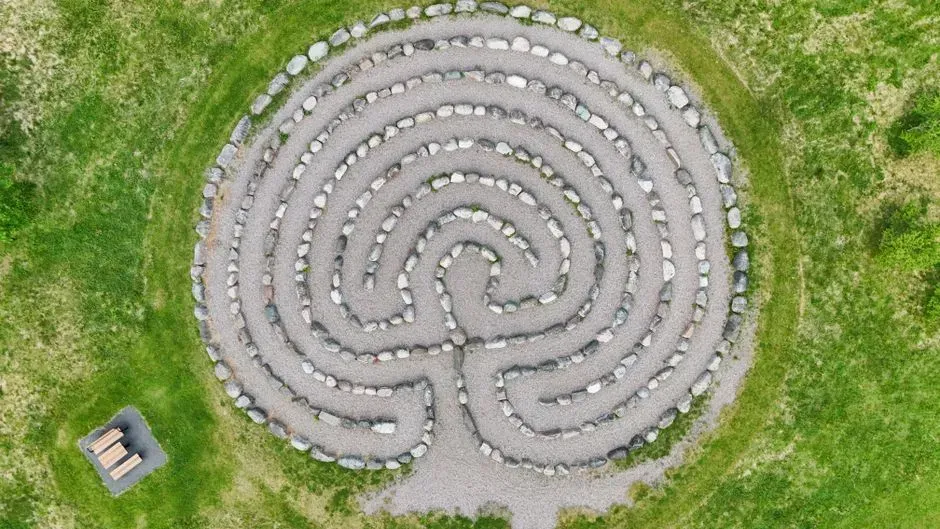
Complex maze-like patterns, especially single-path labyrinths, are carved into rocks and pavements from the Mediterranean to northern Europe, inscribed on artifacts in parts of India, and mirrored in meandering motifs in pre-Columbian and Native North American art. While not always identical, many of these designs share a spiraling, turn-heavy route that winds inward and outward in a controlled way.
On objects, labyrinths and mazes often appear on:
- Small portable items like tiles, plaques or gaming pieces
- Floor designs in sacred or important buildings
- Decorative panels on furniture or ritual gear
- Textiles where the whole surface becomes a wandering path
The appeal is partly mathematical; humans seem to enjoy creating ordered complexity. A labyrinth allows a simple set of rules to generate a design that feels mysterious and absorbing, which is perfect for both play and contemplation.
At the same time, walking or tracing a single-path labyrinth mimics a journey with a guaranteed outcome: you reach the center, then you return. That makes it a convenient metaphor for life stages, initiation and transformation. Even without contact, a culture that enjoys puzzle-like designs and ritual processions might end up inventing similar patterns. When we find them carved into distant stones and woven into unconnected cloth, it is tempting to speculate about long-distance influence, but the raw ingredients – curiosity, symmetry and the urge to turn walking into ritual – are available everywhere.
#11 The Crescent: Moons on Weapons, Jewelry and Flags
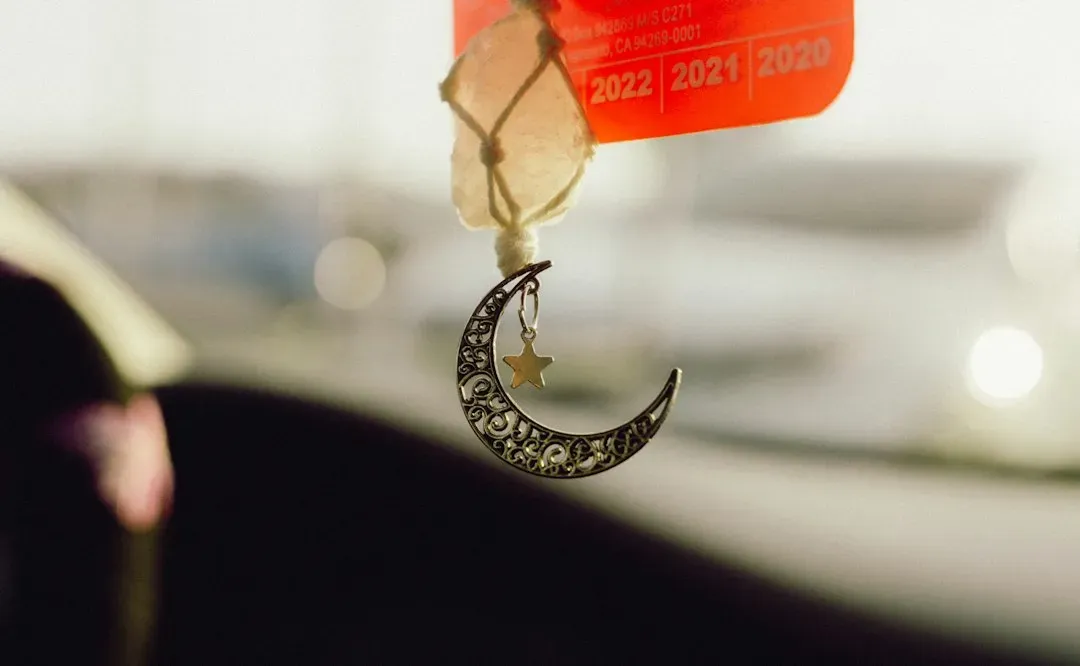
The crescent shape, usually interpreted as the moon in one of its phases, appears across the world: on Bronze Age helmets and ornaments in Europe, on seals and objects in the ancient Near East and Central Asia, on coins and jewelry across South and East Asia, and in varying forms in African and American art. Long before any modern religious associations, people were putting little moons on things.
Unlike the sun, the moon visibly changes shape, which makes the crescent especially striking. It has sharp points but a gentle curve, a combination that feels both delicate and slightly dangerous. Artists and craftspeople often exploit this by placing crescents on the edges of objects – helmet rims, blade decorations, the curve of pendants – so that the symbol echoes the form of the object itself.
Common placements for crescent motifs include:
- Headgear and crowns, linking the wearer to celestial cycles
- Necklaces, earrings and other jewelry that catch light in a moon-like way
- Shields and weapons, where crescent blades and symbols visually merge
- Ritual vessels tied to night-time or seasonal ceremonies
The fact that similar looking crescents show up in distant places does not require a single origin; it mostly requires eyes capable of spotting the thin, bright curve of a new moon. Once that shape is emotionally charged – as a sign for timing crops, tides or rituals – it naturally migrates onto personal and political objects.
#12 The Triangle and the Three-Pointed Motif
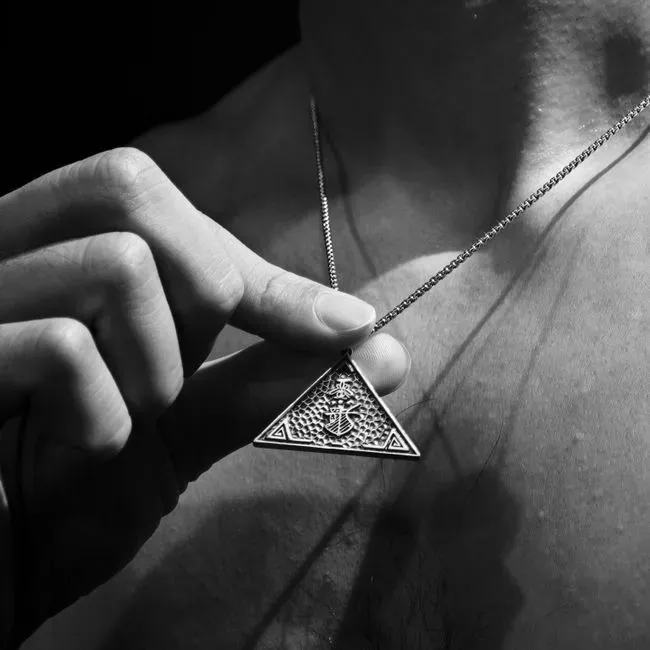
Triangles are among the simplest shapes you can draw, yet their symbolic uses are surprisingly varied and widespread. You can find triangular motifs and three-pointed clusters on prehistoric pottery in Europe and Asia, in African textiles, in Mesoamerican stone reliefs, and in Pacific art. Sometimes they stand alone, sometimes they form repeating bands, and sometimes they combine into more complex geometric schemes.
One intuitive reading is that triangles are the basic building blocks of mountains, roofs, and human bodies in simplified form. Arrange them with the point up and you evoke peaks, spears, or standing figures; flip them and you hint at vessels, wombs or openings. When artists decorate objects like clothing, weapons, storage jars or ritual boards with alternating up and down triangles, they may be playing with opposites: male and female, sky and earth, fire and water.
Across unconnected cultures, three-pointed symbols often carry connotations of stability and completeness. A stool with three legs does not wobble easily; a story with three parts feels satisfying. It is not surprising that this logic shows up visually as clusters of three, triple spirals, triskelion-like motifs, or simple triangular groups scratched into tools and ornaments.
I still remember tracing a band of tiny triangles on a broken shard at a museum and feeling how deliberate they seemed; someone, somewhere, thought three-point rhythm was worth the extra time. Whether those triangles stood for a clan, a concept, or just an aesthetically pleasing pattern, the same taste for threes quietly echoes on entirely different continents.
Conclusion: Shared Minds, Shared Shapes
When you lay these twelve symbols side by side – spirals, sun disks, crosses, eyes, hands, zigzags, rotating crosses, serpents, trees, labyrinths, crescents and triangles – the temptation is to imagine secret oceans crossed, lost maps, forgotten empires knitting the planet together. Some long-distance contacts certainly did exist in the ancient world, but for most of these motifs, the simpler explanation is more powerful: give humans similar bodies, brains and landscapes, and they will keep rediscovering the same shapes.
I think that is actually more astonishing than any single “ancient global civilization” theory. Without coordinated planning, people who never knew of each other carved similar signs into stone, stitched them into clothing, and stamped them onto tools. Their exact stories are different, but their visual language overlaps just enough that a modern viewer can still sense the emotional charge: awe at the sun, fear and respect for snakes, comfort in cycles, pride in leaving a handprint behind.
It also raises an uncomfortable point: if we keep reinventing the same symbols, we can also keep twisting them into very different meanings, as the swastika grimly shows. Symbols are not fixed; they are living negotiations between shape, history and power. That is why studying these recurring motifs matters. It is not just about catalogs of ancient art – it is about understanding how our minds grab onto lines and curves and turn them into stories about who we are.
Next time you notice a spiral on a coffee cup, a crescent on a logo, or an eye charm on a bracelet, it is worth pausing for a second. Somewhere, thousands of years ago, someone with no idea your world would ever exist scratched a similar pattern into a pot or a rock, reaching for the same visual shorthand. For a species scattered across continents and centuries, that quiet continuity is its own kind of miracle – would you have guessed we share this much, just in the way we draw?