

Most people assume science eventually explains everything. Give researchers enough time, funding, and lab equipment, and every strange blip on a screen gets a tidy explanation sooner or later – right? That assumption is wrong more often than most people realize.
There’s a quiet pile of discoveries – from radio bursts to cosmic motion to a medical effect that keeps getting stronger for reasons nobody can pin down – that professional scientists have measured, verified, and then simply shelved. Not because the data was bad. Not because anyone got debunked. They just couldn’t crack it. Here’s what actually happened with the ten cases that never got closed out.
#10 – The Taos Hum

For decades, a small but consistent group of people in specific locations have reported hearing a persistent, low-frequency droning sound that no instrument can fully pin down.
The phenomenon first drew serious attention in Taos, New Mexico, in the early 1990s, when enough residents complained about the same low hum that Congress actually funded an investigation. Investigators from Los Alamos National Laboratory, the University of New Mexico, and Sandia National Laboratories brought sensitive acoustic equipment to the area. They found some low-frequency signals, but nothing that explained why only a fraction of the population could hear it, or why the intensity varied so wildly between listeners standing feet apart.
Fast Facts
- First formally investigated in Taos, New Mexico, in the early 1990s with congressional funding
- Studied by Los Alamos, Sandia, and the University of New Mexico with sensitive acoustic gear
- Also reported in the UK, Canada, and Australia, always affecting only a slice of the local population
- Industrial equipment, wind turbines, and underground pipelines have all been ruled out as sources
Similar hums have since been reported in the UK, Canada, and Australia, always affecting a small subset of the population. The most surprising fact: researchers have never found a single consistent physical source, despite ruling out industrial equipment, wind turbines, and underground pipelines in multiple locations. Some scientists suspect it’s a form of low-frequency tinnitus triggered by environmental infrasound, but that’s a theory, not a confirmed cause.
#9 – Ball Lightning
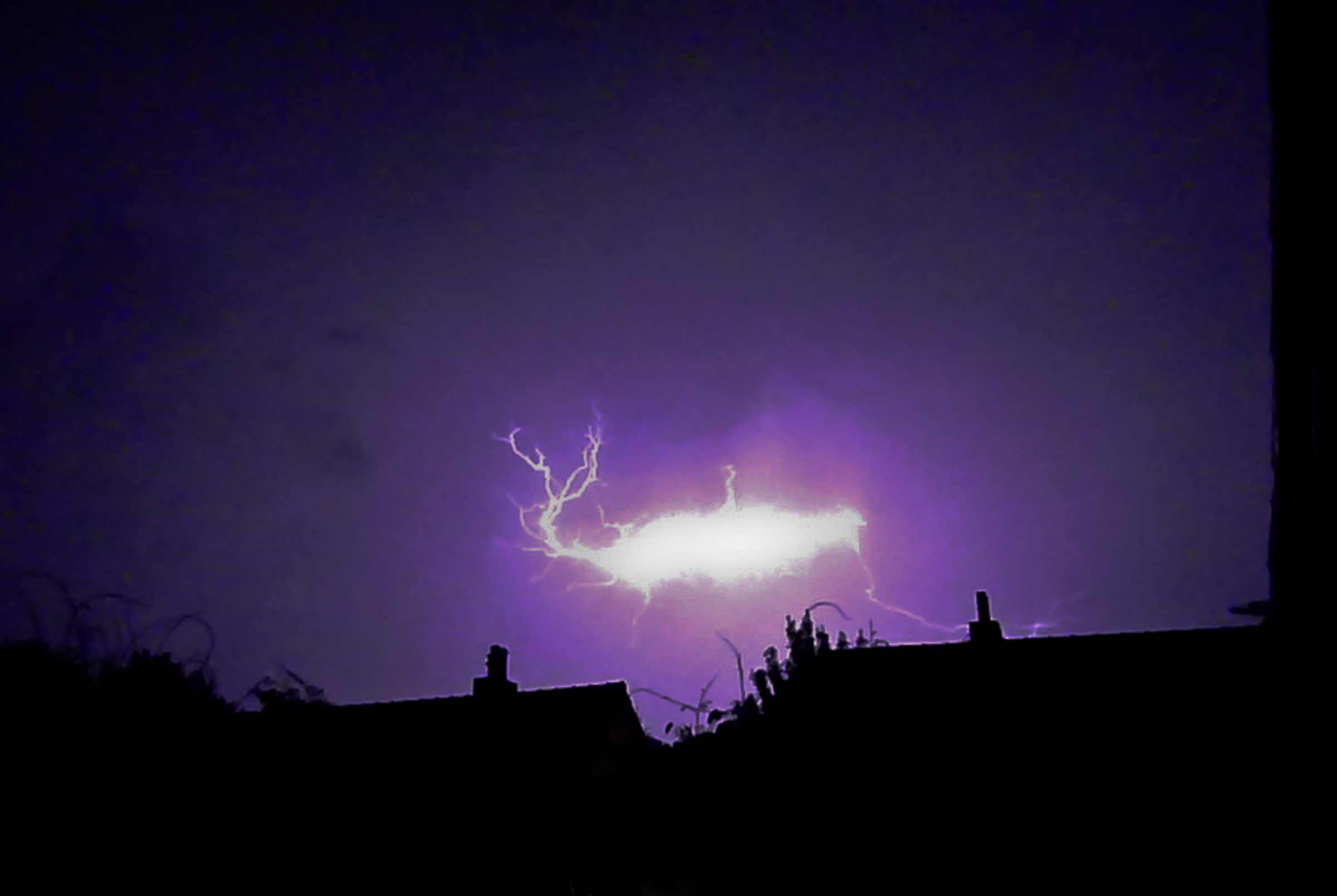
Pilots, sailors, and physicists have independently reported the same glowing, floating orb of light for centuries – and almost nobody can agree on what it actually is.
Ball lightning typically appears during thunderstorms as a luminous sphere, sometimes the size of a basketball, that floats through the air, sometimes passing through walls or windows before vanishing or exploding. Eyewitness accounts go back hundreds of years and come from credible sources, including commercial pilots and meteorologists, which is part of why scientists can’t simply dismiss it as folklore. The problem is reproducing it reliably in a lab.
Researchers have floated dozens of hypotheses: microwave-generated plasma, burning silicon vapor from soil struck by lightning, or even a rare atmospheric electrical discharge. The most surprising fact: in 2012, Chinese researchers captured accidental spectrometer data of a real ball lightning event during a storm, confirming it contained silicon, iron, and calcium – but that single data point still hasn’t produced a repeatable lab model. Without repeatability, physicists can’t fully explain the mechanism, so it stays filed under “observed but unsolved.”
#8 – The Cosmic Microwave Background’s “Axis of Evil”
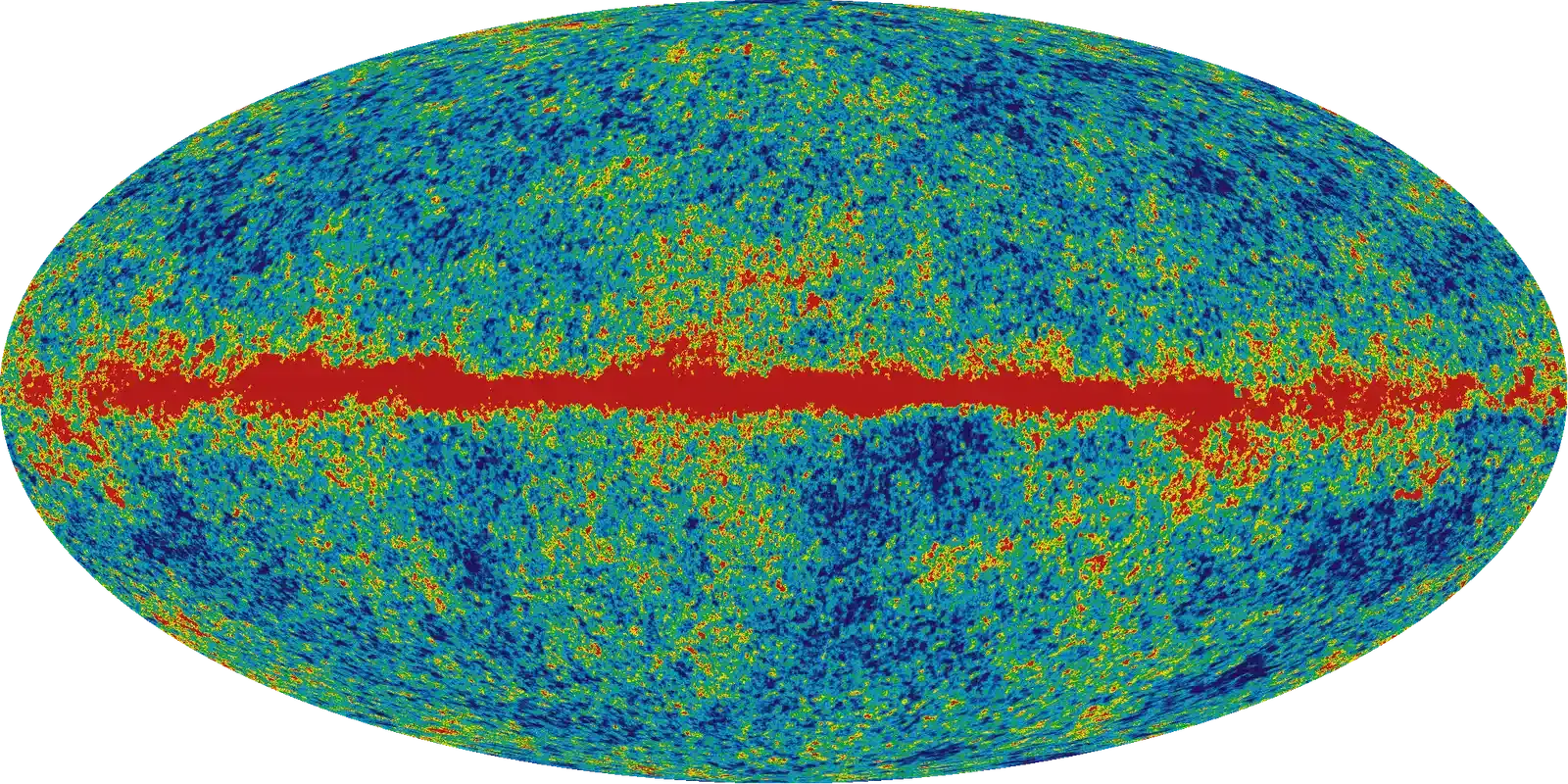
The leftover radiation from the Big Bang was supposed to look completely random in every direction – instead, cosmologists found a pattern that shouldn’t exist.
The cosmic microwave background, or CMB, is the faint radiation left over from roughly 380,000 years after the universe formed. Standard cosmological models predict that its temperature fluctuations should be randomly distributed across the sky, with no preferred direction or alignment. When satellites like WMAP and later Planck mapped the CMB in extreme detail, though, researchers noticed that certain large-scale patterns lined up suspiciously well with the plane of our own solar system.
Why It Stands Out
- Confirmed independently by two separate satellite missions, WMAP and Planck
- Directly contradicts the assumption that no direction in the universe is special
- The alignment matches the plane of our own solar system, which shouldn’t matter cosmically
- Scientists remain split between calling it a statistical fluke or a real flaw in the model
Scientists nicknamed this alignment the “Axis of Evil” because it directly contradicts a basic assumption of cosmology: that there’s nothing special about our vantage point in the universe. The most surprising fact: the alignment has now been confirmed across multiple independent satellite missions, ruling out simple instrument error. Some researchers argue it’s a statistical fluke given how few large-scale features exist to measure. Others think it hints at something genuinely wrong with our model of the early universe.
#7 – The Sun’s Coronal Heating Problem

Common sense says the closer you get to a fire, the hotter it gets – but the Sun completely breaks that rule, and nobody has fully explained why.
The surface of the Sun, called the photosphere, sits at around 5,500 degrees Celsius. Move outward into the corona – the wispy outer atmosphere visible during a total eclipse – and temperatures spike to over a million degrees. That’s backwards from how heat is supposed to behave as you move away from a source, and it’s been a working puzzle in solar physics for nearly a century.
Physicists have proposed two leading theories: tiny magnetic explosions called nanoflares that constantly release energy, and magnetic waves that travel up from the Sun’s interior and dump their energy into the corona. NASA’s Parker Solar Probe was specifically designed to fly close enough to the Sun to gather direct data on this problem. The most surprising fact: even with that spacecraft returning unprecedented close-up readings, solar physicists still haven’t isolated a single dominant mechanism – it may be some combination of both theories working together in ways nobody has modeled correctly yet.
#6 – Dark Flow
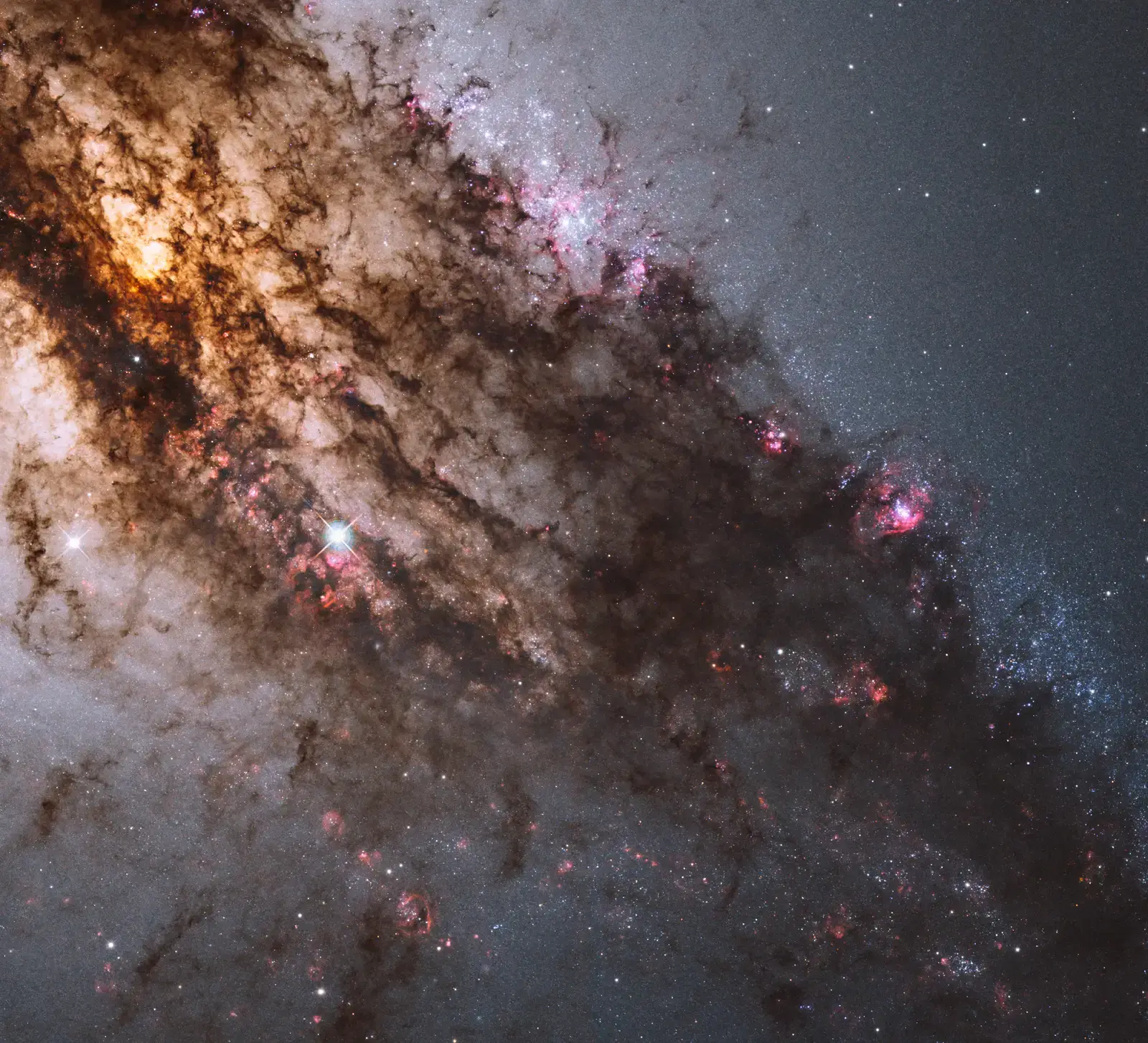
Entire clusters of galaxies, each containing thousands of individual galaxies, appear to be streaming toward the same patch of sky – and there’s nothing visible out there to explain why.
As if the mysteries of dark matter and dark energy weren’t vexing enough, another baffling cosmic puzzle has been discovered: patches of matter in the universe seem to be moving at very high speeds and in a uniform direction that can’t be explained by any of the known gravitational forces in the observable universe. Researchers led by NASA astrophysicist Alexander Kashlinsky discovered this by studying how galaxy clusters scatter the cosmic microwave background as they move.
Evidence suggests the clusters are headed outward along this path, away from Earth, but the team still can’t rule out the opposite flow entirely.
We detect motion along this axis, but right now our data cannot state as strongly as we’d like whether the clusters are coming or going.
Alexander Kashlinsky, NASA astrophysicist
Cosmologists’ best guess is that it’s the gravitational pull from something beyond the visible universe. The most surprising fact: distant galaxy clusters mysteriously stream at a million miles per hour along a path roughly centered on the southern constellations Centaurus and Hydra, and a follow-up study tracked this collective motion out to twice the distance originally reported. Kashlinsky has said this isn’t something the team set out to find – and no matter how they slice the data, it refuses to go away.
#5 – Tabby’s Star
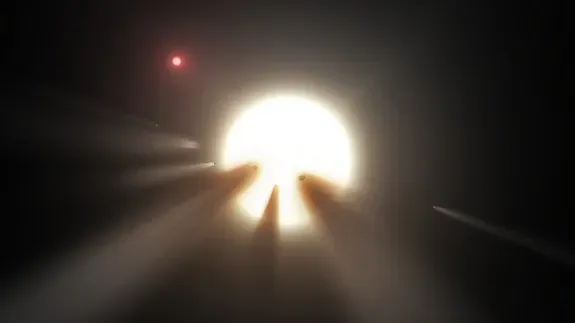
In 2015, astronomers found a star that dimmed by up to 22 percent in irregular, unpredictable patterns – a drop far too extreme for any planet to cause.
The star, officially named KIC 8462852 but nicknamed “Tabby’s Star” after lead researcher Tabetha Boyajian, was flagged by citizen scientists working with NASA’s Kepler telescope. Normal planetary transits dim a star’s light by a fraction of a percent in predictable, repeating cycles. Tabby’s Star dimmed unevenly, sometimes losing over a fifth of its brightness, with no consistent pattern scientists could model against a planet, a binary companion, or even a dust cloud with confidence.
At a Glance
- Official name: KIC 8462852, flagged by citizen scientists using NASA’s Kepler telescope
- Dimmed by as much as 22 percent, versus a fraction of a percent for a normal planet transit
- No single dust or debris model has cleanly matched every dimming event recorded
- The “alien megastructure” theory, though unpopular among astronomers, has never been formally closed out
The dimming events were so bizarre that some researchers seriously floated the idea of an alien megastructure, like a partially built Dyson swarm, harvesting the star’s energy. Most astronomers now lean toward an irregular swarm of dust or debris as the more grounded explanation. The most surprising fact: even a decade later, no single dust model has cleanly accounted for every dimming event recorded, which is exactly why the “alien megastructure” theory, however unlikely, has never been fully closed out by the scientific literature.
#4 – The Oh-My-God Particle

In 1991, a detector in Utah recorded a single subatomic particle moving with more energy than any particle theoretically should have after traveling across the universe – and physicists still can’t identify what fired it.
The particle was a cosmic ray, detected by the Fly’s Eye observatory, carrying roughly the kinetic energy of a fastball baseball packed into a single proton. That’s an almost unthinkable amount of energy for something smaller than an atom. Physics has a theoretical ceiling for how much energy a cosmic ray can retain after traveling long cosmic distances, called the Greisen-Zatsepin-Kuzmin limit, because particles are supposed to lose energy colliding with the cosmic microwave background along the way.
The Oh-My-God particle blew straight past that limit, which meant either it came from somewhere relatively close by, or something in the model was wrong. Researchers scanned the sky in the direction it came from and found essentially nothing – no known galaxy, black hole, or energetic event close enough to explain it. The most surprising fact: similar ultra-high-energy particles have been detected since, and scientists still haven’t confirmed a single source for any of them.
#3 – The Muon g-2 Anomaly

For over twenty years, one of the most precisely measured numbers in all of physics has refused to match what theory says it should be – and the world’s best labs still can’t agree on why.
The muon anomalous magnetic moment, the so-called muon g-2, is a particle physics observable where a significant discrepancy between measurement and the Standard Model has persisted for more than 20 years. Physicists first flagged the mismatch at Brookhaven National Laboratory, then spent over a decade transporting a massive magnetic storage ring to Fermilab in Illinois to remeasure it with far greater precision. In June 2025, scientists working on the Muon g-2 experiment released their third and final measurement of the muon magnetic anomaly, agreeing with their published 2021 and 2023 results but with far better precision.
Here’s the controversial part: instead of settling the debate, the improved measurement muddied it further. The final value complicates the broader narrative, because while discrepancies between experimental and theoretical values initially hinted strongly at new physics, recent theoretical recalculations have moved closer to the experimental results, diminishing that gap. The most surprising fact: a cloud of uncertainty still hangs over the entire question of whether the most significant experimental deviation in particle physics has been killed off by theoretical tweaks or is still alive, and the case can’t yet be conclusively closed. Some physicists privately admit they wanted this anomaly to be real, because it would have cracked open physics beyond the Standard Model.
#2 – The Placebo Effect Is Getting Stronger

A sugar pill with zero active ingredients is becoming measurably more effective at treating pain over time – and nobody in medicine can fully explain why that’s happening.
A 2015 study by researchers at McGill University analyzed clinical trials of neuropathic pain medications to determine whether the placebo response had changed over time, and across eighty studies, the magnitude of the placebo response was significantly stronger in more recent trials than in older ones. In 1996, neuropathic drugs produced 27.3 percent more pain relief than a placebo, but by 2013 that gap had shrunk to only 8.9 percent. That’s not the drugs getting weaker – it’s the placebo arm getting dramatically stronger at doing nothing.
Worth Knowing
- 1996: real drugs beat placebo by 27.3 percent in pain relief
- 2013: that same gap had shrunk to just 8.9 percent
- The rising placebo effect has been traced almost entirely to U.S.-based trials
- Roughly 90 percent of neuropathic and cancer pain drugs have failed clinical trials in the past decade
Here’s the part that should unsettle you: researchers found this increase in placebo strength was driven solely by clinical trials conducted in the United States, and for some reason, the placebo effect isn’t increasing elsewhere. The most surprising fact: in the past decade, around 90 percent of drugs for neuropathic and cancer pain failed to clear the clinical trial hurdle, and some researchers believe a portion of those were real treatments that simply couldn’t outperform an unusually robust placebo response. Most people assume placebo is a psychological trick with a fixed ceiling. It isn’t. It’s a moving target, and medicine still doesn’t know what’s moving it.
#1 – The Wow! Signal
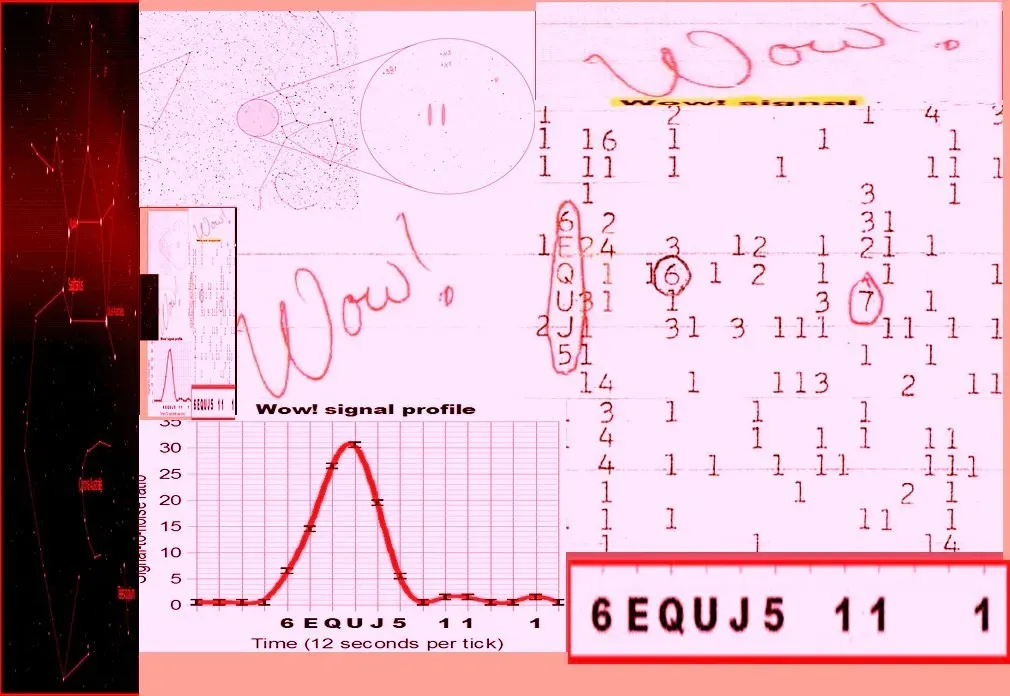
On a summer night in 1977, a radio telescope in Ohio picked up a signal so intense and so perfectly matched to the profile scientists expected from alien technology that the astronomer who found it wrote a single word on the printout: “Wow!”
The Wow! signal was a strong narrowband radio signal detected on August 15, 1977, by Ohio State University’s Big Ear radio telescope, and it appeared to come from the direction of the constellation Sagittarius, bearing expected hallmarks of extraterrestrial origin. It was 30 times more powerful than all background noise detected around it, and it fell almost exactly on the frequency of neutral hydrogen atoms, a spot in the spectrum long considered a likely candidate for alien communication. The entire signal sequence lasted for the full 72-second window during which Big Ear was able to observe it, but it has never been detected again, despite many subsequent attempts.
For decades, this made the Wow! signal one of the most famous unsolved mysteries in astronomy. In 2024, researchers finally proposed a natural explanation involving hydrogen clouds excited by a passing magnetar. Even the team behind that theory admits it doesn’t fully close the case.
Our results don’t solve the mystery of the Wow! Signal, but they give us the clearest picture yet of what it was and where it came from.
Research team, 2024 magnetar hypothesis study
The most surprising fact: outside experts remain skeptical of even this best current guess, with SETI astronomer Jason Wright pointing out that the team is essentially suggesting a phenomenon that has never once been directly observed. Nearly fifty years later, the file is still technically open.
The Bottom Line

Here’s the uncomfortable truth: science doesn’t actually close every case. A muon’s magnetic wobble, a sugar pill’s growing power, galaxy clusters streaming toward nothing visible, and a single radio blip from 1977 – all measured by credible researchers, all still missing a confirmed explanation.
Most of these get quietly shelved instead of loudly debated, because “we don’t know yet” doesn’t make for a satisfying headline. That’s a mistake. Unexplained doesn’t mean unimportant – it usually means we’re standing right next to the next major discovery and just haven’t recognized it yet.
Which one of these do you think gets solved first, and which one do you think never will? Drop your bet in the comments.