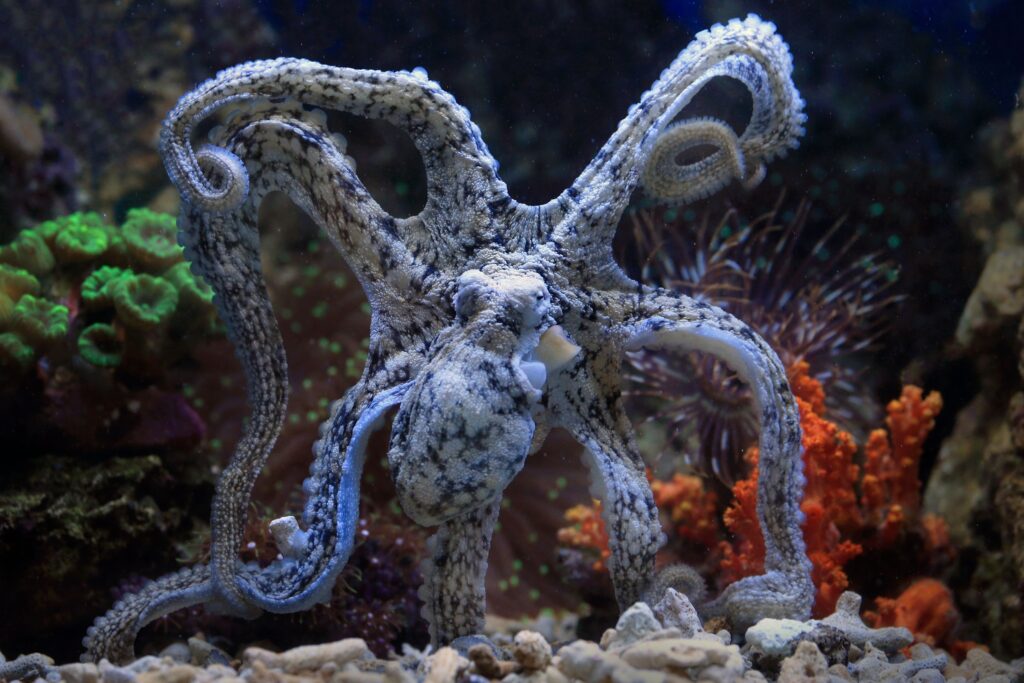

If you think humans are complicated, wait until you meet an octopus. This soft-bodied animal, with no bones and three hearts, is quietly rewriting what we believe about intelligence, consciousness, and even what it means to have a mind. The idea that an octopus has nine brains sounds like a wild science fiction concept, yet it comes straight from serious research into its nervous system.
Even more surprising, scientists are finding that each arm is not just a passive tentacle waiting for orders from the head. Instead, every arm has its own rich network of neurons that can sense, decide, and act with a kind of local autonomy. It is as if the animal carries eight semi-independent “sub-brains” at the tips of its body, each one feeling, exploring, and solving tiny puzzles on its own, while the main brain handles the bigger picture.
The Strange Reality of a Distributed Nervous System
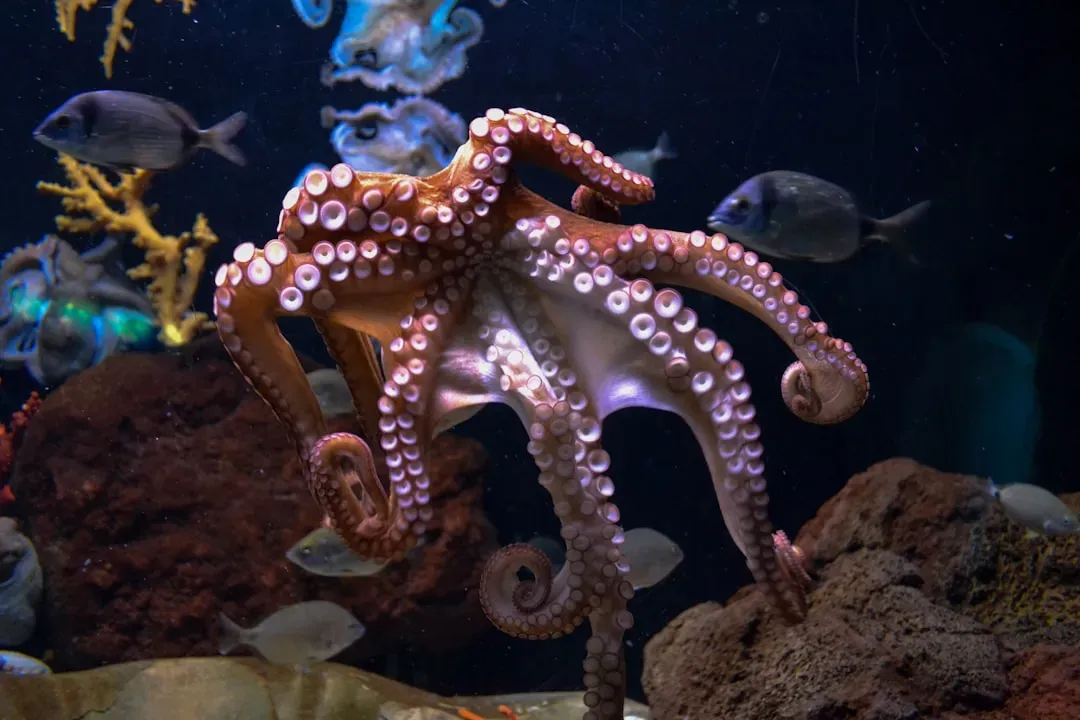
Most of us grow up thinking of the brain as a single control center, like a CEO sitting in the skull, sending orders to the rest of the body. Octopuses break that model completely. A large share of their neurons is not in the head at all but spread throughout the arms, creating a decentralized nervous system that feels more like a network than a strict hierarchy.
In fact, the majority of an octopus’s neurons live in its limbs, not its brain, which is the opposite of how vertebrates like us are wired. The result is a creature that does not rely solely on top-down commands. Movements, reactions, and even problem‑solving in the arms can emerge locally, then feed back into the central brain, like a group chat constantly updating itself instead of waiting for one person to speak.
How Eight Arm “Brains” Cooperate With the One in the Head
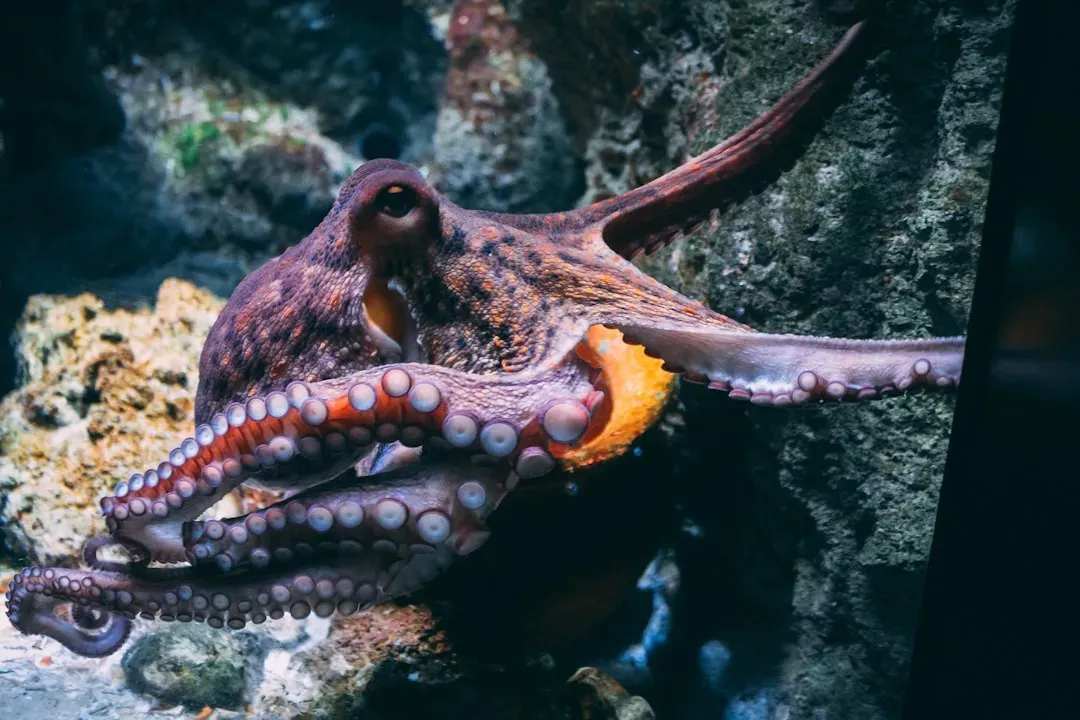
When scientists say octopuses have “nine brains,” they are really talking about one central brain plus eight powerful neural hubs in the arms. Each arm contains dense bundles of neurons that handle sensing and movement, along with surprisingly complex processing. These arm nervous systems can coordinate local muscle patterns, interpret touch and chemical cues, and even generate exploratory behaviors.
The brain in the head still matters a lot, though. It integrates information from all eight arms, guides overall goals, and makes higher-level decisions: where to go, what to hunt, whether to flee or investigate. You can think of it like a conductor working with eight extremely talented soloists. The central brain sets the theme, but the arms improvise, adapt, and sometimes take the lead in ways that even the “conductor” may not micromanage.
Evidence That Octopus Arms Can Act Almost on Their Own
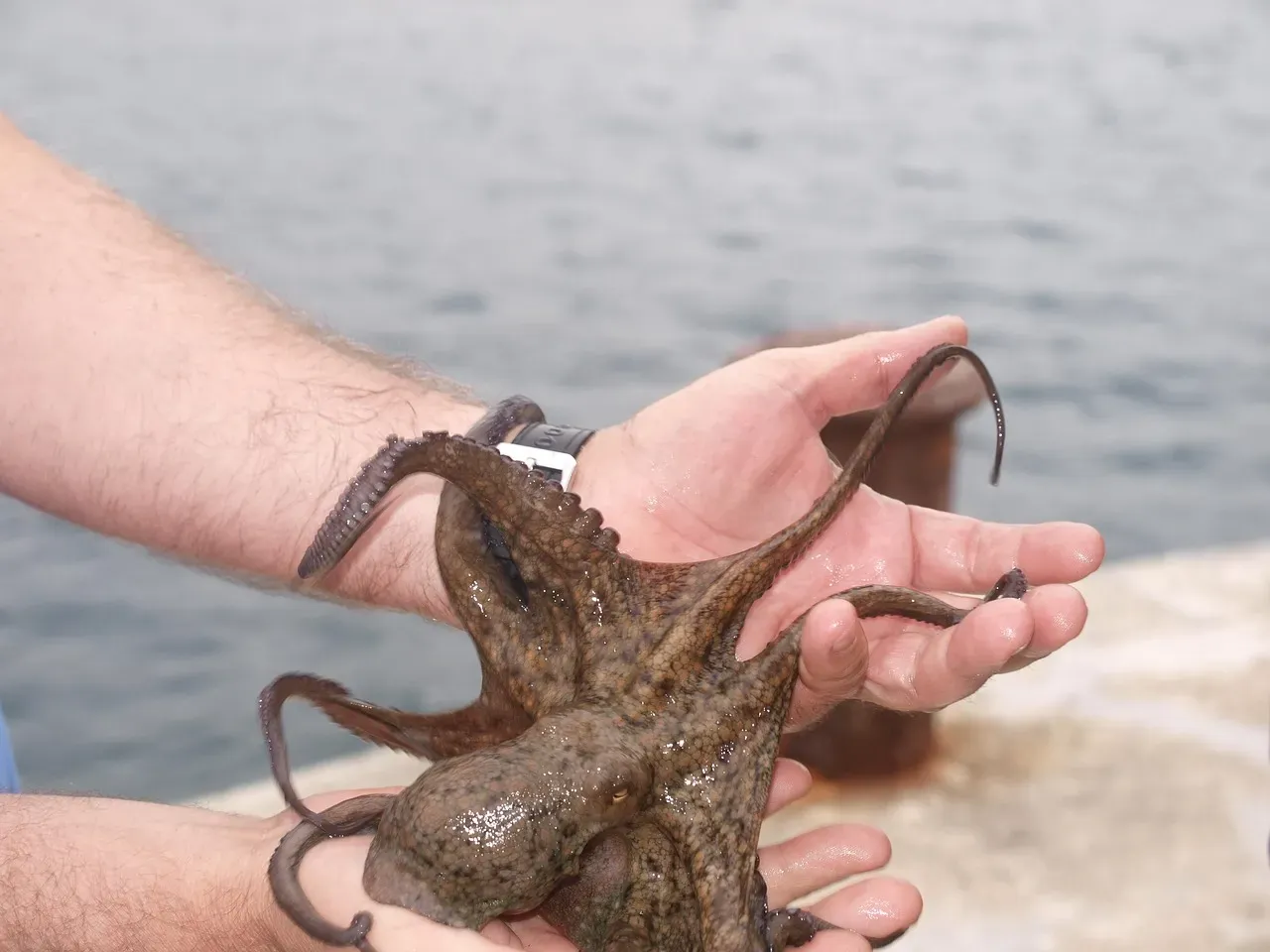
One of the most intriguing findings is that octopus arms can carry out some behaviors without direct moment‑to‑moment supervision from the central brain. In experiments, arms have been shown to perform complex grasping and exploratory movements even when signals from the head are reduced or delayed. The arm nervous system can react quickly to local touch or chemical cues from the environment and generate coordinated motion.
In simpler terms, an arm can “decide” to bend, reach, or withdraw based on what it feels, without waiting for the main brain to approve every tiny movement. That does not mean the arm has a personality or full-blown consciousness, but it does suggest a kind of independent processing that goes beyond being just a cable carrying messages. This is one reason researchers are seriously considering whether each arm has its own primitive form of awareness, tuned to the immediate world around it.
What “Independent Awareness” Might Really Mean for an Arm
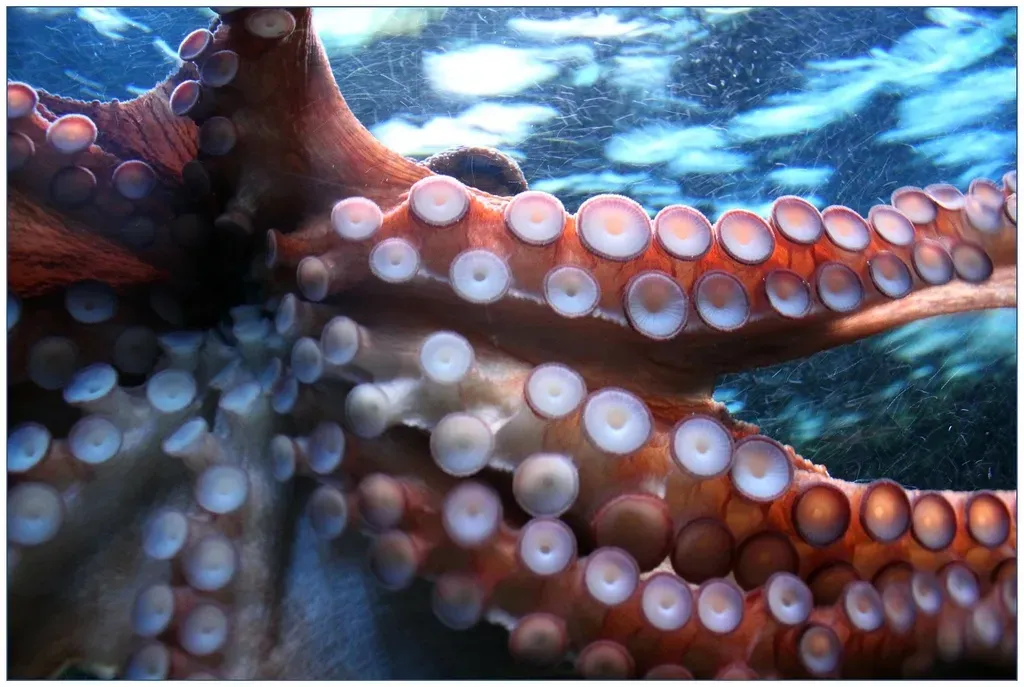
The phrase “independent awareness” sounds dramatic, and it can easily be misunderstood. No one has proven that an octopus arm has thoughts in the way we experience them, or that it has its own personal identity. Instead, researchers are exploring whether each arm has its own self-contained sensory experience and decision-making loop, a bit like a tiny local control center focused on touch, taste, and motion.
If an arm can sense, process, and respond to information without the head brain checking every detail, then it is reasonable to say it has a form of local awareness of what it is touching, where it is moving, and how it should respond. This awareness would be simple and task‑focused: not planning its future or pondering the meaning of life, but tracking immediate sensations with remarkable sophistication. The interesting twist is that these local experiences get woven together into the octopus’s overall behavior, creating a mind that is not neatly contained in one place.
Rethinking Consciousness: A Mind Spread Across a Body
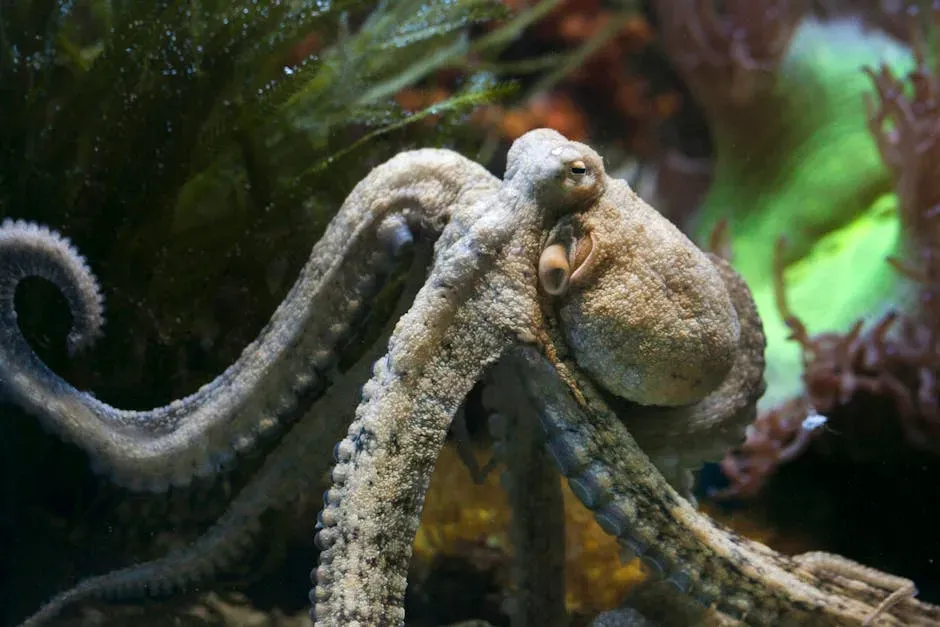
The octopus forces scientists and philosophers to rethink a basic assumption: that a mind must be centralized, located in a single organ like the brain. With this animal, awareness may be distributed, flowing through a network of neural hubs in the arms as well as the head. The octopus becomes less like a single, tightly unified “self” and more like a coalition of semi-independent systems working together.
This challenges very human ways of thinking about consciousness as an all‑or‑nothing switch sitting behind our eyes. Instead, it hints that awareness might come in degrees and flavors, spread across different parts of a body or even emerging through interactions between them. To me, that is both unsettling and beautiful. It suggests that the line between “one mind” and “many minds” might be blurrier than we ever imagined.
Why Octopus Intelligence Feels So Alien Compared to Ours
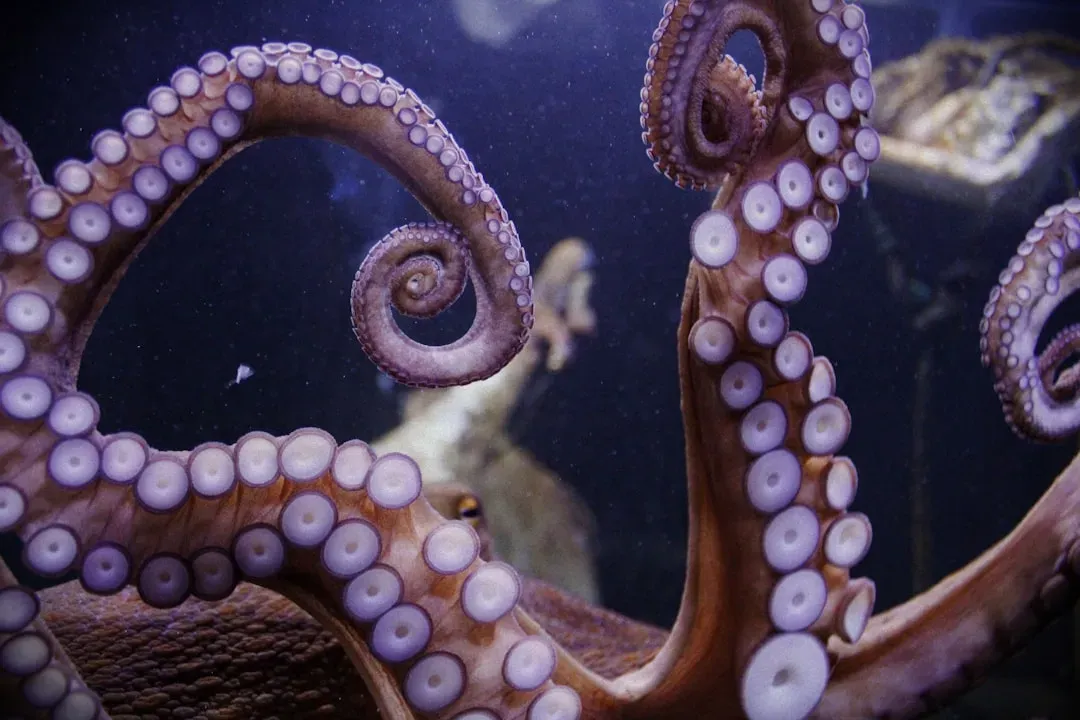
Humans and octopuses last shared a common ancestor a very long time ago, so our nervous systems evolved along completely different paths. We built a rigid skeleton, big centralized brains, and standardized limbs. Octopuses went the opposite way: no bones, flexible bodies, and many semi-autonomous control centers in the arms. Their intelligence is not just a weirder version of ours; it is a separate solution to the challenge of navigating a complex world.
This is why octopus behavior can feel so eerie. They solve puzzles, escape tanks, recognize patterns, and interact with tools, yet the internal machinery generating those abilities is utterly foreign to our own. When you watch an octopus exploring with its arms, you are not just seeing a clever animal. You are watching nine interconnected brains co-create behavior in real time, using a logic that evolved far outside the familiar mammal and bird playbook.
What Octopus Brains Are Teaching Us About Robotics and AI
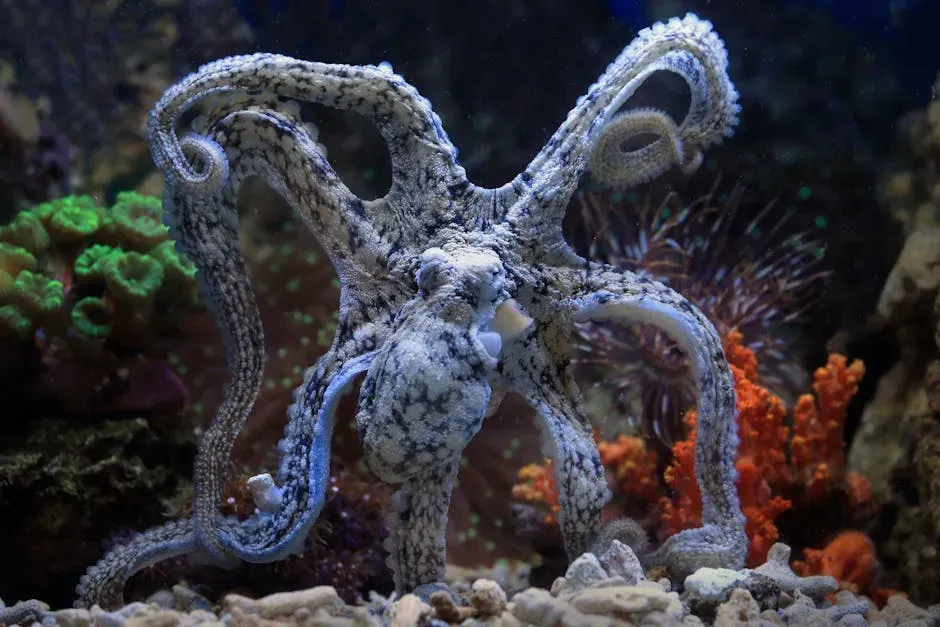
Engineers and roboticists are increasingly obsessed with the octopus, and for good reason. Traditional robots often rely on a central processor that tries to control every movement, which quickly becomes clumsy and inefficient, especially for flexible bodies. Octopus arms offer a different blueprint: push more intelligence into the limbs themselves, let them handle local decisions, and keep the central controller focused on high-level goals.
This idea of distributing “smarts” throughout a system is inspiring new designs for soft robots and even decentralized artificial intelligence. Imagine robots where the fingers can adapt to a delicate object on their own, or underwater machines that explore like octopus arms, sensing and reacting fluidly in real time. The more we learn about this animal’s unusual nervous system, the clearer it becomes that copying nature’s networked approach could make our machines both more capable and more resilient.
Emotional Reactions: Why This Changes How We See Animals
Learning that an octopus may have multiple zones of awareness scattered throughout its body hits you on a gut level. It is no longer just a strange sea creature; it becomes something closer to an alien form of personhood, with complex experiences we can barely imagine. For many people, this makes it harder to see octopuses as mere seafood or lab subjects, and easier to feel a sense of moral concern for their welfare.
There is a growing push to treat octopuses as sentient beings deserving of protection, not simply resources to harvest or tools for experiments. When you realize that an animal’s arms might each be having their own sensory “mini-life” as they explore, taste, and interact with the world, it becomes difficult to ignore the depth of what might be going on inside. Personally, once I grasped that, I stopped looking at an octopus as a thing and started seeing it as a someone, however alien that someone may be.
Conclusion: A Decentralized Mind That Forces Us to Think Differently
The idea that octopuses have nine brains, with eight of them embedded in their arms, is not just a quirky fact to impress friends at dinner. It is a fundamental challenge to the way we think about intelligence, awareness, and the boundaries of the self. Each arm appears to operate with a degree of independent processing, possibly even its own localized form of awareness, while the central brain ties everything together into a coherent animal moving through the world.
In my view, the octopus is quietly telling us that our human model of a single, centralized mind is only one option among many. Minds can be spread out, modular, and messy, yet still astonishingly capable. That should make us humble about our place in nature and curious about other hidden forms of intelligence around us. If a soft-bodied creature at the bottom of the sea can run nine interconnected brains at once, what else might be possible in this universe of minds?