

Imagine this: your dog, who used to sprint into the living room to nap in a sunny patch, now slams on the brakes at the doorway, stiffens, and backs away. Nothing looks different. No new furniture, no odd smells you can notice. Yet your usually fearless friend is acting like that room is suddenly off-limits. Moments like this can feel eerie, almost like your dog knows something you do not.
In recent years, a mix of animal behavior research and veterinary neuroscience has started to explore a wild-sounding possibility: dogs may be picking up subtle electromagnetic changes in the environment that our human senses completely miss. The evidence is early and not fully settled, but it is intriguing enough that many veterinarians and researchers now consider electromagnetic sensitivity a serious piece of the puzzle when a dog abruptly changes how they use space in a home. Let’s walk through what science actually says, what is still speculation, and how to respond when your dog suddenly treats a familiar room like a no-go zone.
When a Loved Room Becomes a “No-Go Zone” Overnight

There is something uniquely unsettling about a dog refusing a place they once adored. One day they are sprawled belly-up under the ceiling fan, the next they are stopping three steps short of the doorway, tail low, eyes wide, maybe even trembling. Many owners first assume a bad association: perhaps they slipped on the floor, heard a loud bang, or were startled when a glass fell. That is a reasonable first guess, because dogs are experts at connecting places with experiences.
But sometimes, you replay the last few days and nothing obvious lines up. No loud events, no visitors, no new training, no punishment, no visible change. That mismatch between what you know and how your dog behaves is what pushes people to ask those slightly spooky questions: is there something in the room I cannot see? Is my dog sensing something invisible or dangerous? While it is easy to drift into ghost stories or conspiracy theories here, veterinary neuroscience gives a far more grounded, if less dramatic, explanation: dogs can perceive aspects of the physical world that sit just outside our human sensory bandwidth.
The Superpowers in Your Dog’s Nervous System (That You Don’t Have)

We already know that a dog’s perception of the world is radically different from ours. Their sense of smell is estimated to be tens of thousands of times more sensitive than ours, and their hearing range reaches into frequencies we simply cannot detect. Their brains are wired to prioritize scent, motion, and subtle sound over the color-rich, detail-focused vision humans rely on. So, from the start, your dog is living in a richer, noisier sensory universe than you are.
On top of the familiar “super senses,” research in different animal species, including canines, has pointed toward something even stranger: sensitivity to the Earth’s magnetic field and other subtle electromagnetic patterns. Studies of dogs aligning themselves along magnetic north–south when urinating or defecating outdoors under calm geomagnetic conditions suggest they may possess a form of magnetoreception, similar to what scientists have observed in birds and some small mammals. If dogs can use magnetic information as a quiet background map of their surroundings, sudden electromagnetic disturbances inside a home could, in theory, feel to them like a warped landscape feels to us.
What Veterinary Neuroscience Actually Says About Electromagnetic Sensitivity

The idea that dogs can detect electromagnetic changes is not pure science fiction, but it is not ironclad fact either. Laboratory and field studies have provided hints that dogs may respond to magnetic fields, altering their body alignment or behavior depending on the state of the Earth’s magnetism. These behaviors tend to show up most clearly when outside environmental noise is low, suggesting that magnetic information might be a subtle, background cue rather than a dominant sense like smell.
In veterinary neuroscience, this topic sits at the intersection of neurology, behavior, and biophysics. Researchers are trying to figure out where in the body or brain a magnetic sense might live, and how electromagnetic changes from human technology could influence it. Hypotheses focus on tiny iron-rich particles in tissues or light-sensitive molecules in the eye that could respond to magnetic fields. None of this is completely settled, but there is enough signal in the data that some veterinary neurologists now at least consider electromagnetic shifts as one of several factors when a dog shows unexplained fear or avoidance of a specific space.
Could Household Electronics and Wiring Be Freaking Your Dog Out?

Once you accept that dogs might register electromagnetic patterns to some degree, a modern house starts to look very different. Power lines, Wi‑Fi routers, smart home hubs, underfloor heating, induction cooktops, and even faulty wiring all produce electromagnetic fields of varying strength. To humans, these fields are virtually invisible and unfelt. To a dog with a sensitive nervous system, they might feel like persistent background “noise” that is usually tolerable – until something changes.
Consider what happens when a new device is plugged in, an old electrical component starts to fail, or a power strip develops a subtle hum and vibration. The change might be too slight for you to hear or see, but it can alter both the acoustic and electromagnetic profile of a room. Some dogs may shrug this off. Others, especially those that are anxious or neurologically sensitive, might interpret that shift as a threat or at least something deeply uncomfortable. From their point of view, the room went from neutral to “wrong” almost overnight, even if it looks exactly the same to your eyes.
How to Tell If It Is Electromagnetic, Fear, Pain, or Something Else

Here is where we need to be blunt: there is currently no home test that says with certainty your dog is avoiding a room because of electromagnetic changes. In practice, veterinarians think in terms of probabilities and patterns. They start by ruling out obvious physical causes. Is your dog limping or reluctant to walk on slippery floors? Has their vision changed, making a room with glossy tiles suddenly look like a confusing mirror? Are there drafts, temperature differences, or strong odors in that specific space?
Next comes behavior analysis. Did something scary happen in that room recently, like a dropped pan, a thunderstorm heard from that side of the house, or an argument? Some dogs form strong place-based fears from a single event. If no physical or clear emotional trigger is found, and especially if avoidance appeared after a new device was installed or electrical work was done, a vet or behaviorist might cautiously consider environmental factors such as sound frequencies, vibrations, and possible electromagnetic shifts. The key is not to latch onto the most exotic explanation first but to move methodically from common to rare causes.
What To Do If Your Dog Suddenly Refuses a Room
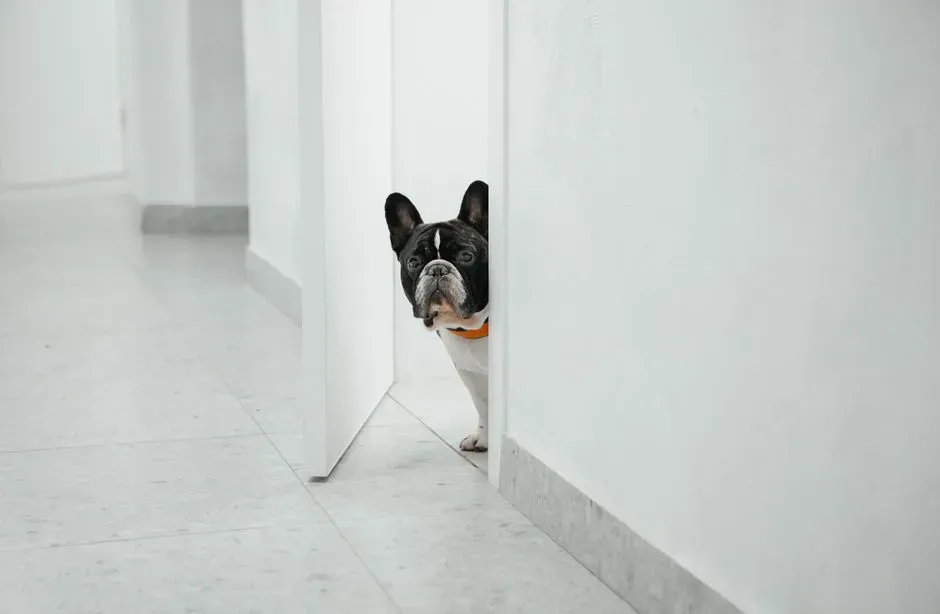
When your dog puts on the brakes at a doorway, your first job is not to drag them in. Forcing a scared dog into a space they believe is dangerous can escalate panic and erode trust. Instead, give them physical and emotional distance from the room while you start quietly investigating. Check for obvious issues: sharp objects, spilled cleaning products, dead batteries, rodent traps, or anything else that could pose a threat. Listen for new hums, rattles, or vibrations coming from walls, vents, or appliances.
Next, think back over the last week or two. Did you install a new modem, move a router, add a baby monitor, or change lighting? Did an electrician work on that part of the house? Try turning off nonessential electronics in or near the room for a day or two and observe whether your dog’s behavior changes. At the same time, make the rest of the house feel extra safe and rewarding. Offer cozy beds, calm routines, and gentle play in the areas your dog still loves. If the issue persists for more than a few days or worsens, bring your veterinarian into the loop rather than hoping it just goes away.
Working With Your Veterinarian and a Behavior Professional

A sudden, intense fear of a specific room is not merely a quirky personality shift; it is a behavioral symptom that deserves a proper workup. A veterinarian can perform a physical and neurological exam, screen for pain, joint issues, sensory loss, or early cognitive changes, and review any medications that might be altering your dog’s perception. They may also ask detailed questions about your home environment, daily routines, and any recent changes that could have triggered anxiety or discomfort.
If no straightforward medical cause appears, your vet may refer you to a certified veterinary behaviorist or experienced trainer who focuses on fear and anxiety. These professionals can design a desensitization and counterconditioning plan, helping your dog reframe the scary room as safe and predictable. In some complicated cases, mild anti-anxiety medication is used alongside behavior therapy to lower the dog’s overall stress while you experiment with environmental adjustments, such as moving electronics, changing lighting, or altering sound patterns that might be contributing to the avoidance.
Practical Steps to Make a “Haunted” Room Feel Safe Again

Once your dog has had a chance to calm down and any medical issues are addressed, you can start reintroducing the room in a gentle, structured way. Begin far from the doorway, in a place your dog feels secure, and create a “reward path” leading toward but not into the room: scattered treats, a favorite toy, calm praise, and maybe a comfy mat just outside the threshold. The idea is to let your dog choose to approach at their own pace, never luring them so far that they freeze or try to bolt.
At the same time, look for ways to change the sensory feel of the space. That might mean adjusting lighting, adding a rug to reduce reflections and noise, or rearranging furniture so the room looks less like the one they are avoiding. If you suspect electronics might be involved, experiment with turning devices off, relocating routers, or having an electrician check for wiring problems or unusual hums. You may never know for sure whether electromagnetic changes were the original trigger, but by methodically reducing possible irritants and rebuilding positive associations, you can usually help your dog reclaim that room over time.
Conclusion: Respect the Mystery, But Start With the Science

When a dog suddenly refuses to enter a room they used to love, it feels like they are perceiving a hidden layer of reality – and in a way, they are. Their nervous system is tuned to smells, sounds, vibrations, and possibly electromagnetic cues that we simply do not register. That does not mean every avoidance behavior is proof of some invisible electromagnetic hazard, but it does mean we should take their reaction seriously rather than dismissing it as stubbornness or drama. Your dog’s fear is real to them, even when the room looks ordinary to you.
My own opinion is that electromagnetic sensitivity is probably one small piece of a much larger puzzle that includes pain, past experiences, anxiety, and subtle environmental shifts we rarely notice. The smartest approach is a humble one: assume your dog is telling the truth about how the world feels to them, investigate calmly, and lean on veterinary and behavioral science rather than superstition. If our dogs are whispering that something about a room has changed, the least we can do is listen closely and ask, with real curiosity, what their nervous system might be trying to say.