Three Peaks with Ancient Stories (Image Credits: Flickr)
Near Reykjavík in southwest Iceland lies Thríhnúkagígur, a dormant volcano that stands alone in geological history. This site offers the unprecedented opportunity to descend into a hollow magma chamber, a feature unmatched anywhere else on Earth.[1]
Three Peaks with Ancient Stories
Thríhnúkagígur, translating to “Three Peaks Crater,” reveals itself through three modest peaks aligned in a row, each separated by roughly 660 feet. The youngest peak rose during an eruption about 4,500 years ago, while the middle one formed around 5,000 years earlier, partially surrounded by solidified lava flows. The oldest peak, dating back 50,000 years, consists of hyaloclastite – a jagged volcanic rock born from lava meeting ice or water.[1]
These peaks sit along the Mid-Atlantic Ridge, where the North American and Eurasian plates pull apart. That tectonic setting has fueled the volcano’s sporadic activity over millennia. Yet despite its eruptions, Thríhnúkagígur remains dormant today, with no signs of imminent revival.[1]
The Puzzle of the Drained Chamber
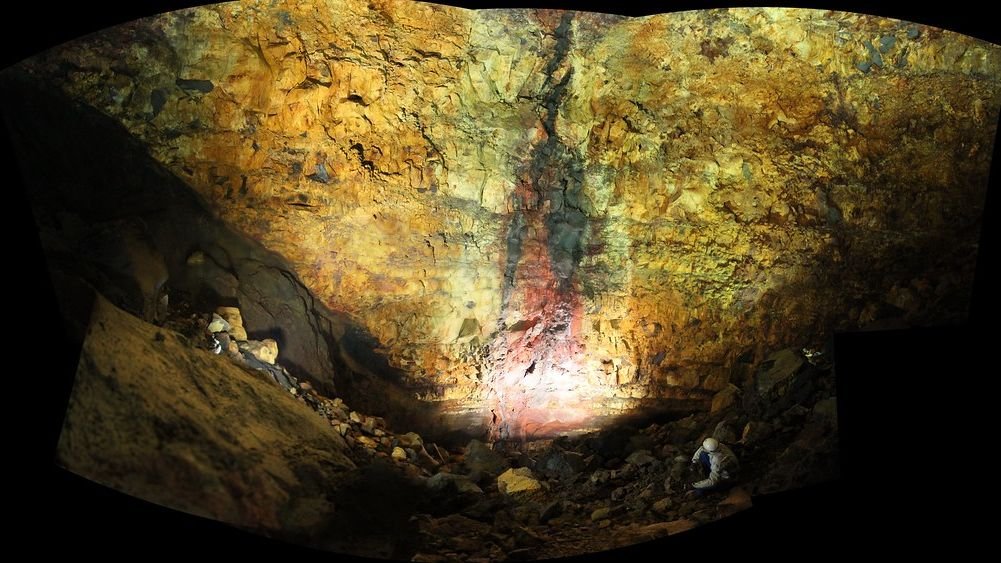
Most volcanoes leave behind solidified remnants of magma in their chambers after eruptions, as pressure drops and the molten rock cools in place. Thríhnúkagígur defies this norm. Its last eruption 4,500 years ago emptied the chamber completely, leaving a vast cavity roughly 700 feet deep – more than twice the height of the Statue of Liberty including its pedestal – and a floor spanning 33,600 square feet.[1]
Scientists puzzle over the magma’s fate. It appears to have drained back into the Earth’s crust, though the exact mechanism remains unclear. Volcanologist Haraldur Sigurdsson, professor emeritus at the University of Rhode Island, described the phenomenon vividly: “It’s like somebody came and pulled the plug and all the magma ran down out of it.”Inside the Volcano[1]
| Peak | Approximate Age | Key Feature |
|---|---|---|
| Oldest | 50,000 years | Hyaloclastite composition |
| Middle | 5,000 years | Encirled by lava |
| Youngest | 4,500 years | Access point to chamber |
Colors and Secrets of the Depths
Descending into the chamber reveals walls adorned in striking hues of bronze and indigo. These colors stem from multiple sources: sulfur-rich gases produce yellow and orange patches, tumbling rocks create indigo and blue tones, and microbes contribute to the palette, though their exact roles demand further study. Puffs of steam occasionally rise from water droplets hitting tour lamps, a harmless effect that underscores the site’s cool, stable environment.[1]
Visitors reach the chamber floor after the descent and explore freely. The vast space evokes a subterranean cathedral, with irregular formations hinting at the violent forces that once dominated here. No molten rock lingers; instead, the hollow expanse invites contemplation of volcanic processes.[1]
A Purpose-Built Path Downward
Access begins at the rim of the youngest peak, where an open cable elevator – installed in 2010 initially for researchers – lowers groups in a metal cage. Tours, operated by Inside the Volcano since 2012, guide participants through this engineered descent. The elevator provides a controlled drop into the depths, opening up the chamber for safe wandering.[1]
Safety remains paramount in this unique setting. The volcano shows no immediate eruption risk, and the steam observed inside arises solely from artificial heat sources. Organized excursions ensure participants experience the wonder without undue hazard.[1]
Unlocking Volcanic Insights
Thríhnúkagígur serves as a unparalleled natural laboratory. Researchers probe its emptied plumbing system to understand magma dynamics, from drainage patterns to the life forms thriving in extreme conditions. Studies of the gases, rocks, and microbes offer clues about volcanic behavior worldwide.[1]
This accessibility sets it apart from every other volcano, where chambers stay sealed or filled. Ongoing exploration could refine models of eruption forecasting and crustal interactions. As plate boundaries continue their slow dance beneath Iceland, Thríhnúkagígur stands as a frozen snapshot of geological drama, inviting both scientists and the curious to peer inside.