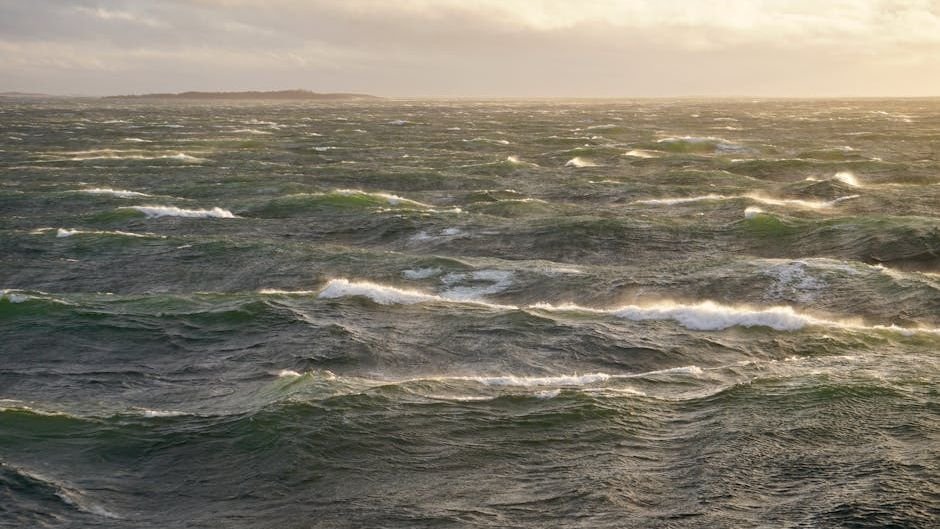
The AMOC Under Siege (Image Credits: Pexels)
Climate scientists have issued stark warnings about the Atlantic Meridional Overturning Circulation, or AMOC, a vast ocean current system that influences weather from Europe to North America. Fresh modeling reveals it could weaken by 43% to 59% by the end of the century, risking abrupt shifts like colder European winters and rising seas along U.S. coasts.[1] In response, researchers propose sealing off the Bering Strait with enormous dams, an idea inspired by Earth’s distant past. This radical intervention seeks to buy time against collapse, though its success hinges on uncertain conditions.
The AMOC Under Siege
The AMOC functions like a global conveyor belt, ferrying warm, salty water from the tropics toward the North Atlantic. There, it cools, becomes denser, and plunges deep, pulling colder water southward in a cycle that sustains marine ecosystems and temperate climates in northern Europe.
Global warming disrupts this balance. Melting Arctic ice adds freshwater, diluting salinity and hindering the water’s ability to sink. Warmer surface temperatures compound the issue. Studies project severe slowdowns unless emissions drop sharply.[1]
Lessons from the Pliocene Epoch
About three million years ago, during the mid-Pliocene warm period, a natural land bridge spanned the Bering Strait, separating the Pacific and Arctic Oceans. Paleoclimate records indicate the AMOC thrived then, even amid higher carbon dioxide levels than pre-industrial times.
Researchers at Utrecht University drew on this history for their hypothesis. Lead author Jelle Soons and colleagues modeled what closing the strait today might achieve. Their work, published last April in Science Advances, simulated ocean dynamics under various greenhouse gas scenarios.[1]
Blueprint for the Strait Barrier
The Bering Strait stretches 51 miles across, interrupted by two islands that simplify the engineering challenge. Planners envision three dams, the longest about 24 miles in length – comparable to the Netherlands’ Afsluitdijk or South Korea’s Saemangeum Seawall.
Maximum depths reach 194 feet, manageable with modern techniques despite fierce currents, sea ice, and remoteness. Yet cooperation between the United States and Russia poses a formidable obstacle in this geopolitically charged region.
Modeling Outcomes: Promise and Peril
Simulations showed encouraging results in moderate scenarios. With modest AMOC weakening and climbing emissions, strait closure bolstered the current, delaying potential tipping points. Co-author Aixue Hu described it as an “alternative way to mitigate the effects of rising CO₂ levels.”[1]
Outcomes flipped in dire cases. If the AMOC had already faltered significantly, blocking Pacific inflows accelerated decline. Hu cautioned that “the overall effect is not consistent and highly depends on the AMOC strength and CO₂ levels… the long-term effect is still uncertain.”[1]
| Scenario | Effect on AMOC |
|---|---|
| Moderate weakening, rising CO₂ | Strengthens, delays collapse |
| Significant prior weakening | Accelerates decline |
Risks to Ecosystems and Communities
Environmental fallout looms large. Shutting the strait would halt exchanges of water, heat, nutrients, and species between oceans, reshaping Arctic and Pacific ecosystems. Marine life migrations could halt abruptly.
Indigenous groups in Alaska and Russia rely on the waters for subsistence hunting, fishing, and trade. Commercial fisheries face upheaval, as do vital shipping lanes. Jonathan Baker, an expert not involved in the study, stressed that any intervention “would need to carefully consider potential unintended consequences alongside any intended benefits.”[1]
What matters now: While the dam idea sparks debate, slashing emissions remains the surest path to safeguard the AMOC. Further models must probe these trade-offs before any real-world steps.
Soons acknowledged the stakes: “The evidence is pointing towards collapse, but it’s very uncertain.” Baker added a sobering note: “This means a dam might put off AMOC collapse only in some situations,” underscoring emissions cuts as the “most reliable way.”[1]
This proposal underscores the desperation of climate engineering discussions. Preliminary though it is, it highlights how far scientists may go to avert catastrophe – provided the planet’s vital currents hold steady long enough to test such fixes.