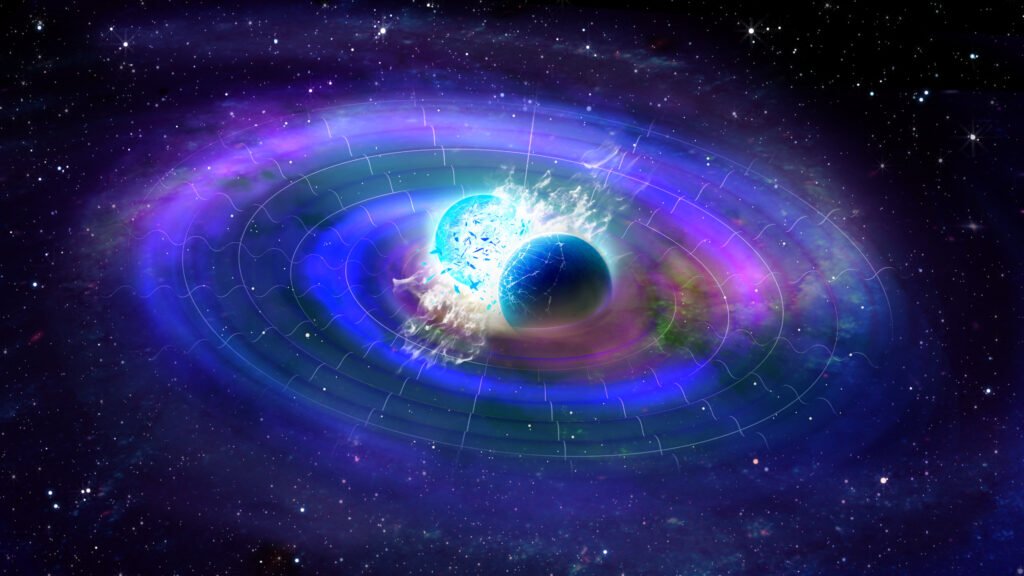

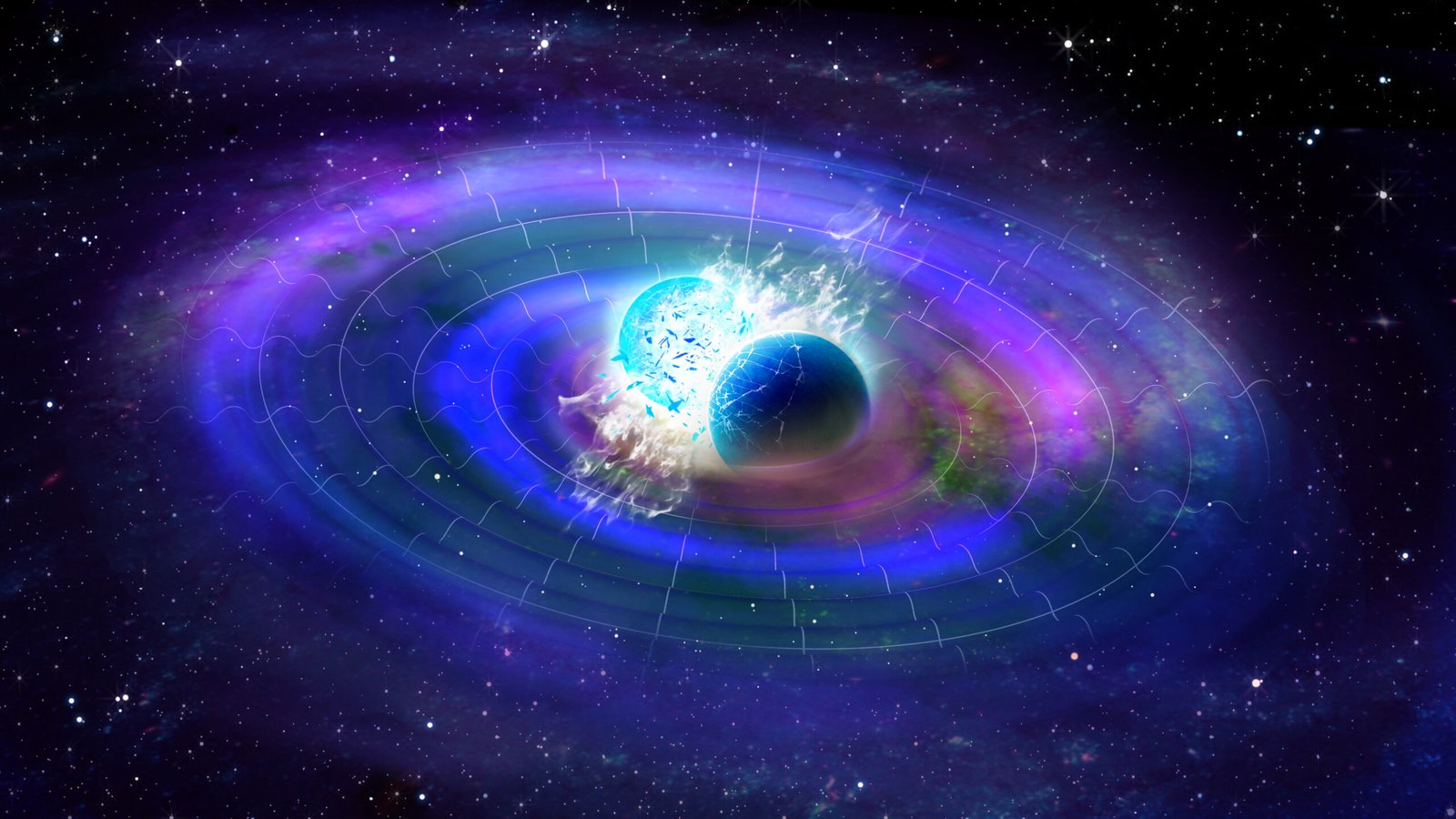
The Enigma of Dark Matter (Image Credits: Upload.wikimedia.org)
A fresh theoretical study has proposed that stochastic gravitational waves permeating the early universe could have generated the particles responsible for dark matter, offering a novel explanation for one of cosmology’s enduring puzzles.[1][2] Published in Physical Review Letters on March 31, 2026, the research by Professor Joachim Kopp of Johannes Gutenberg University Mainz and Dr. Azadeh Maleknejad of Swansea University highlights a mechanism previously unexplored in particle physics models.[1] This idea gains traction now as scientists seek alternatives to traditional dark matter candidates amid ongoing experimental challenges.
The Enigma of Dark Matter
Dark matter constitutes about 23 percent of the universe’s total mass-energy content, far outweighing ordinary visible matter at roughly four percent.[1] Astronomers infer its presence through gravitational effects that hold galaxies together and influence the formation of cosmic structures on the largest scales. Yet, despite decades of effort, no direct detection of dark matter particles has occurred, leaving theorists to propose various production scenarios tied to the Big Bang’s aftermath.
Conventional models often invoke weakly interacting massive particles or axions emerging from thermal processes in the hot, dense plasma of the infant cosmos. The new proposal shifts focus to gravitational phenomena, potentially simplifying the picture by linking dark matter directly to spacetime itself.
Stochastic Gravitational Waves from Cosmic Origins
Gravitational waves represent distortions in spacetime, most famously detected from mergers of black holes and neutron stars. Stochastic versions, however, arise from a superposition of many weaker sources, creating a pervasive background hum rather than distinct chirps.[2] In the early universe, these waves likely proliferated due to phase transitions as the plasma cooled and primordial magnetic fields fluctuated.
Researchers long assumed such waves simply propagated through the expanding universe, carrying imprints of inflationary epochs or quantum fluctuations. Kopp and Maleknejad’s calculations reveal they might have interacted more dynamically with quantum fields, seeding matter production in unexpected ways.[1]
Freeze-In: A Pathway from Waves to Particles
The core innovation lies in a “freeze-in” process where stochastic gravitational waves partially convert into massless or nearly massless fermions – particles akin to electrons, protons, and neutrons in their family classification.[2] “In this article, we investigate the possibility of gravitational waves – which are believed to have been ubiquitous in the early universe – being partially converted into dark matter particles,” Kopp explained. “This leads to a new mechanism of dark matter production that has not been researched before.”[1]
These fermions, initially relativistic and light-speed travelers, would later acquire mass through mechanisms like interactions with the Higgs field as the universe evolved. The resulting stable particles could then cluster gravitationally, matching observed dark matter distributions without invoking exotic new forces or particles beyond the Standard Model.
The model’s elegance stems from its reliance on established gravitational wave backgrounds, potentially testable against cosmic microwave background data or future detectors like LISA.
What matters now: This theory bridges gravitational physics and particle cosmology, prompting refined simulations to quantify production rates and distinguish signatures from competing models.
Uncertainties and Paths Forward
Current results rest on analytical approximations, which carry inherent limitations in capturing the full complexity of quantum-gravitational interactions. Kopp noted that numerical simulations will be essential to sharpen predictions and explore parameter spaces.[2] Additional inquiries could address related puzzles, such as the observed matter-antimatter asymmetry in the universe.
Experimental verification remains distant, as direct gravitational wave-dark matter links evade current detectors focused on astrophysical sources. Still, upcoming observatories sensitive to primordial stochastic backgrounds may offer indirect corroboration, invigorating the hunt for dark matter’s true nature.
This work underscores how relics from the universe’s first instants continue to shape our understanding, reminding researchers that spacetime’s subtle tremors might harbor profound secrets about the invisible scaffold of reality.