
A Historic Headache in Cosmology (Image Credits: Upload.wikimedia.org)
Providence, Rhode Island – Physicists at Brown University suggested that the underlying topology of space-time within a specific quantum gravity framework could neutralize disruptive quantum effects, stabilizing the cosmological constant at its observed minuscule value.[1]
This proposal revives a traditional method of quantizing gravity and borrows insights from condensed matter physics to address a longstanding discrepancy between theory and observation. The work highlights how non-trivial mathematical structures in space-time might protect cosmic parameters from chaos.[1]
A Historic Headache in Cosmology
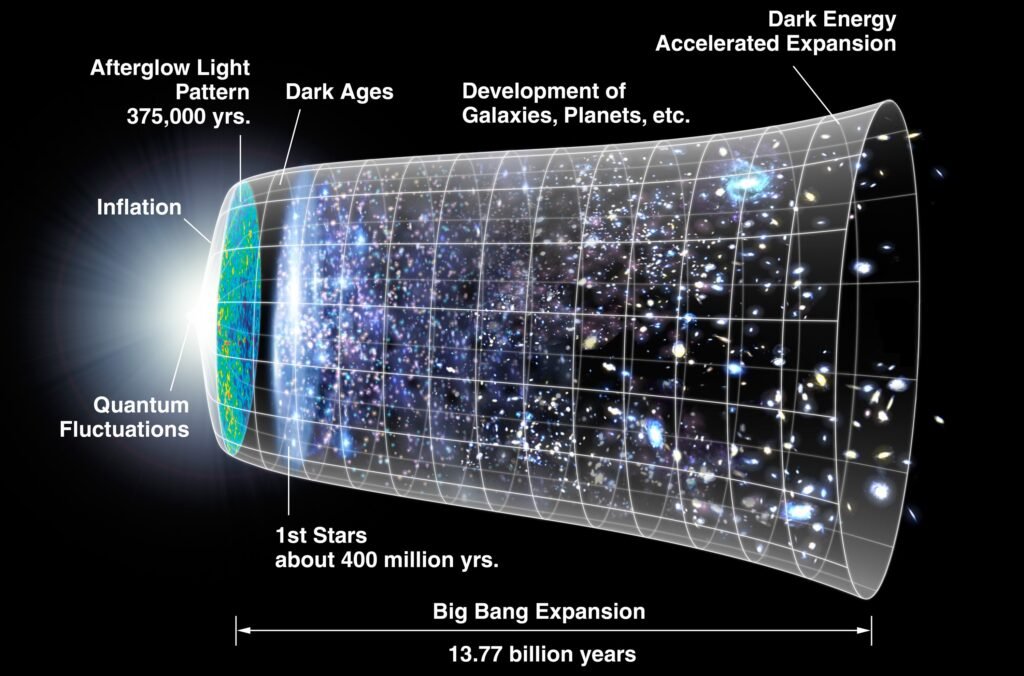
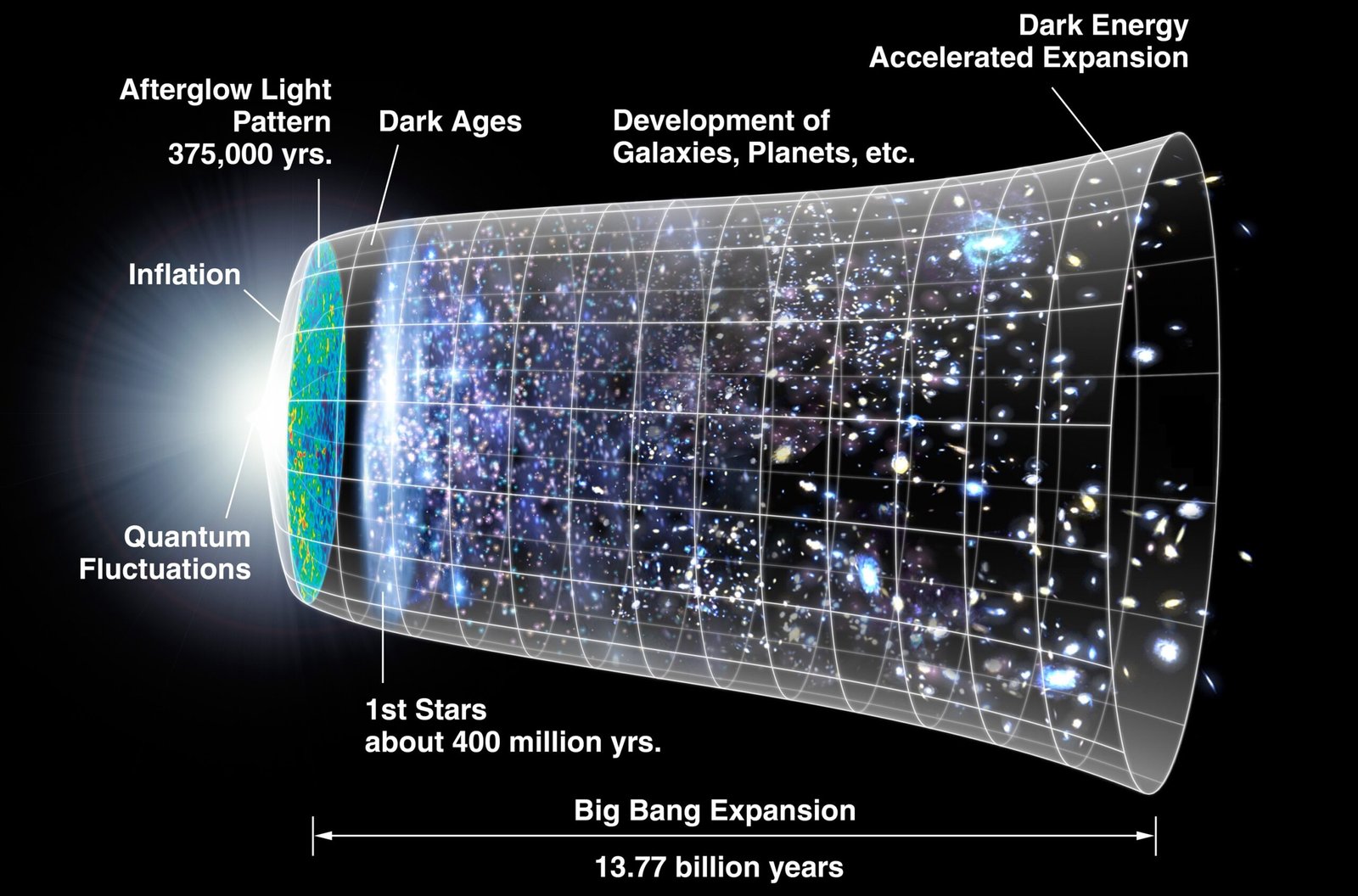
The cosmological constant emerged as a puzzle early in the 20th century. Albert Einstein introduced it into his general relativity equations to maintain a static universe, only to retract it after Edwin Hubble confirmed cosmic expansion in 1929. Observations in 1998, from distant supernovae, revived the constant as evidence mounted for the universe’s accelerating growth.[1]
Quantum field theory paints empty space as a frothing sea of virtual particles, predicting vacuum energy densities vastly larger than measurements indicate – by up to 120 orders of magnitude. This mismatch, known as the cosmological constant problem, has stymied physicists for decades. Researchers now seek mechanisms to explain why the constant remains tiny and finite despite such theoretical turmoil.[1]
The Chern-Simons-Kodama Ground State
Brown University researchers Stephon Alexander, Aaron Hui, and Heliudson Bernardo explored the Chern-Simons-Kodama (CSK) state as a candidate ground state for quantum gravity. This framework applies canonical quantization techniques pioneered by figures like Paul Dirac, Erwin Schrödinger, and John Wheeler – methods rooted in quantum field theory without radical departures.[1]
The CSK state incorporates a non-trivial topology into space-time’s fabric. Proponents argue this structure imposes rigid constraints on physical quantities. In their analysis, published in Physical Review Letters, the team demonstrated how these topological features prevent quantum fluctuations from inflating the cosmological constant.[1]
“What we’ve shown is that if space-time has this non-trivial topology, then it resolves one of the deadliest problems of the cosmological constant,” said study co-author Stephon Alexander, a professor of physics at Brown. “All the quantum perturbations that should blow up the value of the cosmological constant are rendered inert by this topology, which keeps the constant’s value stable.”[1]
Parallels with the Quantum Hall Effect
The breakthrough analogy comes from the quantum Hall effect, observed in two-dimensional materials under strong magnetic fields and low temperatures. Here, electrical conductance quantizes into precise plateaus, insulated from impurities by the system’s topology. Electrons form a collective state where mathematical invariants dictate stable values.[1]
Aaron Hui, a co-author, noted the striking similarity: “What we find is that this quantization of the electrical conductance in quantum Hall has an analog with the cosmological constant. It also ends up becoming quantized for topological reasons. There turn out to be constraints in the theory that force the cosmological constant to take certain allowed quantized values.”[1]
- Both phenomena feature topological invariants that lock in quantized outcomes.
- Imperfections or fluctuations fail to disrupt the protected quantities.
- CSK equations mirror quantum Hall mathematics, suggesting a “gravitational Hall effect.”
- Space-time topology acts as a shield, much like electron wavefunctions in Hall systems.
- This protection ensures finite, stable values despite quantum “noise.”
Interdisciplinary Sparks and Future Horizons
The collaboration bridged cosmology and condensed matter physics, fostering fresh insights at Brown’s Theoretical Physics Center. Alexander praised this environment: “This is the beauty of the Brown Theoretical Physics Center. We want to be a place where there’s a mixing of lots of perspectives, and this is us practicing what we preach – a cosmologist working closely with a condensed matter theorist.”[1]
The paper, titled “Cosmological Constant from Quantum Gravitational θ Vacua and the Gravitational Hall Effect,” uncovers overlooked features in established theory. “We took something old, which is this conservative, canonical approach to quantum gravity, and discovered something new that had been there all along,” Alexander added.[1]
While promising, the idea requires further refinement to integrate with full quantum gravity models. It could illuminate dark energy’s nature and refine predictions for cosmic evolution. Ongoing efforts aim to expand this topological perspective.[1]
Key Takeaways
- CSK state’s topology renders vacuum fluctuations inert, stabilizing the cosmological constant.
- Quantum Hall effect provides a condensed matter blueprint for gravitational protection.
- Revives canonical quantization, linking old methods to modern cosmology puzzles.
This topological approach offers a elegant, conservative path forward, potentially harmonizing quantum mechanics with general relativity. As physicists probe deeper, it underscores topology’s quiet power in the universe’s architecture. What do you think of this quantum gravity twist? Share your views in the comments.