Double Prominence Burst Captivates Observers (Image Credits: Upload.wikimedia.org)
Space weather monitors tracked a coronal mass ejection launched from the sun on April 21, 2026, that forecasters expect to graze Earth around April 24. This partial halo event stemmed from a rare double prominence eruption and arrives amid lingering fast solar wind from a vast coronal hole. The combination could stir geomagnetic unrest, boosting chances for northern lights visible at higher latitudes after a recent spate of displays reached mid-northern regions.[1]
Solar activity remained subdued through April 22, with mostly minor flares punctuating an otherwise quiet sun. Yet this incoming material highlights the sun’s persistent dynamism even as Solar Cycle 25 progresses.[1]
Double Prominence Burst Captivates Observers
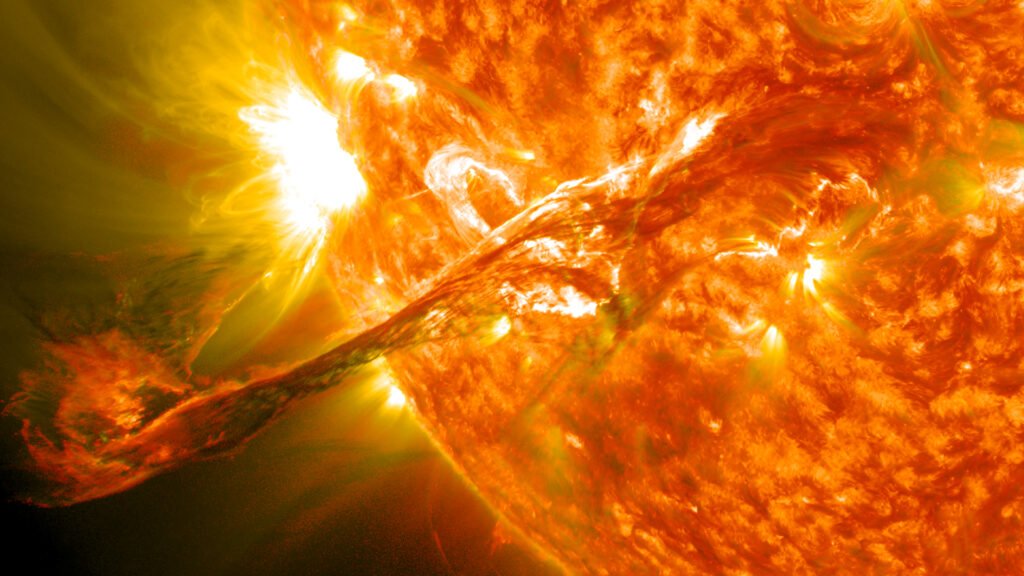
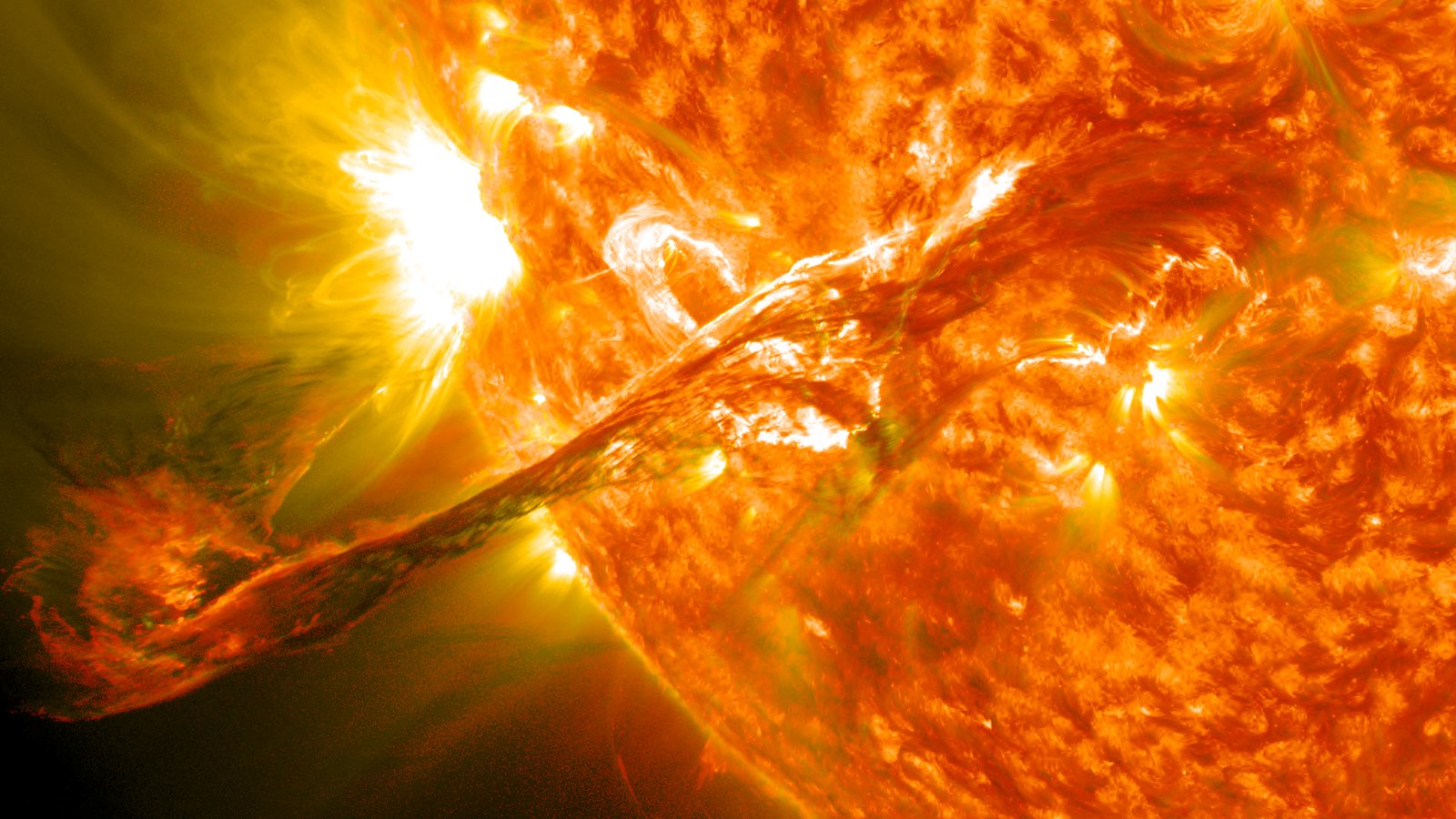
Two fiery prominences erupted in opposite directions from near the sun’s poles on April 21, hurling a cloud of charged particles into space. Instruments aboard NOAA’s GOES-19 satellite captured the event in extreme ultraviolet light, revealing the dramatic ejections.[1]
Coronagraph imagery from the SOHO spacecraft confirmed the resulting coronal mass ejection as a partial halo, aimed partially toward Earth. Travel time for such solar material typically spans two to four days, aligning with the projected April 24 arrival. This glancing trajectory means Earth will likely experience only peripheral effects rather than a direct hit.[1]
Low-Level Flares Dominate Recent Activity
Solar flare output stayed at low levels from April 18 through April 22, featuring primarily B-class and C-class events. No M-class or stronger flares disrupted communications or power grids during this period.[1]
Active sunspot regions fueled the activity. Key contributors included:
- AR4419, a beta-gamma region that produced multiple flares, including a C1.0 event.
- AR4420, a new northeastern spot responsible for 18 flares, peaking with a C4.0 on April 21.
- AR4421 in the southeast, adding isolated bursts.
- AR4422 on the northwest limb, emerging recently.
Forecasters noted a continued risk of C-class flares, with slim odds for an M-class from AR4419 or AR4420.[1]
Coronal Hole Fuels Recent Storms and Lights
A expansive coronal hole steered high-speed solar wind toward Earth starting April 17, peaking at nearly 700 km/s by April 19. Southward swings in the interplanetary magnetic field reached -14 nanoTeslas, injecting energy into Earth’s magnetosphere.[1]
This sparked geomagnetic storms rated G1 minor from April 19 to 21, with a brief G2 moderate episode. Auroras danced overhead in places like Lake Vermilion in Minnesota, northern England, Toronto, and Chicago. Displays persisted into early mornings, drawing reports from skywatchers across mid-latitudes.[1]
Conditions quieted to Kp 1-2 levels by April 22, shrinking aurora ovals back to polar regions.
April 24 Outlook: Glancing Blow Ahead
The April 21 CME joins residual coronal hole effects to potentially elevate geomagnetic activity on April 24. Experts anticipate unsettled to active conditions, with Kp indices of 1 to 4, favoring auroras poleward of 50 degrees latitude.[1]
Quiet intervals prevail April 22 and 23, offering a calm before any disturbance. No other major Earth-directed ejections appeared in recent monitoring. For real-time views, check coronagraph feeds from the SOHO/LASCO C3 instrument.[1]
Key Takeaways
- A partial halo CME from April 21’s double eruption eyes a glancing Earth impact April 24.
- Recent G1-G2 storms from a coronal hole lit auroras unusually far south.
- Solar flares stayed minor (B/C-class), with low odds for escalation soon.
As the sunspot number hovers below Solar Cycle 25 averages, events like this remind us of its unpredictable power. Sky enthusiasts should monitor forecasts closely for April 24 viewing opportunities. What do you think about these solar surprises? Tell us in the comments.