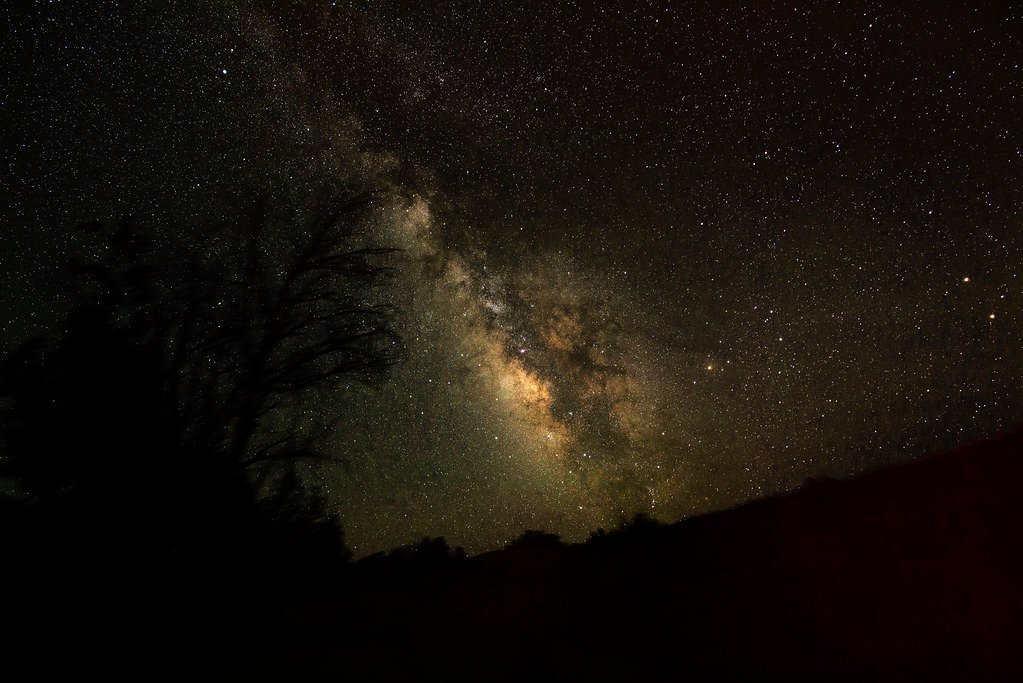
U-Shaped Age Profile Signals Sharp Cutoff (Image Credits: Flickr)
An international team of astronomers pinpointed the outer boundary of the Milky Way’s star-forming disk through a detailed analysis of stellar ages. Their work showed that the galaxy’s primary star birth zone extends no farther than about 40,000 light-years from the Galactic Center.[1] This discovery clarifies long-standing questions about the galaxy’s structure and evolution, drawing on vast datasets from multiple surveys. The findings highlight how our home galaxy assembles itself over billions of years.
U-Shaped Age Profile Signals Sharp Cutoff
Researchers uncovered a distinctive U-shaped pattern in the ages of stars across the Milky Way’s disk. Average stellar ages decrease with distance from the center, reflecting inside-out growth, until they reach a minimum around 35,000 to 40,000 light-years out. Beyond this point, ages increase again, marking the edge where star formation efficiency plummets.[1]
This reversal arises because outer stars result from radial migration rather than local formation. Stars drift outward along spiral arms over time, but migration proves too slow to populate the fringes with young stars. The pattern confirms a well-defined active region amid the disk’s gradual fade.[1]
Powerful Data and Simulations Drive Breakthrough
The team examined over 100,000 giant stars selected for their orbits in the main disk. Data came from the LAMOST and APOGEE spectroscopic surveys, paired with precise positions and motions from the Gaia satellite. Advanced computer simulations on supercomputers tested scenarios of galaxy evolution.[1]
Lead author Dr. Karl Fiteni noted, “The extent of the Milky Way’s star-forming disk has long been an open question in galactic archaeology; by mapping how stellar ages change across the disk, we now have a clear, quantitative answer.”[1] The simulations matched observations, linking the age minimum to a drop in star formation. This approach isolated the disk’s growth signal from other dynamics.
Inside-Out Assembly and Stellar Journeys
Galaxies like the Milky Way build outward from dense cores, with star formation spreading gradually. Younger stars dominate inner regions, while migration scatters older ones to the periphery. Spiral arms act as highways, allowing stars to “surf” waves to larger radii on nearly circular orbits.[1]
Prof. Victor P. Debattista emphasized, “A key point about the stars in the outer disk is that they are on close to circular orbits, meaning that they had to have formed in the disk. These are not stars that have been scattered to large radii by an infalling satellite galaxy.”[1] Such evidence rules out mergers as the source of outer populations. The boundary may stem from the central bar’s influence or an outer warp disrupting gas flows.
- LAMOST: Provided spectroscopic data for stellar compositions and ages.
- APOGEE: Delivered detailed surveys of giant stars across the disk.
- Gaia: Supplied accurate 3D positions and velocities for over 100,000 stars.
- Supercomputer simulations: Modeled migration and star formation efficiency.
Shaping Views of Galactic History
Prior efforts struggled to define the disk’s edge due to its subtle taper. Stellar ages now offer a precise tracer, ushering in refined galactic archaeology. The study, published in Astronomy & Astrophysics, sets a benchmark for future work.[1]
Upcoming surveys like 4MOST and WEAVE promise even sharper data. Prof. Laurent Eyer observed that Gaia combines with spectroscopy and models to decode the Milky Way’s past. These tools will probe what halts star formation at the frontier.
- Star formation peaks within 40,000 light-years; efficiency drops sharply beyond.
- U-shaped age curve pinpoints the active disk’s limit via migration effects.
- Internal processes, not external events, explain outer disk stars.
This boundary revelation underscores the Milky Way’s orderly evolution, blending observation with theory to illuminate cosmic assembly. As precise ages unlock more secrets, our grasp of the galaxy strengthens. What aspects of the Milky Way’s history intrigue you most? Share in the comments.