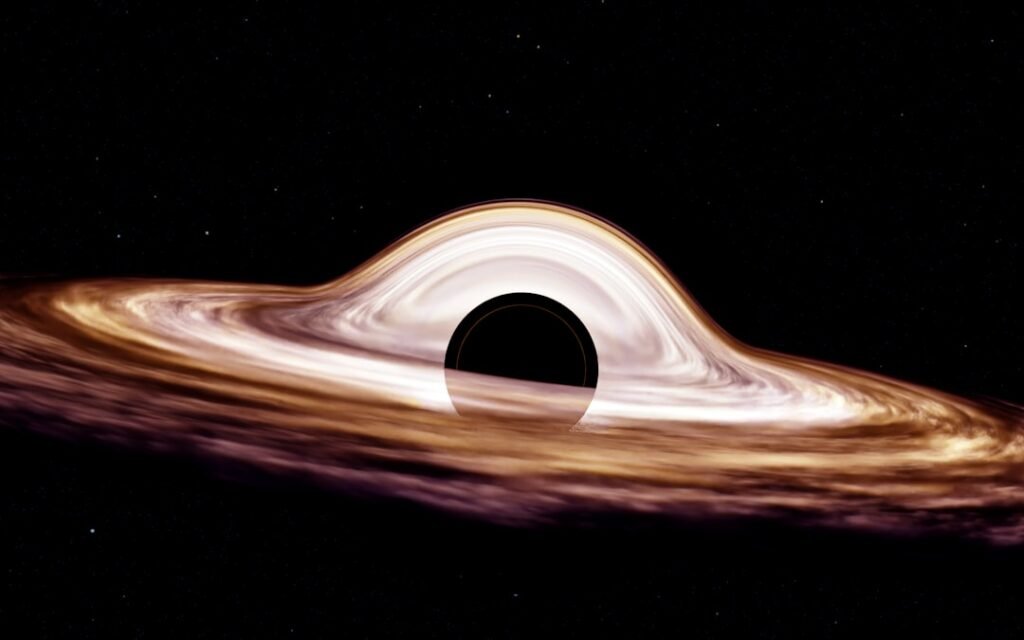
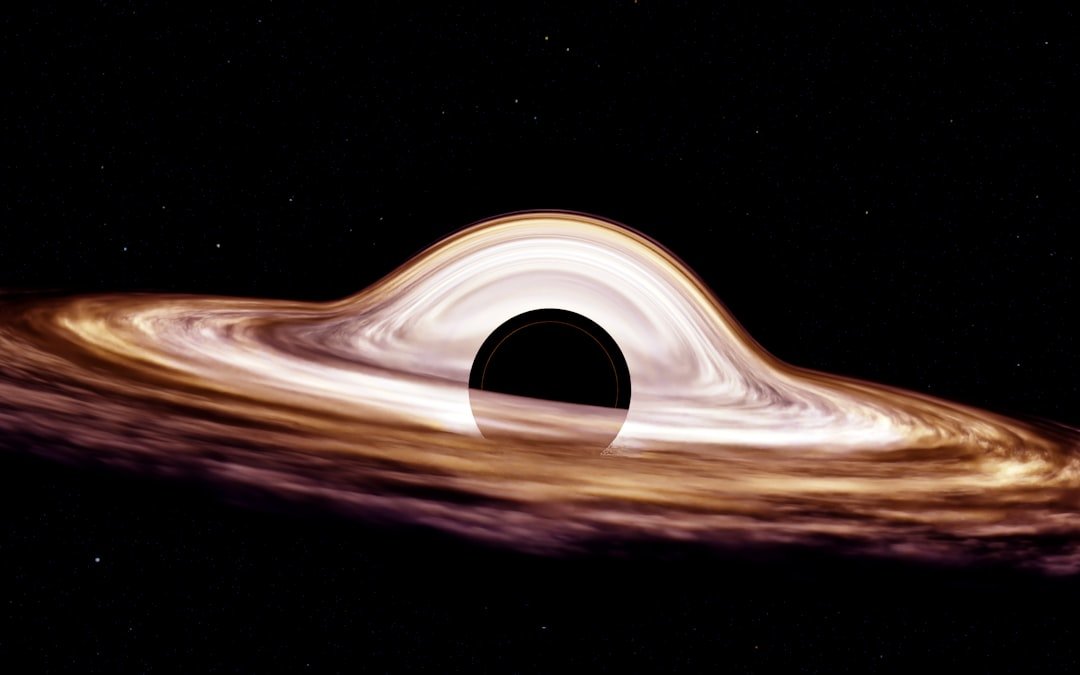
The Paradox That Challenged Physics (Image Credits: Unsplash)
Physicists have long grappled with a puzzle posed by Stephen Hawking decades ago: what happens to information swallowed by black holes? A recent theoretical paper argues that the answer lies in extra dimensions, suggesting black holes stabilize into minuscule remnants rather than vanishing entirely. This framework preserves the lost information and ties into fundamental particle physics, offering fresh insights into quantum gravity.[1]
The Paradox That Challenged Physics
In the 1970s, Stephen Hawking demonstrated that black holes emit radiation and evaporate over time. This process raised a profound issue: the radiation appears thermal, carrying no trace of the matter that formed the black hole. Quantum mechanics insists information cannot be destroyed, yet full evaporation seemed to erase it forever.[1]
The contradiction, known as the black hole information paradox, has fueled debates for generations. Traditional views held black holes as eternal vaults, but Hawking radiation upended that notion. Resolving it demands reconciling general relativity with quantum principles, a quest that continues to drive theoretical research.
Extra Dimensions Enter the Fray
A team from the Slovak Academy of Sciences proposed a seven-dimensional universe as the solution. They envision three compact, hidden dimensions curled in a G₂ geometry, a structure borrowed from string theory and M-theory. This configuration twists space-time, introducing torsion – a repulsive force at tiny scales.[1]
Senior researcher Richard Pinčák explained, “This repulsive force acts as a brake, halting the evaporation before the black hole vanishes completely.”[1] The model predicts black holes shrink to stable remnants with masses around 9 × 10⁻⁴¹ kilograms, billions of times lighter than an electron. Information lingers in these relics through quasinormal mode oscillations.
Remnants as Information Safekeepers
Unlike complete evaporation, remnants halt the process near Planck densities, where semiclassical physics gives way to new effects. The effective potential in the model features a minimum at this remnant mass, ensuring stability. Pinčák noted, “What distinguishes our approach is that we do not claim semiclassical evaporation operates all the way down to the remnant mass. At that point, a new physical effect takes over and stabilises the configuration.”[1]
These remnants could dot the universe, remnants of primordial black holes or stellar collapses. Detection might occur indirectly via gamma rays from evaporating primordial ones or gravitational waves. The idea shifts black holes from destroyers to archivists of cosmic history.
Linking Black Holes to Particle Physics
The theory extends beyond gravity, connecting to the electroweak scale. The torsion field mirrors the potential giving mass to W and Z bosons via the Higgs mechanism. Pinčák highlighted, “The same torsion field generates a potential energy landscape that is identical in form to the one responsible for giving mass to the W and Z bosons – the carriers of the weak nuclear force.”[1]
It also forecasts Kaluza-Klein particles, excitations from extra dimensions, at about 10¹⁶ gigaelectronvolts – far beyond current colliders but potentially observable in cosmic signals. This unification hints at a deeper structure underlying forces.
| Feature | Standard Model | 7D Torsion Model |
|---|---|---|
| Black Hole Fate | Full evaporation | Stable remnants |
| Remnant Mass | None | 9 × 10⁻⁴¹ kg |
| Extra Dimensions | 0 | 3 compact (G₂) |
| Particle Link | Higgs only | Torsion + Higgs |
Testing the Seven-Dimensional Hypothesis
The study appeared on March 19, 2026, in General Relativity and Gravitation (DOI: 10.1007/s10714-026-03528-z). Pinčák emphasized testability: “The important point is that the predictions are concrete – the model can be wrong, which is what makes it scientific.”[1]
- Gamma-ray bursts from primordial black hole evaporation.
- Gravitational wave signatures from remnant formation.
- High-energy cosmic rays hinting at Kaluza-Klein particles.
- Precision tests of electroweak interactions for torsion effects.
- Future collider searches beyond LHC energies.
Challenges remain, as Planck-scale physics eludes direct probes. Yet the framework’s falsifiability strengthens its scientific merit.
- Seven dimensions with G₂ geometry introduce torsion, stabilizing black holes.
- Remnants preserve information, resolving Hawking’s paradox.
- Model links gravity to particle masses, predicting testable particles.
This proposal reframes black holes not as cosmic erasers but enduring records of the universe’s past. As research advances, it invites scrutiny of hidden dimensions’ role in reality. What implications do stable remnants hold for cosmology? Share your thoughts in the comments.