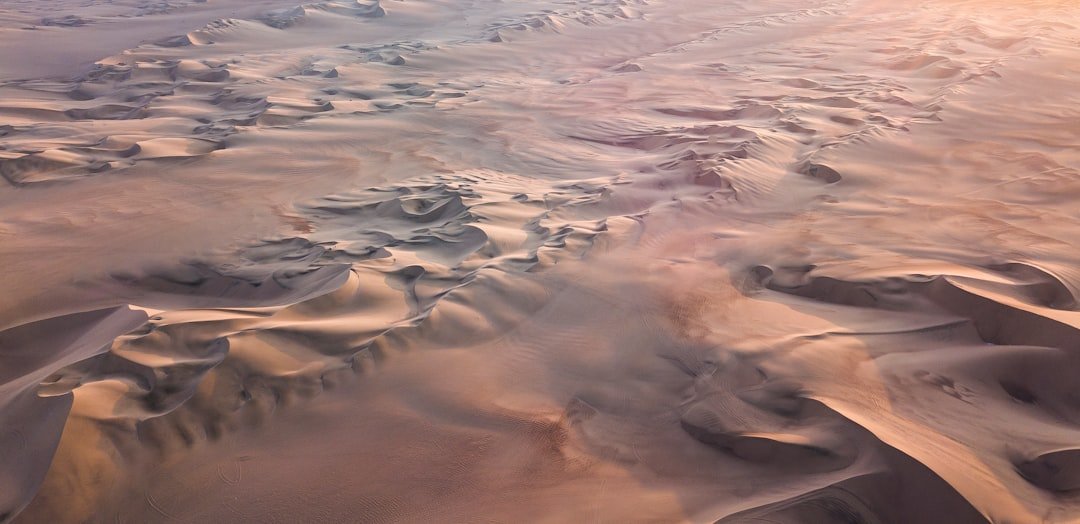
A Serendipitous Find in Jawbone Canyon (Image Credits: Unsplash)
Gale Crater, Mars – Researchers have identified traces of an extraordinary sandstorm that swept through the Red Planet roughly 3.5 billion years ago. NASA’s Curiosity rover captured images of distinctive ripples carved into bedrock slabs, marking the first solid evidence of such a powerful ancient wind event. This discovery highlights a time when Mars supported a denser atmosphere, capable of generating winds far stronger than those today.
A Serendipitous Find in Jawbone Canyon
The breakthrough came unexpectedly during Curiosity’s exploration. On December 13, 2024 – or sol 4391 in Mars time – the rover navigated through Jawbone Canyon within Gale Crater. Team members spotted unusual patterns in black-and-white panorama images from the navigation camera.
Planetary geologist Steven Banham of Imperial College London led the analysis. He described the moment: “This was very serendipitous. We weren’t really looking for these deposits, and then lo and behold, we drove around the corner and found them.” Closer examination revealed millimeter-thick, crinkly laminations on the rock surfaces, prompting further study.
These bedrock blocks preserved delicate structures known as supercritical climbing wind ripple strata. Such features arise from sustained winds transporting vast quantities of sand over short periods.
Deciphering the Ripples’ Story
The ripples record the briefest wind fluctuations yet detected on ancient Mars. Each layer captures gusts lasting mere minutes, while the overall set points to a broader event enduring hours. Scientists interpret this as a single, intense sandstorm or gale.
Unlike typical sediments that reflect seasonal patterns, these strata indicate transient atmospheric bursts amid a drying climate. The thin succession of layers underscores the event’s brevity and ferocity. No similar structures had appeared in prior Martian samples.
- Millimeter-scale crinkly laminations from sand migration.
- Evidence of winds moving large sand volumes rapidly.
- Shortest-duration wind records on ancient Mars.
- Linked to a hours-long storm in arid transition period.
- First physical proof of intense sandstorm activity.
Clues to a Denser Martian Atmosphere
Mars today hosts planet-wide dust storms despite its thin air. However, the ancient ripples demand stronger forces. They formed only under conditions mimicking Earth’s more robust winds.
The study, published March 27, 2026, in the journal Geology, confirms a thicker atmosphere prevailed 3.5 to 3.6 billion years ago. Banham noted: “These deposits in themselves indicate that the atmosphere was denser at the time than it is now, to form these structures.”
This aligns with other Gale Crater evidence, like ancient lake and river beds from precipitation. The sandstorm occurred as the planet shifted toward aridity, preserving a snapshot of volatile weather.
Parallels with Earth and Popular Imagination
On Earth, equivalent ripples remain scarce, typically from active dunes. Martian versions stand out as the planet’s first documented examples. Modern Mars winds lack the punch to create them.
Banham evoked vivid imagery: “You just think that on a Tuesday afternoon, sometime, maybe 3.6 billion or so years ago, there was a sandstorm that rolled into Gale Crater. It would be like one of those scenes in ‘Dune’ where there’s a sandstorm happening.” Such comparisons bridge scientific data with cultural touchstones.
Current dust devils and storms offer pale echoes of this power. Yet the ancient event underscores Mars’ dynamic history.
Future Horizons for Martian Climate Research
The announcement followed April 4, 2026, building on Curiosity’s long mission. Rovers continue hunting direct precipitation signs, like raindrop imprints, absent despite river evidence.
Banham reflected: “Everybody knows that the wind blew on Mars…. But this is the first definitive evidence that we’ve found of such a sandstorm.” These ripples enrich our view of early Mars.
- First direct evidence of ancient intense sandstorm on Mars.
- Points to denser atmosphere 3.5 billion years ago.
- Curiosity’s images from Jawbone Canyon hold the key.
This window into Mars’ turbulent youth prompts reflection on planetary evolution. What other secrets lie in Gale Crater’s rocks? Share your thoughts in the comments.