A Universe That Bounces, Not Begins (Image Credits: Unsplash)
Dark matter remains one of cosmology’s deepest puzzles, exerting gravitational pull on galaxies without emitting or absorbing light. Recent research proposes a striking solution: these invisible masses could consist of black holes that endured from a universe before our Big Bang. In a model of cosmic evolution known as bouncing cosmology, such relics might have survived a dramatic rebound, influencing the structures we observe today.
A Universe That Bounces, Not Begins
Traditional Big Bang theory posits an initial singularity where density and temperature soared infinitely. Yet researchers now explore alternatives that avoid this mathematical impasse. Bouncing cosmology envisions the universe contracting to extreme yet finite density before rebounding into expansion.
This rebound erases fine details from the prior phase but preserves overall mass and certain structures. Quantum effects, such as degenerate pressure akin to the Pauli exclusion principle, halt total collapse. Structures larger than about 90 meters withstand the transition, according to calculations in a new study.
The model integrates standard physics, including gravity and quantum mechanics, without invoking exotic new forces. Inflation, the rapid early expansion, arises naturally from bounce dynamics. Enrique Gaztanaga, who detailed the idea in recent work, noted that this framework challenges the notion of an absolute cosmic beginning.[1]
Relic Black Holes: Forged in a Forgotten Era
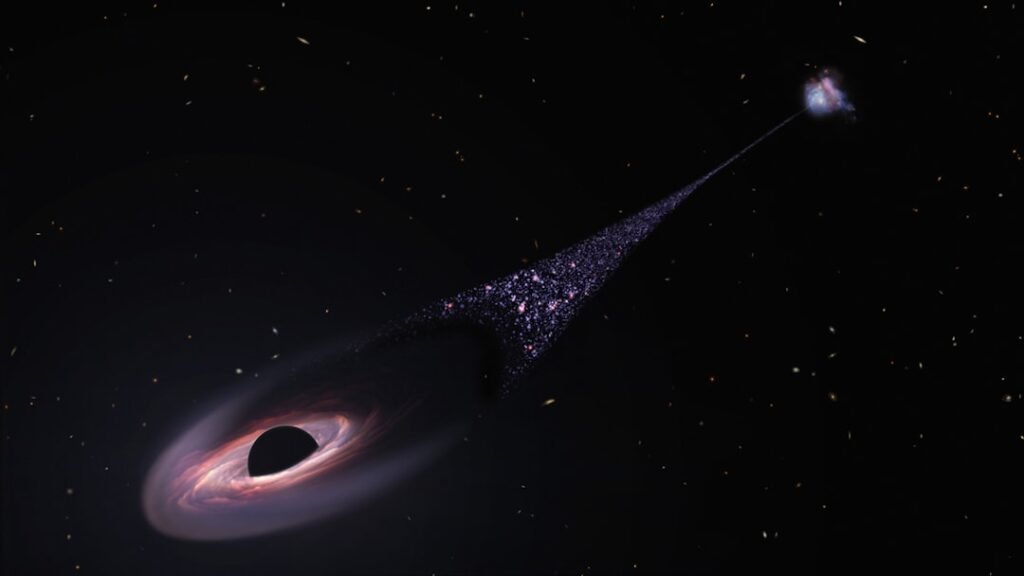
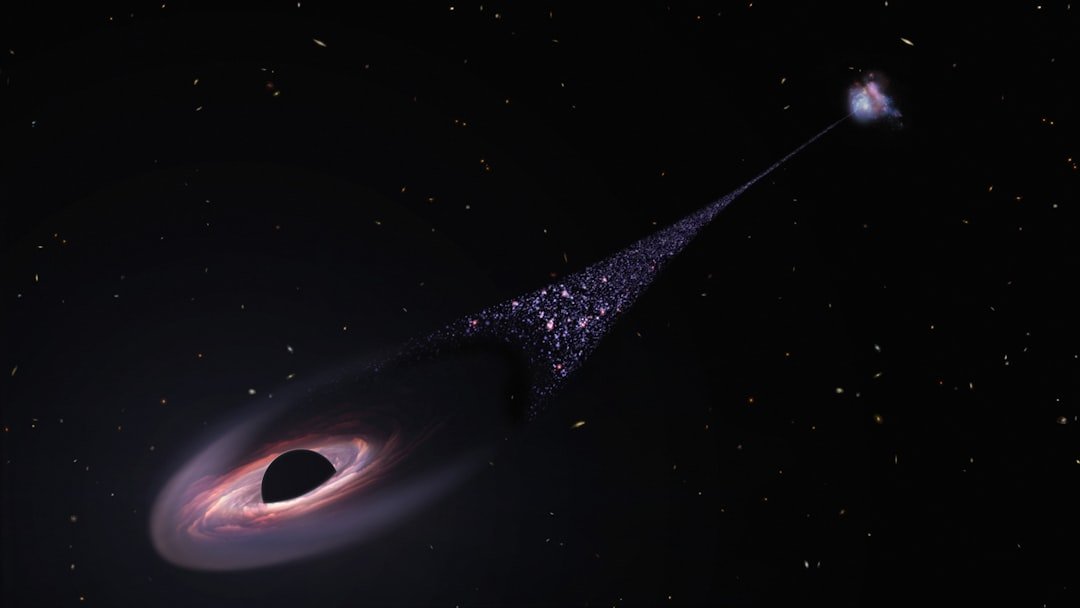
Black holes from the contraction phase could persist directly if compact enough, or form post-bounce as matter clumps under gravity. These relics carry substantial mass yet remain dark, interacting solely through gravity. Gaztanaga explained, “In our work, we found that things larger than 90 meters could have survived the transition from collapse to expansion.”
Two primary formation paths emerge in this scenario:
- Direct survival of pre-bounce perturbations and compact objects, shielded by quantum resistance to compression.
- Gravitational collapse of surviving mass distributions shortly after the bounce, creating new black holes from ancient material.
- Generation of gravitational waves and density fluctuations as additional relics.
Unlike primordial black holes formed fractions of a second after the Big Bang, these relics trace origins to a prior cosmic cycle. Their masses span a wide range, fitting observations of galactic halos.
Why Black Holes Fit the Dark Matter Profile
Dark matter must account for roughly 85 percent of the universe’s mass, binding galaxies without luminous signatures. Particle candidates like WIMPs have eluded detection despite decades of searches. Relic black holes offer a particle-free alternative, embodying the required darkness and mass.
Gaztanaga highlighted their appeal: “Ancient black holes from before the big bang also fit the bill. They are dark, but also carry mass – exactly the properties required.” If the bounce generated sufficient numbers, they could dominate dark matter content.
| Candidate | Key Traits | Challenges |
|---|---|---|
| Weakly Interacting Massive Particles (WIMPs) | Subatomic, weakly interacting | No detections in labs |
| Axions | Light bosons, cold dark matter | Hard to produce/test |
| Relic Black Holes | Massive, gravity-only interaction | Requires bounce model validation |
This comparison underscores how black hole relics sidestep particle hunts, relying instead on gravitational signatures.
Observational Clues from the James Webb Telescope
The James Webb Space Telescope has revealed “little red dots” in the early universe – compact, red objects harboring supermassive black holes far sooner than standard models predict. These might represent relic black holes seeding rapid growth. Their unexpected presence aligns with bounce survivors seeding today’s galactic cores.
Gravitational lensing and galaxy rotation curves further support diffuse dark mass distributions consistent with clustered black holes. Future detectors could hunt merger signals from these ancient objects, providing testable predictions.
A Paradigm Shift in Cosmic History
This theory unifies dark matter with broader puzzles: dark energy as finite-universe geometry, supermassive black holes’ origins, and the Big Bang’s true nature. Gaztanaga reflected on the stakes: “Relic black holes offer a compelling alternative. If the bounce produces enough of them, they could make up a significant – perhaps dominant – fraction of dark matter.”
The idea invites scrutiny through simulations and observations. It reimagines our cosmos as a rebounding entity, with dark structures as echoes of a pre-bang epoch. Read the full study details on Phys.org.
Key Takeaways
- Bouncing cosmology allows black holes over 90 meters to survive a cosmic rebound, potentially forming dark matter.
- These relics explain gravitational effects without new particles, matching galaxy dynamics.
- James Webb observations of early massive black holes bolster the case for ancient origins.
What implications does this hold for our understanding of the universe? Share your thoughts in the comments.