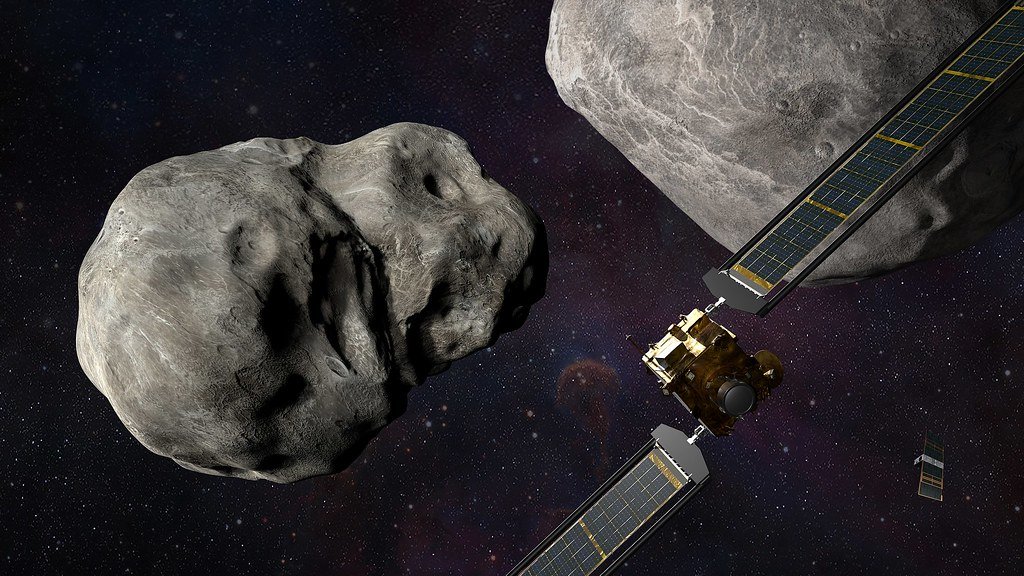
Drawing Lessons from NASA’s DART Triumph (Image Credits: Flickr)
Blue Origin has introduced a promising mission concept aimed at bolstering Earth’s defenses against near-Earth objects. Developed alongside NASA’s Jet Propulsion Laboratory and Caltech, the NEO Hunter initiative leverages advanced spacecraft technology to characterize and deflect potentially hazardous asteroids. This collaboration highlights the growing role of commercial space firms in planetary protection efforts.[1][2]
Drawing Lessons from NASA’s DART Triumph
NASA’s Double Asteroid Redirection Test marked a milestone in 2022 when its spacecraft collided with the asteroid Dimorphos. The impact shortened Dimorphos’s orbit around its parent asteroid Didymos by about 33 minutes and subtly altered the binary system’s path around the Sun. Recent analyses confirmed this velocity change of roughly 11.7 microns per second, validating kinetic impact as a viable deflection strategy.[1]
Blue Origin’s NEO Hunter builds directly on these findings. The concept incorporates a more powerful kinetic option while introducing complementary methods. This evolution addresses limitations of single-technique missions, preparing for diverse asteroid threats.[2]
Unpacking the NEO Hunter Mission Phases
The mission unfolds in deliberate stages to maximize effectiveness. First, the spacecraft releases a swarm of CubeSats that rendezvous with the target asteroid. These small satellites gather critical data on the object’s composition, mass, and density, informing the optimal deflection tactic.[1]
Next comes the deflection phase, where the primary spacecraft maneuvers into position. Operators select either a gentle ion beam nudge or a decisive kinetic strike based on the gathered intelligence. A specialized CubeSat named Slamcam deploys prior to any impact, capturing high-resolution footage to verify success and aid future missions.[2]
This phased approach ensures precision and adaptability. It minimizes risks associated with unknown asteroid properties, a challenge in past simulations.
Versatile Deflection Technologies at the Core
Central to NEO Hunter are two innovative deflection methods. The ion beam emitter fires a steady stream of charged particles at the asteroid, exploiting the same physics as ion propulsion systems. This contactless technique gradually imparts momentum, nudging the rock off its Earth-bound course without physical contact.[1]
For tougher targets, robust kinetic disruption takes over. The NEO Hunter spacecraft, nearly nine times heavier than DART, slams into the asteroid at speeds up to 22,600 mph. This delivers about 1.5 times the kinetic energy of the earlier mission, promising a more pronounced trajectory shift.[2]
- Ion beam: Ideal for smaller or distant threats; slow but safe momentum transfer.
- CubeSat characterization: Provides real-time data to choose the right tool.
- Kinetic impact: High-energy option for larger, faster-moving objects.
- Slamcam observer: Documents effects for analysis and refinement.
- Hybrid flexibility: Adapts to asteroid variability.
Blue Ring Platform Powers the Mission
Blue Origin’s Blue Ring serves as the backbone for NEO Hunter. This modular “space tug” offers high maneuverability and extended operational life, supporting diverse payloads from science instruments to defense tools. Recent tests included structural evaluations at NASA’s Marshall Space Flight Center and preparations for its first flight unit.[1]
The platform’s reusability drives down costs for high-priority tasks. Blue Origin emphasized its potential in a March 11, 2026, announcement: “NEO Hunter tests multiple asteroid-deflection techniques, including ion-beam deflection and robust direct kinetic impact, helping protect Earth from potential threats. This is another example of how commercial platforms like Blue Ring can conduct low-cost, high-priority science, exploration, and planetary defense missions.”[2]
| Method | Approach | Best For |
|---|---|---|
| Ion Beam | Charged particles stream | Gradual deflection, contactless |
| Kinetic Impact | High-speed collision | Large/fast asteroids |
Toward a Safer Cosmic Neighborhood
NEO Hunter aligns with broader planetary defense initiatives, including NASA’s NEO Surveyor telescope set for launch no earlier than mid-2027. That infrared observatory will hunt for objects over 140 meters in diameter, cataloging 90 percent as mandated by Congress. Complementary efforts like Europe’s Hera mission, arriving at the Didymos system in November 2026, will refine impact data.[1]
Key Takeaways
- NEO Hunter combines characterization, ion beams, and kinetic impacts for versatile defense.
- Blue Ring enables affordable, multi-mission operations.
- Builds on DART’s proven success to handle real-world threats.
As asteroid detection improves, missions like NEO Hunter position humanity to act decisively. These advancements transform science fiction safeguards into practical reality, ensuring our planet remains secure amid the solar system’s hazards. What role do you see commercial space companies playing in planetary defense? Share your thoughts in the comments.