

There is something quietly unsettling about the idea that simply watching something can change what it is. Not bending it, not touching it, not interfering with it physically. Just looking. It sounds like the kind of philosophical riddle you might debate over coffee, yet science confirms it, psychology documents it, and you probably live it every single day without realizing it.
From the subatomic world to your own workplace, from a physics laboratory to your bathroom mirror, the observer effect is everywhere. It is one of those concepts that, once you truly grasp it, rewires the way you see reality. So let’s dive in and see just how deep this particular rabbit hole goes.
What Exactly Is the Observer Effect?

In physics, the observer effect is the disturbance of a system by the act of observation. This is often the result of utilizing instruments that, by necessity, alter the state of what they measure in some manner. Think of it like this: the moment you try to measure something, you have already joined the experiment. You are no longer just a spectator. You are a participant.
The observer effect is the fact that observing a situation or phenomenon necessarily changes it. Observer effects are especially prominent in physics where observation and uncertainty are fundamental aspects of modern quantum mechanics. Observer effects are also well known in fields other than physics, such as sociology, psychology, linguistics, and computer science. Honestly, that range alone should tell you something remarkable. This is not just a quirk of particle physics. It is a universal pattern baked into how reality responds to attention.
The Double-Slit Experiment: Where Reality Gets Weird
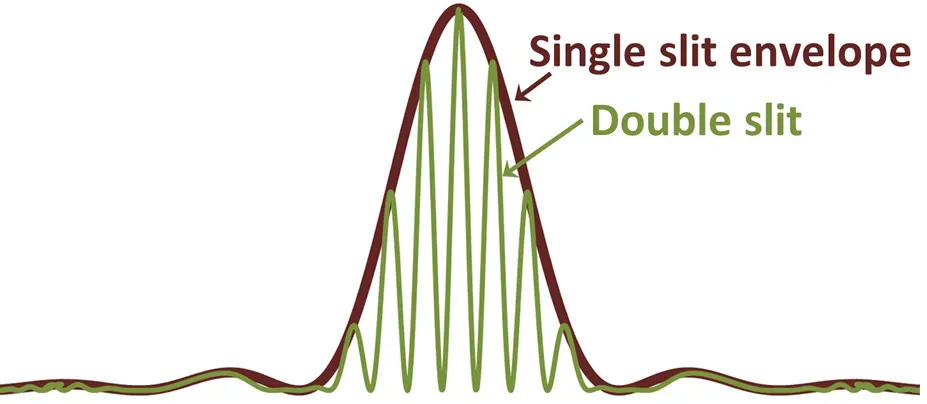
In the double-slit experiment, particles of light exhibit both particle-like and wave-like behavior: the former if their path over time is observed, and the latter if only their final position in space on the screen is observed. When their motion through space and time is unobserved, light photons behave as waves, simultaneously passing through both slits and joining to form an interference pattern on the detection screen. However, when the path of the photons is observed from beginning to end, they behave as discrete particles, passing through one slit or the other, without creating an interference pattern.
Let that sink in for a second. The same particle, going through the same setup, produces a completely different result depending on whether you are watching it. Strange as it may sound, interference can only occur when no one is watching. Once an observer begins to watch the particles going through the openings, the picture changes dramatically: if a particle can be seen going through one opening, then it is clear it did not go through another. In other words, when under observation, electrons are being forced to behave like particles and not like waves. I find this genuinely mind-bending, even after encountering it many times.
Wave Function Collapse: How Observation Creates a Single Reality

Particles like electrons do not occupy a definite position or momentum until they are observed. Instead, they exist in a superposition, a combination of all possible states, until a measurement collapses this superposition into a specific outcome. This is one of those ideas that sounds poetic but is absolutely grounded in real, testable science. Before you look, everything is a cloud of possibility. After you look, there is only one answer.
A key focus point is that of wave function collapse, for which several popular interpretations assert that measurement causes a discontinuous change into an eigenstate of the operator associated with the quantity that was measured, a change which is not time-reversible. It is a one-way door. Once you collapse the probability wave by observing it, you cannot go back. The observer effect remains one of the deepest mysteries in physics. It forces us to confront the role of information and measurement in the very fabric of reality. The line between the observer and the observed is not as clear as we once thought.
Schrödinger’s Cat: The Most Famous Thought Experiment in Science

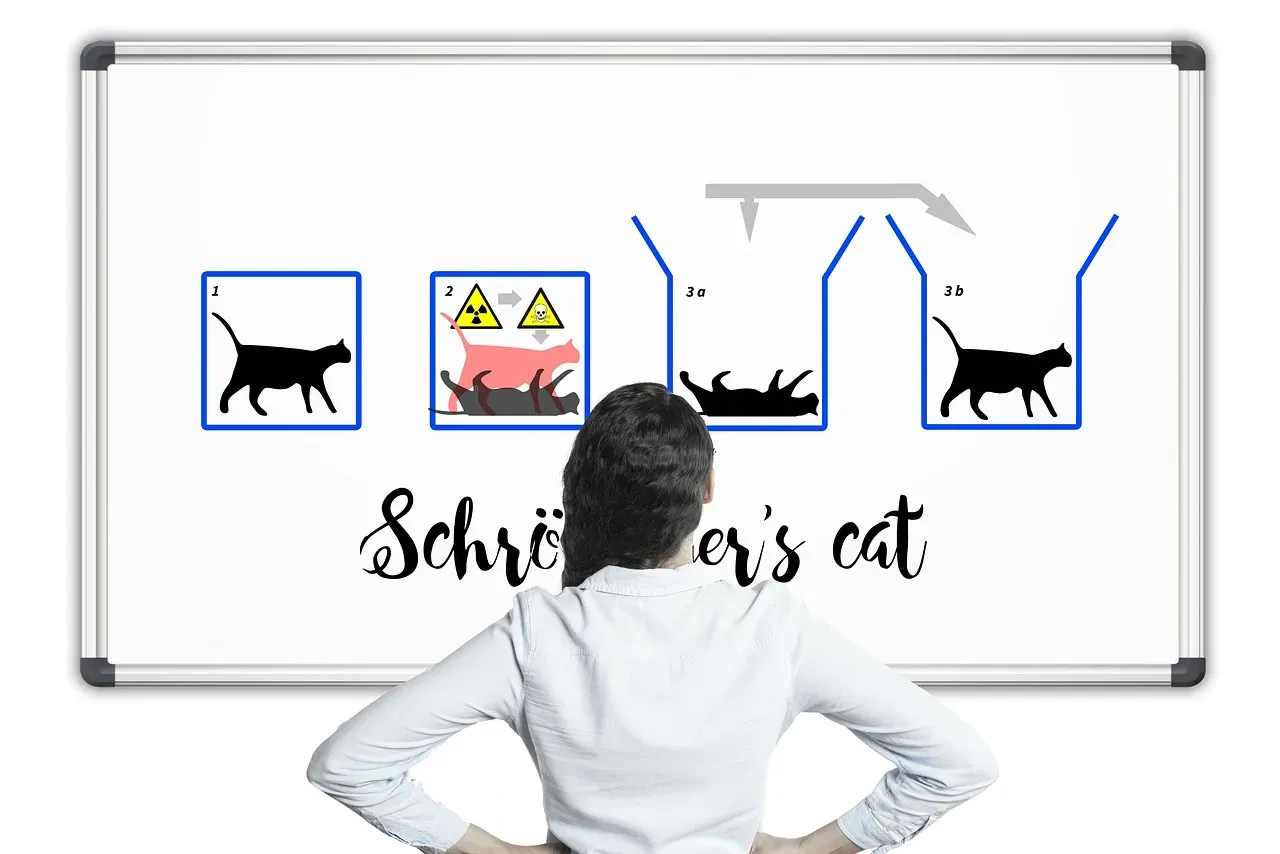
Schrödinger asked us to imagine a cat placed in a box with a radioactive atom that might or might not kill it in an hour. Until the box opens, the cat exists in a state of superposition, meaning the cat is both alive and dead. Only by observing it does the cat shift permanently to one of the two states. The observation removes the cat from a state of superposition and commits it to just one. It is, without question, one of the most effective ways science has ever illustrated a counterintuitive truth.
The observation turns potential states into reality. New Age philosophies take this idea, plus other psychological principles like priming and the placebo effect, and present them as evidence that your thoughts create your own reality. To be fair, the philosophical leap from quantum particles to human thought is a very large one. Unfortunately, this hypothesis is not provable in a laboratory setting due to too many variables, ethical questions, and controls involved, and the observer effect can be induced by any measuring device and not just human observation. Still, the symbolic power of Schrödinger’s cat is undeniable.
The Observer Effect in Human Psychology: The Hawthorne Effect

The Hawthorne Effect describes a situation in which people change their behavior when they know they are being watched. For example, in a workplace setting, employees might be more productive if they know management is observing them. Although not directly related to quantum mechanics, this effect underscores how observation can influence behavior. You have almost certainly experienced this yourself. We all have that slightly sharper focus that kicks in the moment someone is watching us work.
In psychology, observer effect is the name given to the phenomenon that occurs when the subject of a study alters their behavior because they are aware of the observer’s presence. This results in incorrect data: the researcher records behavior that is not the way the subject actually behaves when not under observation. This is a serious problem for researchers worldwide. In scientific contexts, the observer expectancy effect can lead to skewed results if an experimenter inadvertently signals desired outcomes to participants. Notably, techniques like double-blind studies are employed to mitigate these biases by ensuring that neither the participants nor the experimenters know who is receiving the treatment versus a control.
The Observer Effect in Everyday Life: From Traffic Cameras to Thermometers

A common example is checking the pressure in an automobile tire, which causes some of the air to escape, thereby changing the amount of pressure one observes. Similarly, seeing non-luminous objects requires light hitting the object to cause it to reflect that light. While the effects of observation are often negligible, the object still experiences a change. Ordinary life is full of these small, quiet distortions caused by the act of measuring or watching.
Consider traffic flow at an intersection monitored by a police officer or a camera. Knowing they are being observed, drivers tend to be more cautious, changing their behavior in a way that shapes traffic patterns. Just as quantum particles change under observation, people’s behavior shifts when they sense an external observer. The same principle shows up in health monitoring too. People who regularly measure and track their blood pressure or blood sugar find that the act of monitoring makes them more aware of their lifestyle choices and encourages them to adopt healthier habits. Looking changes things. Always.
Does Consciousness Have Anything to Do With It?

Despite the observer effect in the double-slit experiment being caused by the presence of an electronic detector, the experiment’s results have been interpreted by some to suggest that a conscious mind can directly affect reality. However, the need for the observer to be conscious is not supported by scientific research, and has been pointed out as a misconception rooted in a poor understanding of the quantum wave function and the quantum measurement process. This is one of the most common misunderstandings surrounding the observer effect, and it is worth being clear about.
Decoherence theory suggests that interactions with the environment, like with a measuring device or even air particles, can cause a collapse, not just human observation. For example, if an electron encounters an air molecule, this measurement may suffice to change its state, whether or not anyone is watching. In fact, most physicists agree that observation does not require consciousness. Instead, it is about interaction: when a quantum system interacts with its environment, it effectively chooses a state due to decoherence, where the possible states of the particle become entangled with those of the environment, reducing the superposition to a single observable outcome. Yet despite all that scientific clarity, some physicists and philosophers go even further and say that the universe is observing itself through us, and that our consciousness, our ability to reflect, focus, and change course, is the universe’s way of becoming aware of its complexity.
Conclusion
The observer effect is not just a laboratory curiosity or a favorite riddle of physics professors. It is a window into something genuinely profound about the nature of reality. You cannot stand outside the universe and watch it neutrally. You are always, in some way, part of the experiment.
Whether you are a physicist aiming a detector at an electron, a manager watching your team, or simply someone paying attention to their own thoughts and habits, the act of observation changes the thing being observed. The observer effect reminds us that we are not just passive players in this world. We are active participants shaping the narrative. That is both a responsibility and, honestly, a kind of quiet power. So the next time you think you are simply watching something unfold, ask yourself: am I watching it, or am I already changing it?