
A Forceful Collision Exceeds Expectations (Image Credits: Cdn.mos.cms.futurecdn.net)
NASA’s Double Asteroid Redirection Test mission has demonstrated humanity’s ability to alter a celestial body’s trajectory around the Sun for the first time.[1][2]
A Forceful Collision Exceeds Expectations
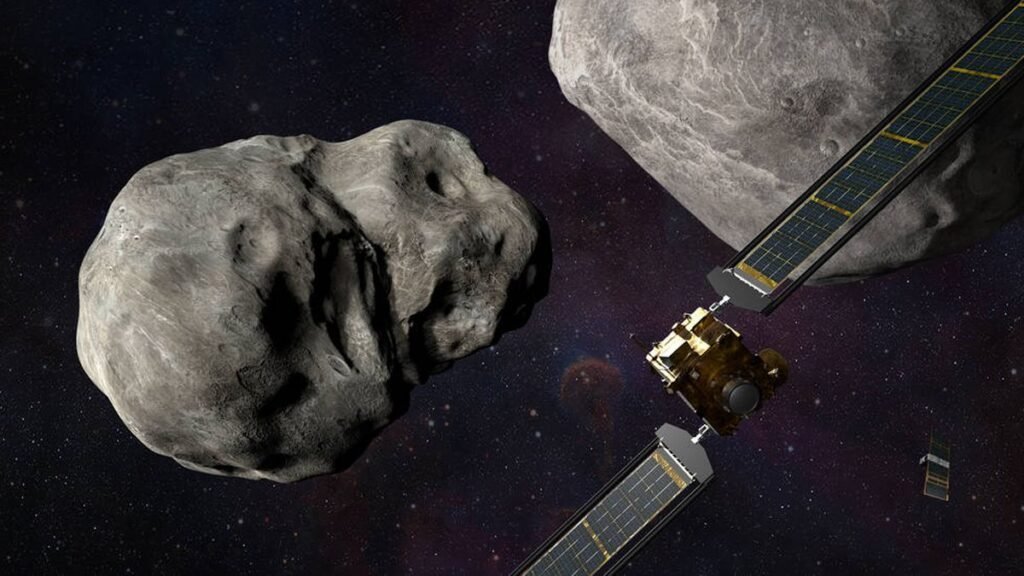
On September 26, 2022, the DART spacecraft slammed into Dimorphos, the 170-meter-wide moonlet orbiting the larger asteroid Didymos, at over 14,000 miles per hour. The impact not only shortened Dimorphos’s 12-hour orbit around Didymos by a remarkable 33 minutes but also produced an enormous plume of ejecta that amplified the effect.[3] Scientists initially aimed to change the moonlet’s orbital period by at least 73 seconds, yet the outcome far surpassed that goal.
The debris cloud, acting like an extra rocket thrust, doubled the momentum transfer from the 500-kilogram spacecraft alone. This unexpected boost reshaped Dimorphos and propelled material away from the binary system. Observations from the Hubble Space Telescope later revealed two tails of dust trailing the asteroids.[4]
Precision Measurements Unlock Orbital Shift
Astronomers tracked the subtle heliocentric changes through 22 stellar occultations between October 2022 and March 2025. These events, where the asteroids briefly dimmed distant stars, combined with decades of ground-based data and radar observations, revealed a 0.15-second lengthening in the binary system’s 770-day solar orbit.[1]
The system’s orbital speed slowed by 11.7 microns per second, equivalent to 1.7 inches per hour. “This is a tiny change to the orbit, but given enough time, even a tiny change can grow to a significant deflection,” said Thomas Statler, NASA’s lead scientist for solar system small bodies.[2] Volunteer observers worldwide contributed crucial data from remote sites, often enduring harsh conditions.
Unveiling Asteroid Secrets Through Density
The mission exposed stark differences in the asteroids’ makeup. Dimorphos, with a density of about 1.5 grams per cubic meter, behaves like a loose rubble pile, while Didymos registers denser at 2.6 grams per cubic meter, suggesting a more solid structure.[4]
- Dimorphos formed likely from debris shed by fast-spinning Didymos.
- Impact reshaped the moonlet, confirming its porous nature.
- Lower density explained the excessive ejecta and enhanced momentum.
- Didymos remained largely intact, highlighting varied responses to collisions.
- These insights refine models for future deflection strategies.
Strengthening Earth’s Shield Against Space Rocks
The results validate kinetic impactors as a viable tool for planetary defense, especially for binary systems where striking the smaller body affects the pair. Early detection remains critical, as small nudges accumulate over years to avert collisions.[5] NASA plans the NEO Surveyor mission to spot elusive threats sooner.
The European Space Agency’s Hera spacecraft will arrive in late 2026 for close-up verification. “Over time, such a small change in an asteroid’s motion can make the difference between a hazardous object hitting or missing our planet,” noted study lead author Rahil Makadia.[1]
- Kinetic impact doubled effectiveness via ejecta thrust.
- First measurable human alteration of solar orbit.
- Target binaries for efficient deflection.
This milestone proves defensive action works, provided threats emerge with sufficient warning. What do you think about humanity’s new power over asteroids? Tell us in the comments.