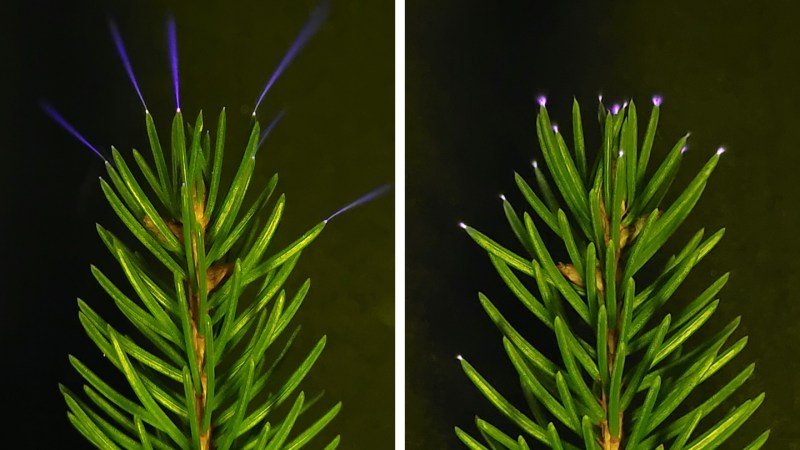
A Century-Old Mystery Solved (Image Credits: Sciencenews.org)
Pembroke, North Carolina – Faint ultraviolet flashes illuminated leaf tips and branches in forest canopies as thunderstorms charged the atmosphere overhead.[1]
A Century-Old Mystery Solved
Researchers at Pennsylvania State University achieved a breakthrough by capturing corona discharges on trees in their natural environment for the first time.[2] Patrick McFarland, the lead author, described the moment as confirmation of a long-suspected phenomenon. “These things actually happen; we’ve seen them; we know they exist now,” he stated.[3]
The team observed 41 such coronae over 90 minutes on a single sweetgum tree, with flashes lasting up to three seconds and hopping between leaves.[4] Similar events appeared on nearby loblolly pines and other species during four additional storms. These weak electrical discharges had previously appeared only in laboratory settings, where they produced a subtle blue glow under controlled darkness.
Storm-Chasing Science in Action
To document the elusive sparks, the scientists outfitted a 2013 Toyota Sienna minivan as a mobile laboratory. The vehicle carried an ultraviolet camera, electric field detector, laser rangefinder, and a roof-mounted periscope to channel light directly to the sensor.[5] Vibration-dampening pads ensured steady footage amid the chase.
During summer 2024, the team pursued thunderstorms across the U.S. East Coast, from Florida to Pennsylvania. In Pembroke, they parked beneath a passing storm and recorded 859 individual UV signals that clustered into the coronae. The UV spectrum proved essential, as ambient light under stormy skies obscured visible wavelengths.[1]
- Sweetgum tree branches hosted the initial sightings.
- Loblolly pine showed comparable activity.
- Multiple tree species exhibited flashes across storm intensities.
- Events peaked at 260-nanometer wavelengths.
- Wet leaves amplified emissions by 30-40 percent in lab tests.
The Physics Behind the Glow
Thunderstorms build negative charges aloft, inducing positive charges on the ground that flow upward through conductive tree trunks. These charges concentrate at sharp leaf tips, creating intense electric fields that ionize surrounding air molecules.[4] The resulting plasma emits ultraviolet radiation, manifesting as coronae.
About one microamp of current sufficed for the observed brightness. In nature, the discharges likely blanket entire forest canopies, resembling a swarm of UV fireflies to eyes sensitive to those wavelengths, such as those of bees or mantis shrimp.[2] McFarland noted that superhuman vision would reveal “a pretty cool light show” across treetops.
Potential Ripple Effects on Ecosystems
Beyond spectacle, coronae generate hydroxyl radicals that oxidize air pollutants and volatile organics from trees, possibly forming local haze or smog.[5] On trees, the discharges burn leaf tips, rupturing cell membranes and chloroplasts to impair photosynthesis.
Though individual events cause minor harm, repeated storms could stress canopies cumulatively. Forests may harbor evolutionary adaptations, such as resilient cuticles, honed over millennia. Forest ecologist Evan Gora remarked, “Trees are incredibly resilient… if [coronae] can damage trees, then trees also likely have some adaptations to them.”[3]
Key Takeaways
- Coronae confirm trees’ role in thunderstorm electrification.
- UV emissions signal potential air chemistry changes in forests.
- Leaf damage hints at selective pressures shaping tree evolution.
This discovery opens doors to deeper inquiries into atmospheric-tree interactions. As McFarland plans collaborations with botanists, one question lingers: how widespread are these electric symphonies across global woodlands? What do you think this means for forest health? Tell us in the comments.